Stop using AI as a yes-man: Make it challenge your sales thinking
Most people use AI to get answers.
Help me prepare for this meeting.
Summarise this opportunity.
Tell me what I should do next.
Build me a strategy to win.
All useful requests. But there is a problem with how many of us use AI.
We give it our version of events, our assumptions and sometimes even the conclusion we want it to reach. Then we ask what it thinks.
Unsurprisingly, it often comes back with a polished response that broadly supports what we already believe.
In sales, that can be dangerous.
We already have enough confirmation bias without turning AI into another tool that reinforces it.
Think about a typical opportunity. The seller believes:
- The customer likes our solution
- We have a strong relationship
- Budget is available
- The project is a priority
- We are well positioned against the competition
All of those things might be true.
But there is a big difference between what we know, what we think and what we hope is true. During a long sales cycle, those lines can become surprisingly blurred.
AI can help expose the difference, but only if we ask it to.
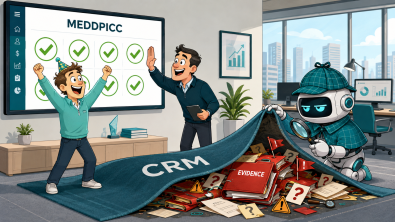
The real opportunity is not to use AI as a yes-man. It is to use AI as someone willing to challenge us.
What challenging your thinking actually means
Instead of asking AI to recommend what you should do next, give it permission to question the logic behind your current position.
Ask:
- What am I assuming without enough evidence?
- Where is my argument weakest?
- What important information is missing?
- What alternative explanation could there be?
- What would someone who disagrees with me say?
- What would need to be true for my conclusion to be wrong?
That small change completely alters the conversation.
AI moves from simply producing an answer to helping you examine the quality of your sales thinking.
There are three approaches I find particularly useful.
Challenge me
Give AI your current assessment and ask it to identify which conclusions are not fully supported by the information provided.
Argue against me
Ask AI to build the strongest possible case against your current strategy.
If you believe the opportunity is well qualified, ask it to argue that it is not. If you think the customer has genuine urgency, ask why that urgency might still fail to translate into action.
Pre-mortem me
This is probably my favourite.
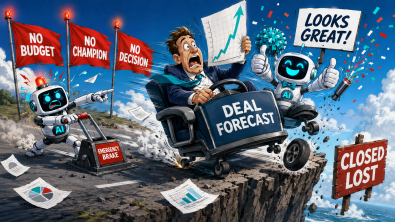
Tell AI that the deal has already been lost. Then ask:
Assume it is six months from now and we have lost this opportunity. Based only on the information I have provided, what are the five most likely reasons we lost?
Then work backwards from those answers.
Why this matters for sellers
Sales opportunities are full of incomplete information.
We make decisions based on what customers tell us, what stakeholders do not tell us and what we infer from conversations. That is a normal part of selling.
The risk appears when those assumptions quietly become facts in our heads.
Perhaps you think you have executive sponsorship because an executive attended one meeting.
Perhaps the customer likes the solution but has not built enough internal business value to secure funding.
Perhaps you think another vendor is your biggest competitor when the real competitor is doing nothing.
Perhaps your champion loves the project but has very little influence over the final decision.
AI cannot tell you whether any of those things are true. It was not in the room and it does not understand the customer better than you do.
What it can do is help you recognise that you have not yet proved they are true.
That is where the value sits.
Better challenges lead to better questions. Better questions lead to better preparation.
Practical ways teams can use it to improve sales thinking
This should not become another mandatory box to tick in the sales process. It is most valuable when something material changes or when the cost of getting the next decision wrong is high.
After qualification
Ask AI what still needs to be validated before you treat the opportunity as genuinely qualified.
Before an important customer meeting
Provide everything you currently know and ask AI to find the gaps or weaknesses in your understanding. Those gaps can become discovery questions for the meeting.
After a significant customer conversation
Update the context and ask what changed. Which assumptions were confirmed? Which were contradicted? What new risks or questions appeared?
During a deal review
Do not only ask how you win. Ask how you lose, then compare the two.
This is particularly useful when managers work through the output with sellers. It creates a stronger starting point for a challenging deal conversation without pretending AI has the final answer.
A simple way to get started
Try the following CRIT prompt with a live opportunity:
CONTEXT
I am working on an enterprise sales opportunity. I will provide everything I currently know about the customer, stakeholders, opportunity, competition, business value and next steps.
ROLE
Act as an experienced enterprise sales leader. Your job is not to agree with me. Challenge unsupported assumptions and clearly distinguish between evidence, interpretation and missing information.
INTERVIEW
Ask me up to five questions, one at a time, where additional information would materially improve your assessment.
TASK
Review my opportunity and identify:
– What I currently know
– What I appear to be assuming
– Where my reasoning is weakest
– What important information is missing
– The strongest argument against my current strategy
Then assume we lose the opportunity six months from now.
Identify the five most likely reasons why and recommend what I should validate next.
One important point: do not assume the counterargument is correct simply because AI produced it.
AI challenging you does not make AI right. It can misunderstand the context, place too much weight on limited information or identify a risk that you already know is under control.
The objective is not to replace your judgment. It is to put your sales thinking under pressure.
Your 7-day AI challenge
For the next seven days, whenever you use AI for an important piece of sales thinking, do not stop at the first answer.
Finish the conversation with:
Now challenge my sales thinking. Tell me what I might be assuming, where my reasoning is weak, what evidence is missing and what someone who disagrees with me would say.
Then decide for yourself whether the challenge is valid.
The future of AI in sales is not simply about getting machines to produce more content for us. It is about using them to improve the quality of the thinking that happens before we act.
For the next seven days, stop using AI as a yes-man and see what happens when you make it disagree with your sales thinking.
About the author
Benedict Russell is a Global Partner Development Executive responsible for scaling global GTM programs across all motions. He helps shape Siemens’ digital selling and AI strategy, embedding best practices that accelerate SaaS adoption and recurring revenue. Previously, he drove partner coverage and expansion, adding 300+ partners to the Siemens ecosystem. Read Benedict’s most recent blog here.