Value selling in manufacturing software: how AI helps sellers prepare better
Selling enterprise software has changed, and I think we need to be honest about what that means for all of us in sales, partner management and enablement.
For a long time, product knowledge gave us credibility. If we could explain the platform, walk through the capabilities and position why a solution was best in class, that was often enough to get the conversation moving. And to be clear, product knowledge still matters. We absolutely need sellers and partners who understand what Siemens technology can do.
But I do not think product knowledge alone is enough anymore.
In manufacturing software, customers are not simply asking what a product does. They are asking whether we understand the pressures inside their business. They are dealing with margin pressure, delayed programmes, engineering complexity, too many product variants, supply chain disruption, quality risk, workforce challenges and constant pressure to move faster without adding more operational risk.
That is the world our software needs to connect to.
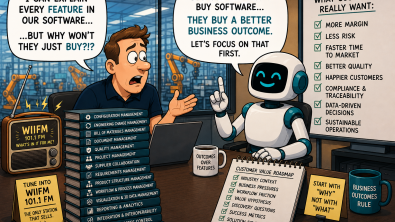
This is why value selling matters so much. We cannot lead with product, feature and function, then expect the customer to translate that into business value on our behalf. That translation is our responsibility. If we do not do it, the customer may understand the technology but still not see why it matters enough to change.
For Siemens and our partner ecosystem, this is a real shift. We are rightly confident in the strength of our portfolio. Teamcenter, Designcenter, Simcenter and the wider Siemens portfolio all have deep capability and strong market credibility. But customers do not buy credibility alone. They buy a path to a better business outcome.
That means the sales conversation has to start somewhere different.
Not with what Siemens can do.
Not with what the product can do.
But with what the customer is trying to achieve, what is stopping them and what that friction is costing the business.
What industry value discovery actually is
For me, industry value discovery is about understanding the customer’s world before we position our own. It sounds obvious, but it is very easy to skip this step when we know the product well and want to get quickly to the answer.
The problem is that the same business issue can look very different depending on the industry or sub-industry. Configuration management in industrial machinery is not the same conversation as configuration management in marine or aerospace. Engineering change in a high-volume automotive supplier does not carry the same implications as engineering change in a project-based shipbuilder.
The terminology is different. The workflows are different. The stakeholders are different. The commercial pressure is different.
If we treat those conversations as the same, we lose relevance. We may still be technically correct, but we risk sounding disconnected from the customer’s reality.
That is why we need to get much more specific. Not just manufacturing, but which part of manufacturing. Not just automotive, but which part of automotive. Not just marine, but whether we are talking about yacht production, commercial shipbuilding, offshore vessels or marine equipment suppliers.
The more specific we are, the more credible the conversation becomes.
Why this matters for sellers and partners
Value selling changes the role of the seller. The seller is no longer just explaining capability. They are helping the customer connect operational friction to business impact.
That is a very different conversation.
Instead of saying, Teamcenter can improve collaboration, we should be asking where disconnected engineering, manufacturing and supplier processes are creating delay, rework, quality risk or margin pressure. Instead of saying, this capability supports configuration management, we should be asking how product variants are managed today and where complexity starts to slow the business down.
This is where partners have a major opportunity. Partners often have strong local relationships and a strong understanding of their market. When that is combined with better industry insight, better terminology and better value framing, the customer conversation becomes much more relevant.
The opportunity is not just to sell more. It is to sell better.
Better preparation means better discovery. Better discovery means stronger qualification. Stronger qualification means we can position Siemens capabilities against a business issue the customer has actually validated, rather than one we have assumed.
That matters because enterprise customers are under pressure to justify investment. They need to understand why change is worth prioritised now. A product-led message may create interest, but a value-led conversation is much more likely to create urgency.
How to apply value selling in practice
The practical shift starts with changing the order of preparation. Too often, we begin with the question, which product should we position? A better starting point is, what business problem is this customer likely trying to solve?
That one change makes a big difference.
A stronger preparation process should start with the industry context. What is happening in that market? What trends, pressures, regulations or customer expectations are shaping the customer’s priorities? From there, we need to go deeper into the sub-industry because broad industry messaging is rarely enough.
Once we understand the context, the next step is to identify where friction appears in the customer’s workflows. That could be engineering change, configuration management, quotation, manufacturing planning, quality, supplier collaboration, service or another process entirely.
Then we need to translate that friction into business impact. What could it mean for time, cost, margin, quality, risk, customer experience or speed of execution?
This is where the seller builds a value hypothesis. Not a made-up ROI number. Not an invented saving. A hypothesis that can be tested with the customer.
For example, delayed engineering change may be increasing rework, slowing release cycles or creating margin risk. That might be true, or it might not be. The point is to go into the conversation prepared to validate it with the customer, not to assume it as fact.
Only after that should we map Siemens capability.
That order is important because it keeps the conversation grounded in the customer’s business rather than our internal product structure.
Where AI can help
This is where I believe AI can genuinely improve how sellers and partners prepare.
Not because AI magically creates value. It does not. And it should never replace commercial judgement or real customer discovery.
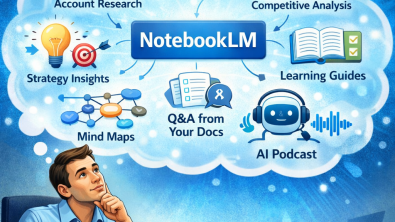
But AI can help structure the thinking. It can help sellers research an industry, understand a sub-industry, identify likely business pressures, prepare persona-specific questions and translate product-led language into customer-ready business language.
For example, AI can help a seller ask better questions before a meeting:
What is distinctive about this customer’s sub-industry?
Which business pressures are likely to matter?
Which personas should we engage?
What terminology should we use?
What terminology should we avoid?
Where might workflow friction appear?
What value hypotheses should we validate?
What questions will move the conversation beyond product interest?
That is the real value. AI helps improve the quality of preparation, so the seller can have a better conversation. It creates a more consistent way to prepare across teams, regions and partners, without forcing everyone into the same generic message.
For a global partner ecosystem, that consistency matters. If every partner prepares differently, the customer experience becomes inconsistent. If we give partners a common way to understand industries, frame challenges and validate value, we create a more scalable go-to-market motion.
A simple way to get started
A simple starting point is to take one live account or one upcoming customer conversation and rebuild the preparation around value. The goal is not to create a perfect account plan. The goal is to enter the conversation with a sharper view of what may matter to the customer and what needs to be validated.
One practical way to do this is to use a simple CRIT prompt.
Context
I am preparing for a customer conversation in enterprise manufacturing software. I want to move away from leading with product, feature and function, and instead prepare around the customer’s industry, sub-industry, business pressures, workflows, stakeholders and likely value drivers.
Role
Act as an industry researcher, Challenger seller and value-based sales coach. Help me think like the customer before helping me position any Siemens capability.
Interview
Before giving me the final output, ask me up to five questions, one at a time, to get more clarity.
Task
Create a short pre-meeting preparation summary that helps me prepare around value, not product. Include:
- The industry, sub-industry and geography I should understand before speaking to this customer
- The likely business pressures, trends or operating challenges this type of company may be facing
- The personas I should be speaking to and the language that will matter most to each of them
- The workflow friction that may appear in areas such as engineering change, configuration management, quotation, manufacturing planning, quality, supplier collaboration or service
- The value hypothesis I should test with the customer before positioning any Siemens capability
The final output should include one value hypothesis, five strong discovery questions and a clear view of where Siemens may be relevant if the customer validates the issue.
This gives the seller or partner a much better starting point. Instead of preparing around a product message, they prepare around a business conversation.
That is the key shift. The product conversation is not removed. It is simply placed after the business need has been understood.
The bigger change we need to make
The future of enterprise software selling will not be defined by who can list the most features. It will be defined by who can create the most relevant business conversation.
That is especially true in manufacturing, where technology decisions sit inside complex operating environments with multiple stakeholders, long-standing processes and real consequences for cost, quality, speed and risk.
For Siemens and our partners, I think this is a major opportunity. We have strong technology, deep industry capability and a partner ecosystem with customer access, local knowledge and market relationships. The next step is making sure we bring those strengths together in a more consistent, value-led way.
This is not just about adopting AI. It is about changing how we prepare, how we think and how we engage customers.
AI can help us scale that shift, but the real transformation is commercial.
We need to stop asking only how we sell more product and start asking how we create more value in every customer conversation.
About the author
Benedict Russell is a Global Partner Development Executive responsible for scaling global GTM programs across all motions. He helps shape Siemens’ digital selling and AI strategy, embedding best practices that accelerate SaaS adoption and recurring revenue. Previously, he drove partner coverage and expansion, adding 300+ partners to the Siemens ecosystem. Read Benedict’s most recent blog here.