What building a Clay-to-Outreach workflow taught me about scaling outbound sales
I am a salesperson, not an integration specialist.
I understand the commercial problem, the behaviour we need from sellers and the outcome we are trying to create. What I did not understand was how to connect all of that into a working system, which is exactly what made building a workflow between Clay and Outreach such a valuable learning experience.
The objective seemed straightforward. I already had a Clay table containing target contacts, account research and five personalized emails for each prospect. I wanted to move that work into Outreach, assign it to the responsible sales representative and make the campaign easy to execute.
In my head, Clay would create the prospect, populate the messaging and add them to a sequence. The reality required considerably more problem-solving.
Some prospects already existed in Outreach while others needed to be created. The personalised content had to reach the correct fields before sequence enrolment, and the right mailbox had to be assigned so replies returned to the right seller. Even email formatting became a workflow problem.
At several points, the system simply returned Bad Request, which was not particularly helpful when I was trying to understand what I had done wrong.
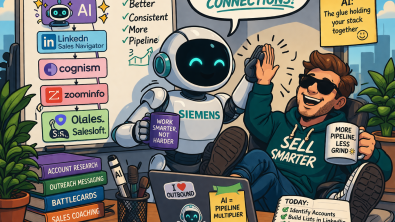
Working through those issues one by one changed how I viewed the project. I stopped seeing AI as a tool for writing outbound emails and started seeing it as part of the sales operating model.
The real opportunity was not the content itself. It was connecting targeting, preparation and seller execution into one repeatable process.
The cost of disconnected sales workflows is not only seller time. It is also lost momentum. A campaign can be well researched, commercially relevant and fully prepared, then still fail because it never reaches the seller in a form they can execute.
Someone provides the account list. Someone finds the contacts. Someone researches the business. A seller adapts the messaging, the data is moved into another system, ownership is checked and a sequence is built.
Every handover creates delay, inconsistency and another opportunity for the campaign to stall.
What the workflow actually is
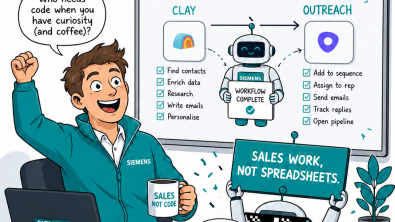
The workflow connects an existing Clay campaign table directly into Outreach.
Clay contains the prospect data, account research and personalised messaging. Outreach manages the sequence, the sending mailbox, seller activity and prospect replies.
The process works like this:
- Clay checks whether the prospect already exists in Outreach
- If they exist, Clay retrieves the current Prospect ID
- If they do not exist, Clay creates a new prospect
- A formula selects the correct ID for either scenario
- Clay updates the prospect with personalised email content
- The prospect is added to the appropriate Outreach sequence
- The sequence is assigned to the responsible representative’s mailbox
- Any response appears directly in that representative’s inbox
From the seller’s perspective, the value is simple: the prospect is already in the system, the message is relevant, the sequence is prepared and any reply comes directly back to them.
Their role shifts from administration towards judgement, timing and conversation.
Why this matters for sellers
Most sales teams do not lack campaign ideas. They already have account lists, target industries, product plays, customer signals and marketing content.
The greater challenge is turning those inputs into consistent seller action.
This workflow reduces the gap between identifying an opportunity and enabling someone to act on it. It also creates a more scalable division of work, where a central team can prepare the targeting, research and messaging while the correct seller reviews, sends and manages the customer response through the system they already use.
The technology prepares the campaign, but the seller still owns the quality check, the timing and the conversation that follows. That balance matters because automation should support seller judgement rather than replace it.
Practical ways sales teams can use it
The clearest application is targeted outbound into named accounts.
A team provides the target accounts, contacts or geographies. Clay enriches the information and prepares the personalized content, then Outreach routes the campaign into the workflow of the correct representative.
The same model could support:
- Product attach campaigns within an existing customer base
- Partner-led campaigns across agreed territories
- Event follow-up
- Competitive displacement programmes
- Adoption and expansion motions
- Industry-specific prospecting
- New market entry campaigns
The use case may change, but the underlying principle remains consistent: prepare centrally where it creates scale and consistency, then execute locally where seller ownership and customer context matter.
A simple way to get started with Clay
I would not begin with hundreds of contacts. I would start with two: one prospect who already exists in Outreach and one who does not.
Then test the process in order:
- Look up the prospect
- Create them only if they are not found
- Confirm the final Prospect ID
- Update the personalised fields
- Preview every email
- Add the prospect to the sequence once
- Send a test message and confirm where the reply arrives
Testing in that order matters because running everything at once makes it difficult to understand where something has failed. It can also add prospects to live sequences before the content, ownership and routing have been checked.
Building this was a useful reminder that salespeople do not need to become developers to create practical automation. We do, however, need to be curious enough to understand the process, patient enough to troubleshoot it and clear enough about the commercial outcome we are trying to create.
I began with a practical integration problem and finished with a broader view of how this could support outbound execution across the business.
I am now looking at how to scale the model across teams so account selection, personalisation and sequence preparation can be managed consistently, while execution and customer conversations remain with the right sellers.
Scaling it will require more than copying the workflow. We will need common campaign inputs, clear ownership, consistent mailbox routing, sequence governance, quality controls and a shared way to measure performance.
The measures that matter will not be how many emails AI generates. They will be campaign launch speed, seller time saved, response quality, meetings created and pipeline influenced.
The potential is clear, but it still needs to be proven through real campaign execution.
The question is no longer whether AI can write a personalised outbound email. The real question is whether we can connect targeting, preparation and seller execution into one repeatable operating model across the business.
About the author
Benedict Russell is a Global Partner Development Executive responsible for scaling global GTM programs across all motions. He helps shape Siemens’ digital selling and AI strategy, embedding best practices that accelerate SaaS adoption and recurring revenue. Previously, he drove partner coverage and expansion, adding 300+ partners to the Siemens ecosystem. Read Benedict’s most recent blog here.