Why data independence is the real unlock for outbound

Most sellers don’t talk about this openly.
But everyone has experienced it.
You’ve worked through your CRM.
You’ve followed up on every inbound lead.
Marketing has slowed down.
And suddenly, you’re stuck.
Not because you don’t know who to target.
But because you don’t have the data to reach them.
That’s the moment outbound stops being a strategy and starts being a constraint.
The real limitation in modern outbound
Tools like LinkedIn Sales Navigator and Outreach are powerful.
But they rely on one thing: data already existing somewhere.
CRM gives you existing contacts.
Marketing gives you inbound or enriched leads.
Sales Navigator shows you who exists, but not how to reach them.
When those sources slow down or run dry, most sellers hit a wall.
You can still identify accounts.
You can still find the right personas.
But you cannot act at scale without contact data.
That dependency is the real bottleneck.
Why this creates a pipeline problem
When sellers rely purely on CRM and marketing, pipeline becomes reactive.
Timing is dictated by lead flow, not seller intent.
High-performing sellers are constrained by data availability.
It also creates inconsistency.
Some sellers sit on strong lead flow.
Others have nothing to work with.
The result is uneven pipeline generation and unpredictable performance.
What changes when sellers become data independent
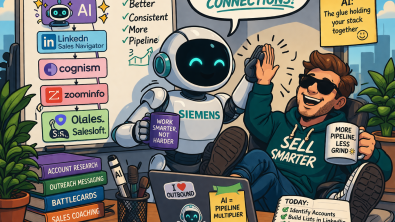
This is where tools like ZoomInfo, Cognism, and Kaspr fundamentally change the model.
They remove the dependency.
Instead of waiting for data, sellers can generate it.
From a target account list, a defined ICP, or a LinkedIn search, you can move directly to verified emails, mobile numbers, and complete contact profiles.
This is the difference between being dependent on inputs and controlling your own pipeline.
Why this matters for sellers
Without a data layer, you are limited in how you can reach people.
Yes, you can still reach out via LinkedIn.
But that is one channel.
One behavior you are relying on.
One place where your message can be ignored.
When you add a data scraping layer, you unlock email and phone alongside LinkedIn.
You move from one channel to three.
That is not incremental.
It is a fundamental increase in how reachable your buyers actually are.
This is not about efficiency. It’s about control.
You are no longer blocked by CRM limitations.
You are no longer waiting on marketing.
You can build pipeline on demand.
And you remove one of the biggest frustrations in outbound.
Knowing exactly who you want to engage, but having no way to reach them.
Where GDPR fits into this
Working with contact data in Europe means operating under General Data Protection Regulation.
These tools are not inherently non-compliant.
But how you use them matters.
Platforms like ZoomInfo and Cognism position themselves around legitimate interest, data transparency, and opt-out mechanisms.
That does not remove responsibility from the seller or the organization.
You still need:
- Clear ICP targeting
- A valid business reason for outreach
- Respect for opt-outs and suppression
- Alignment with internal compliance policies
The risk is not using data.
The risk is using it without structure or intent.
Where AI actually adds value
AI does not replace the data layer. It depends on it.
With accurate data, AI can:
- Summarize accounts before outreach
- Tailor messaging to specific personas
- Prioritize which contacts to engage first
- Refine sequences based on performance
Without data, AI produces generic output.
With data, it becomes a multiplier.
Practical ways to apply this
- Identify 20 accounts outside your CRM
- Extract 2–3 contacts per account using a data tool
- Use AI to refine your messaging
- Build a focused sequence in Outreach
- Track meetings booked vs. CRM-driven outreach
The difference is usually immediate.
Not because your messaging changed.
But because you finally controlled your inputs.
Pricing reality
- ZoomInfo: €10K–€30K+ annually
- Cognism: €8K–€25K annually
- Lusha: typically mid-range, often credit-based or per-seat pricing
- Kaspr: lower-cost, per-seat pricing
But the alternative cost is rarely measured.
Idle selling time.
Missed opportunities.
Over-reliance on inbound.
The shift most sellers need to make
Outbound should not depend on whether your CRM is full or marketing is active.
It should be something you can initiate at any time.
The sellers who outperform are not just better at messaging.
They are better at controlling their inputs.
And increasingly, they combine reliable data, structured execution, and AI to build pipeline consistently.
About the author
Benedict Russell is a Global Partner Development Executive responsible for scaling global GTM programs across all motions. He helps shape Siemens’ digital selling and AI strategy, embedding best practices that accelerate SaaS adoption and recurring revenue. Previously, he drove partner coverage and expansion, adding 300+ partners to the Siemens ecosystem. Read Benedict’s most recent blog here.