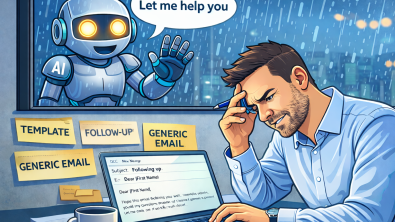
The AI sales coach: the future of cold call training

A sales rep sits at their desk preparing for a cold call.
They have reviewed the LinkedIn profile, scanned the company website and thought carefully about how to position their solution. The phone is in their hand.
But one question still lingers.
How will the prospect actually respond?
Will they challenge the value proposition, dismiss the call immediately or ask questions the rep hasn’t prepared for?
For most sales teams, the uncomfortable truth is that the first time a rep truly tests their messaging is when they are already on the phone with a real prospect.
The stakes are high and the opportunity is real.
Cold calling is one of the most important skills in outbound sales, yet it is rarely practiced in a realistic way.
Artificial intelligence is starting to change this dynamic.
For the first time, sales teams can rehearse real prospect conversations before the call ever happens.
A new training model for sales conversations
AI introduces something sales teams have never had before: a realistic, always available environment where sellers can rehearse conversations before speaking to real prospects.
Instead of practicing occasionally with a colleague, a sales rep can simulate dozens of cold call conversations in a short period of time. Each conversation can include different personalities, objections and responses.
Think of it as a training environment for sales conversations.
Athletes spend far more time practicing than they do competing. Pilots train extensively in flight simulators before flying real aircraft.
Sales, however, has historically lacked a comparable training environment.
AI changes that.
It enables sellers to rehearse conversations repeatedly, refine how they position value and build confidence before they ever pick up the phone.
Why this matters for sales leaders
For sales leaders, the implications are significant.
One of the biggest challenges in building high performing sales teams is the variability in call quality and messaging. Experienced sellers often develop strong instincts through repetition, while newer reps struggle to gain confidence and consistency.
AI coaching creates the potential to standardize and accelerate this learning process.
New hires can practice conversations multiple times before engaging real prospects. They can test different approaches to opening a call, experiment with discovery questions and refine how they respond to common objections.
Managers can also use AI simulations to reinforce messaging frameworks and improve consistency across the team.
Instead of learning slowly through trial and error, sellers can compress months of experience into structured practice sessions.
This has the potential to significantly reduce ramp time while improving the overall quality of prospect conversations.
A shift in how sales skills develop
For decades, sales development has relied heavily on experience.
Reps improved through repetition, feedback and gradual learning from real customer interactions.
AI introduces a new model.
Instead of learning primarily through live opportunities, sellers can now practice before they perform.
They can experiment with different messaging approaches, test how prospects might respond and refine their delivery in a low risk environment.
The result is not just better preparation. It also changes how confidence develops.
Cold calling often fails not because sellers lack knowledge, but because they lack practice in handling unpredictable responses.
AI simulations allow sellers to face those scenarios repeatedly until they become comfortable navigating them.
Over time, this builds a much stronger foundation for real customer conversations.
The next evolution of sales enablement
Sales enablement has traditionally focused on providing content, training and messaging frameworks.
AI introduces a new dimension.
Instead of only telling sellers what to say, organizations can now create environments where sellers practice saying it.
This represents a shift from passive learning to active rehearsal.
As AI capabilities continue to improve, these simulations will become increasingly realistic. Sellers will be able to practice conversations with a wide range of buyer personas, objections and scenarios.
For organizations focused on improving pipeline generation and outbound effectiveness, this could become one of the most powerful tools in modern sales training.
A new way to practice before the call
Sales teams have always improved through repetition.
The difference now is that practice no longer needs to happen on real prospects.
Most sellers practice cold calls on real prospects.
Now you can practice before the call ever happens.
I have created an AI sales coaching bot that simulates realistic prospect conversations so you can rehearse your opening, test your messaging and refine how you handle objections.
It takes less than a few minutes to run your first practice call.
Try the bot and see how your next cold call improves.
About the author
Benedict Russell is a Global Partner Development Executive responsible for scaling global GTM programs across all motions. He helps shape Siemens’ digital selling and AI strategy, embedding best practices that accelerate SaaS adoption and recurring revenue. Previously, he drove partner coverage and expansion, adding 300+ partners to the Siemens ecosystem.