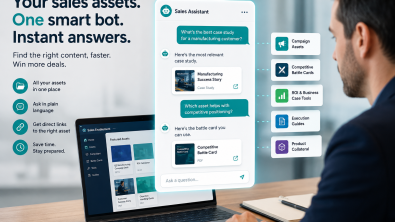
Use AI to create competitive battlecards for smarter prospecting

Competitive battlecards have traditionally been a marketing deliverable. Built periodically, distributed broadly and rarely updated in time for a live opportunity. By the time a seller uses one, the intelligence is often outdated and too generic to influence a real deal.
AI changes that model. (Explore the competitive battlecard BOT)
Battlecards are shifting from static reference documents to account-specific intelligence generated on demand and used directly within the sales workflow. For both direct and partner teams, this has clear implications for preparation quality, deal velocity and competitive win rates.
The prospecting problem AI battlecards solve
Buyers in competitive accounts are informed before the first call. They have already absorbed competitor messaging, pricing narratives and peer feedback. If a seller enters that conversation without a clear view of how the competitor positions themselves and where they are exposed, the narrative is already tilted.
AI addresses this practically.
A seller can synthesize competitor positioning from multiple sources into a structured brief in minutes rather than hours. They can outline differentiation, anticipate technical and commercial objections and prepare at the specific account level instead of relying on generic segment guidance.
Time normally spent scanning analyst reports, review platforms, competitor websites and internal threads can instead be invested in sharper outreach, stronger discovery and more deliberate follow-up.
What changes in preparation and execution
With a well-constructed prompt, AI can generate a focused competitive brief that maps strengths and weaknesses against the target use case, frames total cost of ownership conversations in advance, surfaces common loss themes and aligns messaging to industry context.
This is practical, not theoretical. A seller preparing for a competitive displacement meeting can generate a brief, pressure test it against their own experience and enter the discussion with a structured position rather than relying on an outdated slide.
The impact on consistency is significant. Competitive preparation often varies widely across regions and partner teams. When the research approach becomes standardized, variability decreases and execution discipline improves.
Scale across direct and partner channels
In global and partner-led motions, execution consistency is always a challenge. AI-generated competitive briefs support faster ramp for new sellers and partner teams, more consistent objection handling and reduced dependency on last-minute competitive support from central teams.
Over time, analytics can extend this further. When competitive talking points are correlated with closed-won outcomes, the intelligence improves based on what actually drives results in the field.
What AI does and does not replace
AI accelerates insight gathering. It does not replace sales judgment. Sellers remain accountable for validating the output, contextualizing it to the specific account and deciding how to use it in a live conversation.
What AI removes is friction. The manual research step that often gets skipped because there is not enough time.
Competitive intelligence no longer needs to be a periodic enablement asset. Used correctly, it becomes a daily productivity lever available to every seller and partner before every strategic conversation. Explore the competitive battlecard BOT here. Input your target account and competitor and generate a tailored intelligence brief before your next prospecting conversation.
About the author
Benedict Russell is a Global Partner Development Executive responsible for scaling global GTM programs across all motions. He helps shape Siemens’ digital selling and AI strategy, embedding best practices that accelerate SaaS adoption and recurring revenue. Previously, he drove partner coverage and expansion, adding 300+ partners to the Siemens ecosystem.