Why your MES/MOM is the foundation for industrial AI success

New Tech-Clarity research shows that manufacturing operations software delivers fast, measurable value and gives AI the context it needs to work on the shop floor.
Every manufacturing leader we talk to is being asked the same question in the boardroom: “What is our AI strategy?” At the same time, the pressure on the plant floor keeps growing. Markets are shrinking, material costs are volatile, and skilled people are hard to find. Most companies have a large share of their capital tied up in production, so the plant is where margins are won or lost.
To understand how manufacturers are responding to these pressures, Tech-Clarity, an independent analyst firm, created a new study: The Business Value and Evolution of Manufacturing Operations Software in the Age of AI. Drawing on a survey of more than 400 manufacturing professionals, the research reaches a clear conclusion. Manufacturing Operations Software (MOS), Tech-Clarity’s umbrella term for MES, MOM, and related functions across quality, maintenance, scheduling, inventory, EHS, and connected worker, is no longer just an operational tool. It has become an essential capability for the enterprise and the foundation for successful industrial AI.
Many industrial AI projects stall because of weak data foundations: fragmented architectures, inconsistent formats, and siloed data streams. Without operational context, AI cannot understand how order schedules, material batches, operator shifts, and equipment conditions relate to each other. A mature MES/MOM supported by AI captures these relationships natively, with AI embedded in MES backbone and people kept in the loop.
From recommendations to reality: how Siemens Opcenter fits
We have identified the same principles in the development of the Siemens Opcenter portfolio, which spans from Opcenter MES to quality management, advanced planning and scheduling, research, development, and laboratory (RD&L), as well as intralogistics and supply chain capabilities. Here is how Opcenter supports each of these areas.
A broad-function platform with a common data model
Opcenter is built for this. It connects production execution with quality, scheduling, intralogistics, and supply chain in one consistent operational context. Through the Siemens digital thread, it also connects to Teamcenter, the manufacturing engineering tools, and Insights Hub on the automation side. Process data from Opcenter combined with IIoT asset data from equipment becomes a single source of truth: contextualized, traceable, and ready for both people and AI.
Standardize, measure, and scale across plants
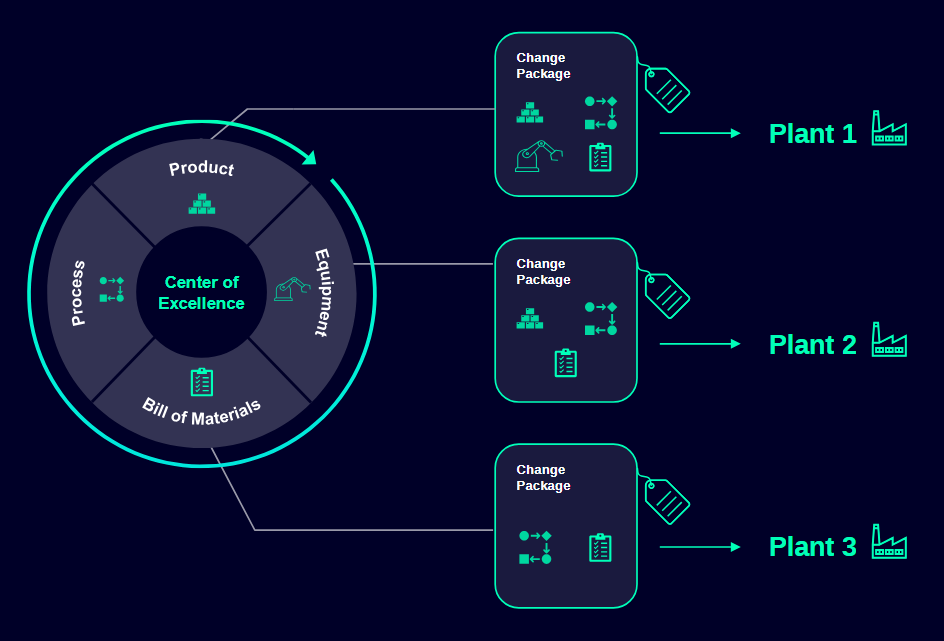
Opcenter supports a “design once, deploy anywhere” approach: a global template that each plant can adapt with low-code tools based on Mendix, without breaking the core or adding hard-to-maintain custom code. This matches the shift from customization to configuration. It also helps customers own, govern, and improve the template over time.
Fast time to value with flexible deployment
Opcenter MES is designed to make that timeline achievable and affordable. Its modernized, containerized, Kubernetes-based architecture uses prebuilt container images to simplify commissioning and upgrades and targets 99.99% availability. Support for Linux and PostgreSQL reduces the hardware footprint by up to 50% and can cut licensing costs by 60% to 85%. Manufacturers can also choose where to run it: Siemens cloud, their own virtual private cloud, or on-premises. That flexibility matches the deployment trade-offs discussed in the e-book.
Treat MES as a work transformation
Opcenter’s task-based user experience guides operators through what they need to do at the moment of execution. This reduces training time and minimizes errors, which matters even more as experienced workers retire and new staff join the line.
AI that augments people, built on MES
This is how we are building AI into Opcenter. Because the AI capabilities sit on top of contextualized MES data, they are grounded in real operations and keep people in the loop:
- Opcenter Copilot: Answers user questions about the application and its documentation in natural language, so users don’t have to search through repositories.
- Opcenter AI Repair Advisor: Helps operators decide whether to repair or scrap a defective component and guides them through the best repair steps.
- Opcenter Modeling and Configuration Copilots: Let teams update workflows, scrap codes, BOM items, and business logic through simple dialogue, reducing configuration effort.
- Production Copilot: Turns production data into corrective action, combining MES and equipment data to give context-aware recommendations that people can validate and act on.
Start building your AI-ready operations foundation
The message is clear, manufacturers that start early and standardize widely gain an advantage that becomes harder for competitors to catch up to.
Download the e-book
Inside you will find:
- The MOS/AI co-evolution: How Top Performers embed AI in their MOS infrastructure to use rich operations data and support human-in-the-loop decisions.
- The Center of Excellence accelerator: Why a CoE correlates with higher executive funding, smoother scaling, and better lifecycle support.
- Deployment and cloud evolution: How manufacturers choose between single-tenant cloud, multi-tenant cloud, and on-premises approaches, and how the balance is shifting from customization to configuration.
- Strategic recommendations: A practical checklist for getting the most value from MOS and AI.
Learn more about Opcenter MES/MOM