From electric telegraphs to FPGA prototyping: Siemens’ journey of innovation
Growing up in Germany in the 1960s, the name Siemens was everywhere. It stood for reliability, innovation, and quality whether it was kitchen appliances, electric trains, traffic lights, X-ray machines, or light bulbs. Later, Siemens became synonymous with mobile phones, communications equipment, and computers.
Through its more than 175-year history, Siemens has always been a company that innovates and transforms industries. Today, Siemens is a global leader in power generation and transmission, medical equipment, and industrial smart infrastructure solutions.
But for many years, there was one area where Siemens did not have a significant presence, electronic design automation (EDA) and semiconductor design.
That changed in 2017 with the acquisition of Mentor Graphics, a major milestone that extended Siemens’ innovation footprint deeply into the semiconductor space. With Mentor came a portfolio of advanced tools and technologies essential for today’s AI- and software-driven world, particularly in hardware-assisted verification, which includes emulation and FPGA-based prototyping.
Software Defines Product Success
Today, software often determines whether a product succeeds or fails. Think about the smartphone in your hand or pocket without its software and apps, it would be little more than an expensive paperweight.
Software also dominates design costs and schedules, which is why efficient verification platforms are critical. This is where emulation and FPGA-based prototyping make all the difference, enabling teams to validate hardware and software long before silicon is available.
The Siemens Advantage in Hardware-Assisted Verification
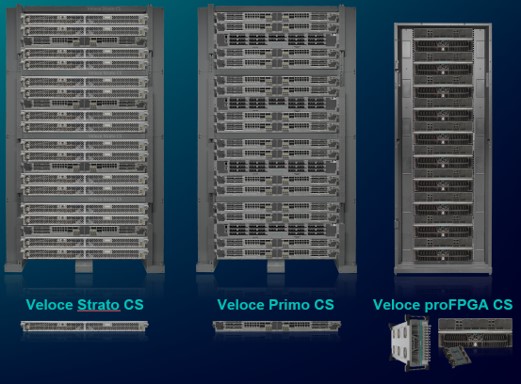
Siemens is now the only one of the “big three” EDA companies with a comprehensive hardware-assisted verification portfolio. Our Veloce™ CS platform includes:
- Veloce Strato CS – a custom-chip emulator
- Veloce Primo CS – an enterprise-level, emulation-congruent prototype system
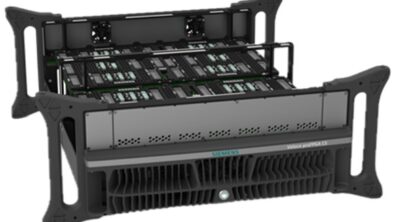
- Veloce proFPGA CS – a high-performance FPGA-based prototyping system
Among these platforms, the newest Veloce proFPGA CS best embodies the speed, agility, and innovation Siemens brings to our customers.
Introducing Veloce proFPGA CS: Powered by AMD VP1902
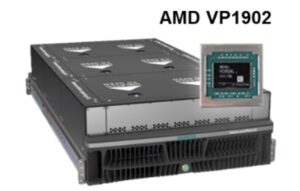
Built on AMD’s latest Versal™ Adaptive SoC, the VP1902, the Veloce proFPGA CS redefines FPGA-based prototyping. Siemens was the first to begin shipping production system, starting in August 2024, just weeks after the VP1902 became available, and well ahead of anyone else in the industry.
Veloce proFPGA CS leads the way with innovative features that boost productivity and usability, including:
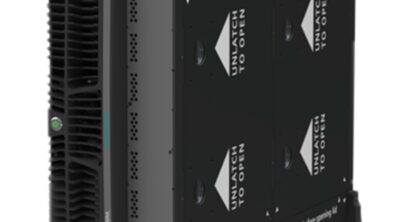
- Flexible configurations, from a single-FPGA UNO setup to multi-blade rack systems with hundreds of FPGAs.
- Unparalleled I/O flexibility, virtually every FPGA I/O is available to the user, enabling the highest possible runtime performance.
- Robust engineering, built to the highest standards and deployed worldwide across thousands of systems.
Empowered by Software: The Veloce Prototyping Suite (VPS)
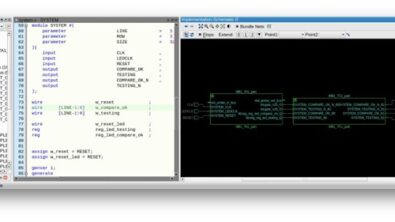
Of course, hardware alone isn’t enough. The real power of the Veloce proFPGA CS lies in the Veloce Prototyping Software (VPS) a comprehensive software suite that enables fast, efficient, and intuitive design mapping. VPS automates many complex tasks such as multi-FPGA partitioning, clock and memory handling, and more. It also provides advanced debug capabilities that rival traditional simulation environments, including:
- Traditional signal probing
- Memory backdoor access
- Full visibility and traceability during runtime
This seamless combination of hardware and software empowers engineers to accelerate design bring-up, debug faster, and achieve better results—shortening time to market and improving confidence in design quality.
A Legacy of Innovation Continues
From Siemens’ first product an electric telegraph built in a Berlin backyard in 1847 to today’s cutting-edge emulation and FPGA-based prototyping solutions, the company’s legacy of innovation remains constant. Watch video https://youtu.be/XjomsZ-VTyY?si=gFyoFLdAG-IYP9Xq