How semiconductor factory managers use real-time data to optimize fab performance

Real-time manufacturing intelligence is the ability to collect, analyze, and act on live manufacturing data from your shop floor and enterprise systems to improve visibility, decision-making, quality, and operational performance.
You’re the semiconductor factory manager. It’s getting late.
Out on the plant floor, all is quiet.
You open your office door for one last look at the in-box before heading home.
But you notice something out of the corner of your eye.
A sealed yellow envelope is on your desk. It wasn’t there when you left.
You could wait until morning. But the letters are hard to ignore:
PROCESS CHANGE REQUEST
Now you remember…
During a routine review of production performance, your Manufacturing Process Planning Team suggested taking a look at a process change based on real-time operational data. The fab is performing well, but the question remains: can it perform even better?
So, you asked the team to work on some suggestions and submit a formal request.
Now it’s finally here.
The team wants to know if there might be something hiding in the real-time data we can learn from.
If we can find an insight that could make our process even a fraction of a percentage better, it would be well worth the effort.
What do semiconductor leaders say?
Industry observers have noted that as semiconductor manufacturing becomes more connected, operational intelligence becomes a competitive differentiator:
Building on the platform of Lean techniques, the time has come for semiconductor manufacturers to expand into Smart solutions. Connecting every aspect of manufacturing and gathering real-time data will enable manufacturers to make intelligent decisions on market cycles, planning, production, capital investments and more. This will be necessary for succeeding in a new semiconductor world driven by chips going into almost every global industry.”
—Fram Akiki, President, Joun Technologies
Quoted in Smart manufacturing for semiconductors, The Evolution from Lean Manufacturing to Smart Manufacturing, Siemens, 2024
For more insights about how leading semiconductor manufacturers use real-time operational intelligence to make better decisions, download our eBook e-book-real-time-insights-for-smarter-semiconductor-manufacturing/
The limits of lean: Where do we go next?
You’re not talking about lean manufacturing here. You’ve already squeezed out everything you can from lean—eliminating waste, streamlining processes, and enhancing flow. You’ve seen the benefits: lower costs, faster production, better quality. But here’s the thing: you’ve hit a wall. The easy wins are gone.
Usually, your advanced planning tools are only activated when something bad happens. But your team is thinking that now when things are running smoothly, we can use some of these advanced tools like smart manufacturing analytics to explore optimizations for the plant manager to consider.
Advanced planning tools are usually activated only when problems occur. Smart manufacturing analytics lets your team explore optimizations proactively, giving factory managers better options even during smooth operations.
Why real-time data changes the game
So, what is it about real-time data?
After all, you have tons of historical data in the drawer from past runs.
For one thing, your proven process may have evolved to the point where something new and important is now discoverable. It was always there. It was hidden. But now it could be clearly evident. Real-time data may help expose previously undetected patterns.
High-quality data is essential, Anne Meixner writes in a recent Semiconductor Engineering article. “That analysis requires high-quality data, without which engineering teams and ML algorithms could misdirect efforts to improve yield and maintain equipment.”
Real-time data provides instant awareness of your current conditions, so you can detect and address issues as they happen, rather than after the fact. Not only could you discover something new to give your process an edge, but you could also discover a process variation you need to correct now before it escalates to become a future problem.
Your semiconductor manufacturing execution system (MES), such as Opcenter Execution Semiconductor | Siemens, already collects and processes an enormous amount of real-time data from the fab that could be extremely helpful to this effort.
So, as factory manager, what types of real-time data should you expect your team to collect?
Real-time data expectations
Your team’s real-time data report could include:
1. Equipment performance data
- Machine status (running, idle, down)
- Utilization rates
- Throughput rates (wafers processed per hour)
- Equipment alarms and error codes
- Temperature, pressure, and vibration readings
2. Process parameters
- Critical process variables (e.g., etch rates, deposition thickness, chemical concentrations)
- Environmental conditions (cleanroom temperature, humidity, particle counts)
- Recipe adherence and deviations
3. Yield and quality data
- Defect density and location (inline inspection results)
- Scrap and rework rates
- Out-of-spec measurements (critical dimensions, overlay, etc.)
- SPC (Statistical Process Control) charts
4. Material tracking
- Lot and wafer movement (location, status, timestamps)
- Inventory levels of chemicals, gases, and consumables
- Material genealogy and traceability
5. Production metrics
- Cycle time per process step and overall
- Bottleneck identification
- Work-in-progress (WIP) levels
- Insights from fab floor visibility
6. Maintenance and reliability data
- Predictive maintenance indicators, such as wear, cycle counts, Mean Time Between Failures (MTBF)
- Maintenance work orders and completion status
7. Energy and utility usage
- Real-time consumption of electricity, water, gases, and chemicals
- Environmental emissions and waste tracking
8. Operator and shift data
- Operator actions and interventions
- Shift handover notes and exceptions
Once your team launches into collecting the above data, you’ll need to have a plan to leverage it.
Why deploy a Digital Twin?
A digital twin is a virtual representation of your physical plant, processes, or systems, used to understand and predict the physical counterpart’s performance characteristics, according to The Siemens Glossary. It lets you run “what if” scenarios based on real-time data, before you make actual changes.
The benefit: simulate real-world conditions virtually, explore improvement possibilities, and make confident decisions about your manufacturing operations in a virtual model without incurring the high cost of designing or building actual manufacturing operations.
Real-time intelligence meets digital twin: A breakthrough strategy
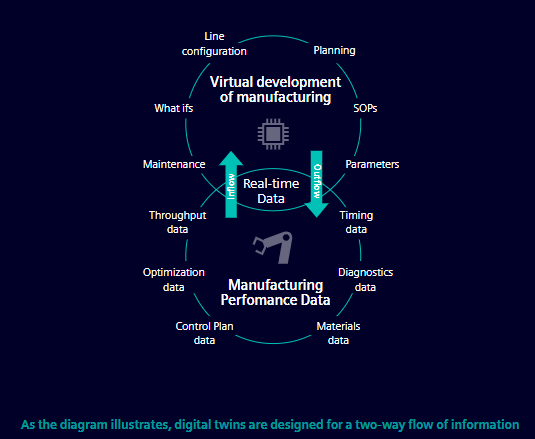
The team feeds real-time operational data into the Digital Twin to model plant performance and evaluate optimization opportunities.
Some of the uses the team has in mind for the Digital Twin include:
1. Enhanced process modeling
Your digital twin is a virtual copy of your physical plant that pulls in real-time data. See exactly how your equipment, workflows, and processes interact. Accurately visualize the complex dynamics that drive your manufacturing.
2. Predictive analytics & optimization
The digital twin uses real-time data to spot equipment failures, yield problems, and bottlenecks before they happen. Test process changes in the virtual world first, see what works, and roll out changes to the shop floor with confidence. Shift left in your manufacturing process to verify and validate earlier, before costs are driven up. This might include simulating product flow: running simulations to visualize and analyze the flow of wafers through each line, considering potential bottlenecks and resource utilization.
3. Scenario planning & problem resolution
Test every decision before making it. Recipe changes, equipment upgrades, new products. Simulate them all using live data. When issues happen, the Digital Twin compares actual vs. simulated performance to reveal root causes instantly for faster problem resolution. Make informed decisions that optimize your production. This will include simulating process variations: analyzing the impact of different process parameters on yield and quality of each test, considering their capabilities and limitations.
4. Continuous improvement & agility
Feed live data into the Digital Twin and run simulations constantly. Test ideas immediately. See if they work. If yes, roll them out. If no, iterate and try again. Quickly adapt to changing market demands, customer requirements, and supply chain disruptions. Fast feedback loops. Quick validation. Innovate without wasting time or resources.
What will be the impact on plant operations?
Your operations manager reviews each of these simulation outputs from the Digital Twin to understand:
- Throughput impact
- Yield impact
- Bottleneck changes
- WIP flow implications
- Equipment utilization impact
- Staffing and shift impacts
- Cleanroom, utility, and sub-fab implications
His next step will be to determine whether the proposed change is operationally viable.
For example, a simulation may improve yield by 2%, but:
- Increase cycle time
- Create a bottleneck
- Increase maintenance requirements
- Overload a critical toolset
The operations manager must balance these types of tradeoffs before submitting his assessment back to your Manufacturing Process Planning team.
Your next-generation manufacturing process plan
Your planning team will begin a new manufacturing planning process based on the simulation insights generated from the real-time data.
This could include developing detailed production plans for each fab:
- Equipment utilization, material requirements, and labor allocation
- Compare cost and time estimates: Analyze the cost and time implications of each production plan, considering factors like equipment setup, process validation, and potential yield variations
- Generate reports: Generate comprehensive reports summarizing the simulations, analyses, and cost/time estimates for each fab, providing a clear basis for decision-making
Feeding real-time data into a digital twin ultimately empowers semiconductor plant managers with the accurate simulations and insightful reports required to make critical decisions about optimizing processes, improving yield and quality, reducing downtime and maintaining a competitive edge through data-driven decisions and continuous innovation.
Finally, you’ve looked at the scenarios on the Digital Twin and it is now decision time.
As the factory manager, your key question is:
“If we implement these changes, what will happen to factory performance?”
Want to learn how leading semiconductor manufacturers use real-time operational intelligence to answer questions like these? Download our eBook e-book-real-time-insights-for-smarter-semiconductor-manufacturing/
Ready to stop guessing and start deciding with confidence?
It all starts with the power of real-time manufacturing intelligence for semiconductors.
Download our eBook now to unlock the power of real-time data e-book-real-time-insights-for-smarter-semiconductor-manufacturing/
Please stay tuned and join us for our next Blog, where our semiconductor Factory Manager will explore what happens after his decision to deploy the Process Change Notice (PCN) in the fab, including the steps, the monitoring and the specific KPIs that follow…
FAQs
Q1: What is real-time manufacturing intelligence in semiconductor production?
A: Real-time manufacturing intelligence combines live operational data from your equipment, processes, and systems and turns it into actionable insights. It gives you moment-by-moment visibility into your fab’s performance, helping you shift left to identify issues early, evaluate efficiency, and make faster, data-driven decisions.
Q2: How does a digital twin use real-time semiconductor manufacturing data?
A: A digital twin is a virtual replica of your factory fed with real-time data. It mirrors your plant’s behavior, letting you test process changes, equipment upgrades, and new recipes virtually before you deploy them. It empowers you to see potential impacts on yield, throughput, and bottlenecks and validate decisions risk-free.
Q3: What benefits can semiconductor manufacturers gain from real-time operational data?
A: Real-time operational data improves process visibility, identifies bottlenecks early, reduces downtime, and enables faster decision-making. Manufacturers gain higher yields, continuous improvement, and increased agility to adapt to market changes. The result enables your fab to shift from reactive to proactive manufacturing and stay competitive in a rapidly-evolving industry.