AI-driven predictive maintenance: Solving semiconductor fab uptime challenges
A fab doesn’t get much room for error, and semiconductor-industry-facility pros have seen it all: A fan drifts out of range. A pump starts pulling harder than usual. Chamber pressure moves during a recipe that ran clean yesterday. Small issues can move fast, and by the time a standard alarm makes them obvious, the team may already be dealing with scrap, an interrupted lot, an unplanned maintenance scramble – or worse yet, an interruption in production.
But predictive maintenance is emerging as a critical strategy for semiconductor fabs facing tighter yield targets and rising equipment complexity. By leveraging existing equipment data and AI-supported analytics, fabs can detect issues 20-40 minutes before they impact production – giving maintenance teams time to act instead of react.
In a recent webinar, Siemens speakers Darin Wood, Semiconductor Enterprise Account Executive, and Genaro Quiroz, Solutions Architect, explained how fabs can use existing equipment data, edge processing and AI-supported maintenance insight to spot issues before production is forced to come to a screeching halt. Their main point? Most fabs already contain useful data. But the hard work consists of getting the right signals to the right people, while there is still time to act.
Utility systems drive 30% of fab downtime
Process tools usually get the attention because they carry direct risk for quality and throughput. The webinar also spent time on the systems around those tools. Exhaust fans, air handling units, make-up air units, pumps, motors, drives, gearboxes and chillers run constantly. If an exhaust fan slips outside its normal operating range, static pressure at a tool can change. That can affect quality and yield even when the tool itself keeps running.
As described by Siemens experts, each asset has its own operating fingerprint. For example, a pump is not just the pump body. A fan is not just the fan blade. Current, voltage, vibration, temperature, flow, pressure and valve behavior all help show what healthy operation looks like. Once that baseline is clear, maintenance teams can see when an asset begins to move away from normal.
Edge processing prevents data overload in high-volume fabs
Modern fabs already collect large amounts of data. The webinar noted that a single etch tool can generate 10 to 50 GB of data per day. In a 200-machine fab, raw data can reach petabyte scale over a single month. Sending all of that raw data to a central system – and hoping the useful signals rise to the top – is an expensive and slow process.
Enter edge data aggregation, which keeps early analysis close to the machine itself. Sensors and actuators feed the tool-level edge node. Meanwhile, the edge node filters, compresses and extracts the features that matter. Fab-level edge or cloud systems then work with cleaner information, such as anomaly scores, metadata and maintenance signals.
That local context matters. Recipes change. Weather and room conditions shift. Tools age. A pressure change that is normal during one recipe may be a warning sign during another. Without this context, teams get nuisance alarms. And after enough of those, people stop trusting the system.
Effective AI models mirror real equipment failure modes
Quiroz made a clear point in the webinar: AI has to be grounded in the way equipment actually fails. A model that spots a statistical outlier helps only when the team can connect that signal to a 1. likely cause, and 2. maintenance action.
The etch example shows why. Plasma etching depends on tight control of gas flow, RF power, chamber pressure and temperature. Siemens cited failure signals such as etch rate drift detected through optical emission spectroscopy, RF impedance shifts that can point to chamber wall degradation, and micro-arcing signatures that can appear before dielectric breakdown.
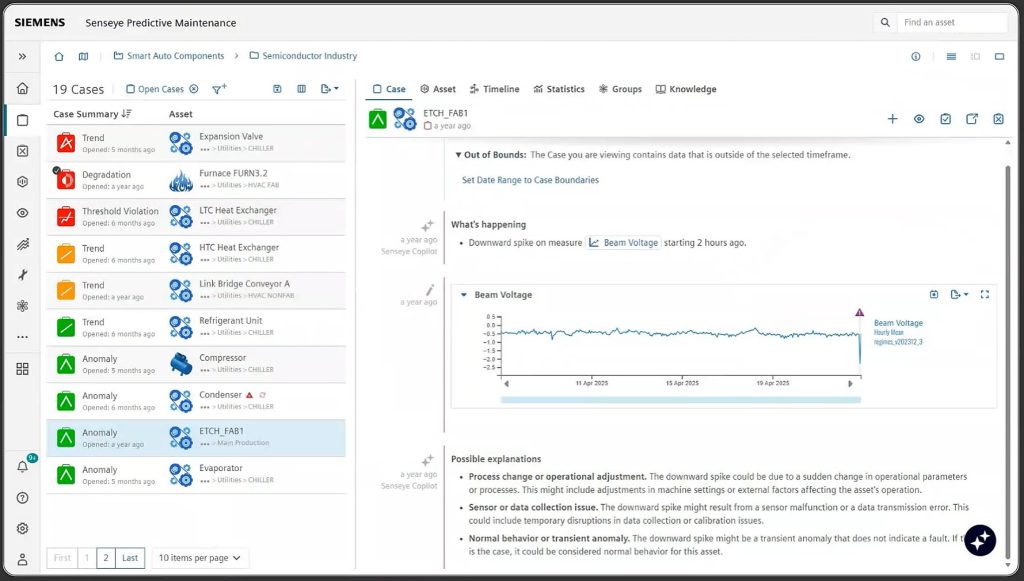
The Senseye web-based, cloud predictive maintenance has specific agents that monitor and supervise equipment and applications, notify with alerts and documents audits for future maintenance.
The useful signal is specific. A beam voltage drop, chamber pressure change or RF shift appears under a certain recipe and operating condition. From there, the system helps the maintenance team look at the most likely causes first.
20- to 40-minute early warnings give teams room to work
The webinar also included example targets for AI-supported etch monitoring: up to 30% downtime reduction, 15% scrap-rate decrease, 20 to 40 minutes of early warning and a 99% yield protection target. Siemens presented those numbers in the context of trained models that detect anomalies early and trigger preventive maintenance before yield drops.
That early warning changes the workday. If a pump begins to degrade, the team may keep the asset running until the end of a shift and repair it during a planned window. If chamber pressure moves in a suspicious way, the team can check the recipe, sensor behavior or process condition before the issue becomes a lot-level problem.
The value is choice. Maintenance teams can decide when to act, whom to send and what information to bring. That is different from chasing a fault after production has already ceased.
LLM-supported troubleshooting reduces technician burden
A predictive maintenance system can still fail if it gives people more screens to watch. In the demo, the software raised an asset’s attention level when an anomaly appeared, then returned the asset to normal after the issue cleared or the corrective action worked. That feedback loop helps reduce false positives and captures maintenance history.
The demo also showed how a large language model (LLM) can support troubleshooting when it has access to maintenance procedures, decision matrices, flowcharts and equipment-specific data. Instead of asking a technician to interpret raw trends, the system can summarize what changed, show the evidence and suggest which checks to make first based on the available procedure.
That matters in fabs where experienced people are stretched and newer team members need practical guidance. Predictive maintenance can help retain shop-floor knowledge by recording what happened, what action(s) were taken and whether the asset returned to normal.
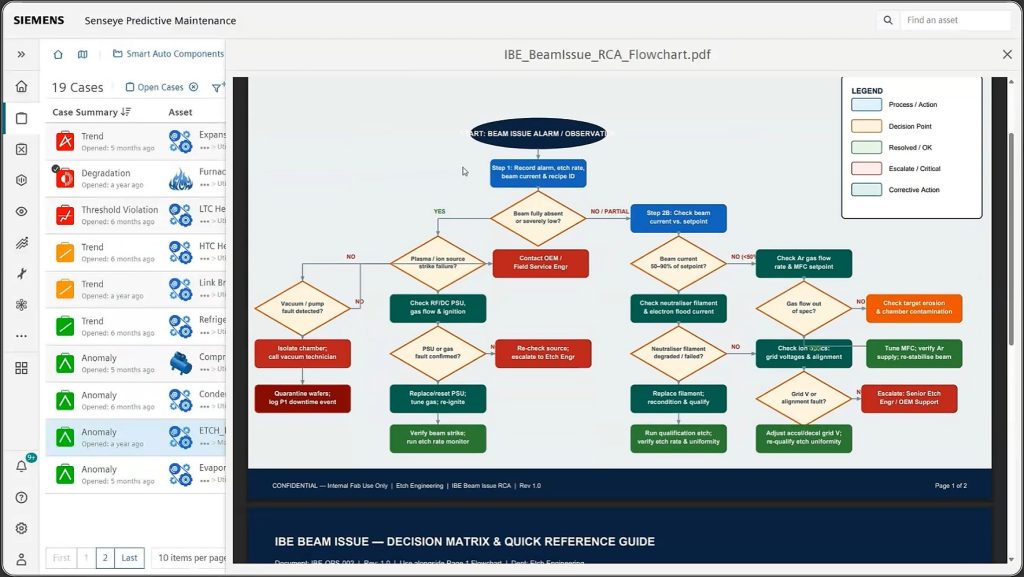
The LLM has capability to ingest images and schematics and connect those back to the data. The AI joins data analytics and prescriptive learning to relay information that leads to action.
Start where the pain is visible
Predictive maintenance is not a rip-and-replace project. Siemens presenters described several paths, including on-premises edge analytics, hybrid setups and cloud-enabled systems. Some fabs may keep process-side analytics local while sending utility-side insight to a cloud application. Others may already have an OT and IT network that can feed fab-level analysis.
The same flexibility applies to sensors; if the signals needed for a high-priority failure mode already live in the control system, teams can start there. If vibration or another measurement is missing, sensors can be added for that use case. A practical starting point is a known failure mode, available data and an asset where downtime hurts enough to justify action.
Utilities often provide a strong first use case. Air compressors, water systems, chillers, pumps and fans run heavily and affect large areas of the fab. Process tools can follow with models that account for recipes, tool behavior and quality signals.
A more usable maintenance routine
Predictive maintenance won’t solve all semiconductor manufacturing challenges. Fabs will still manage tight schedules, strict quality targets and expensive equipment. But it does give teams a better view of trouble while there’s still time to respond.
For Siemens, the case for predictive maintenance rests on real equipment behavior, existing data and maintenance workflows usable on a busy shift. Uptime improves in moments when a technician gets a useful warning, understands why it matters and can act before a small drift becomes lost production.
Key takeaways:
- Predictive maintenance reduces fab downtime by up to 30% through early issue detection
- Edge processing handles petabyte-scale data locally, delivering actionable insights without overload
- AI models grounded in real failure modes provide 20- to 40-minute early warnings
- Starting with utilities (pumps, chillers, fans) offers quick wins before scaling to process tools
- LLM-supported troubleshooting helps retain and transfer shop-floor knowledge
Click here to learn more by viewing the full Siemens webinar on Improving Semiconductor Fab Uptime with Predictive Maintenance.
FAQs
Q: What is AI-driven predictive maintenance for semiconductor fabs?
A: AI-driven predictive maintenance leverages existing equipment data and AI-supported analytics to detect manufacturing issues 20 to 40 minutes before they impact production. This approach gives maintenance teams time to act proactively rather than react to failures, helping reduce downtime.
Q: How much downtime reduction can fabs expect from predictive maintenance?
A: Predictive maintenance can reduce fab downtime by up to 30% through early issue detection. Additional benefits include up to 15% scrap-rate decrease and a 99% yield protection target when AI models are properly trained to detect anomalies early.
Q: Why is edge processing important for predictive maintenance in fabs?
A: Modern fabs generate massive amounts of data; a single etch tool can produce 10-50 GB per day, and a 200-machine fab can reach petabyte scale monthly. Edge processing keeps early analysis close to the machine, filtering and extracting only the features that matter before sending cleaner information to fab-level or cloud systems. This prevents data overload and delivers actionable insights faster.
Q: What types of equipment should fabs prioritize for predictive maintenance?
A: Utilities like air compressors, water systems, chillers, pumps and fans offer strong first-use cases because they run constantly and affect large areas of the fab. Utility systems drive about 30% of fab downtime. Process tools can follow models that account for recipes, tool behavior and quality signals.
Q: How do AI models detect equipment failures before they occur?
A: Effective AI models are grounded in real equipment failure modes. For example, in plasma etching, the system monitors specific signals such as etch rate drift through optical emission spectroscopy, RF impedance shifts indicating chamber wall degradation and micro-arcing signatures that appear before dielectric breakdown. Each asset has its own operating fingerprint based on parameters like current, voltage, vibration, temperature, flow and pressure.
Q: How does LLM-supported troubleshooting help maintenance teams?
A: LLMs with access to maintenance procedures, decision matrices, flowcharts and equipment-specific data can summarize what changed, show evidence and suggest checks to perform first. This reduces the burden on technicians via practical guidance – especially valuable when experienced personnel are stretched and newer team members need support. The system also helps retain shop-floor knowledge by recording what happened, what actions were taken and whether the asset returned to normal.
Q: Does implementing predictive maintenance require replacing existing systems?
A: No. Predictive maintenance is not a rip-and-replace project. Siemens offers several flexible deployment paths, including on-premises edge analytics, hybrid setups and cloud-enabled systems. Fabs can start with existing signals in their control systems and add sensors only when needed for specific failure modes. The practical starting point is identifying a known failure mode, available data and an asset where downtime justifies action.
Q: What makes the 20- to 40-minute early warning valuable?
A: Early warnings give maintenance teams the choice to decide when to act, whom to send and what information to bring. For example, if a pump begins to degrade, the team can keep the asset running until the end of a shift and repair it during a planned window rather than dealing with an emergency shutdown. This transforms reactive maintenance into proactive planning.