5 ways simulation-driven design gets electronics products to market faster
Today, hardware engineers are facing electronic designs that are more complex than ever and getting those products to market on time often determines whether a product launch is a success or not. Ensuring product time-to-market (TTM) schedules are met leaves little to no room for setbacks like late-stage design changes or unscheduled prototype iterations. These setbacks, however, can be avoided. Leading electronics companies are implementing modern, simulation-driven “shift-left” design workflows that both local and global teams can access and collaborate on throughout their design process to ensure first-pass design success.
What is a simulation-driven design workflow?
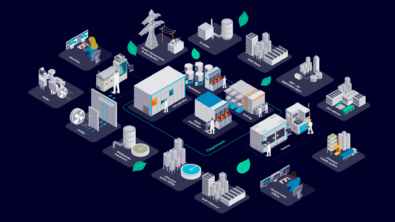
From concept to manufacturing, a simulation-driven design workflow in your digital engineering process empowers you to optimize power electronics performance by combining thermal management expertise, decisive testing, and advanced simulation. This workflow approach validates real-world performance data, identifies optimal configurations, and evaluates mechanical, electromagnetic, and acoustic characteristics, delivering “shift-left” insights throughout the design flow that ensure your design’s reliability and performance throughout the entire design process. Download this infographic to share with your team.
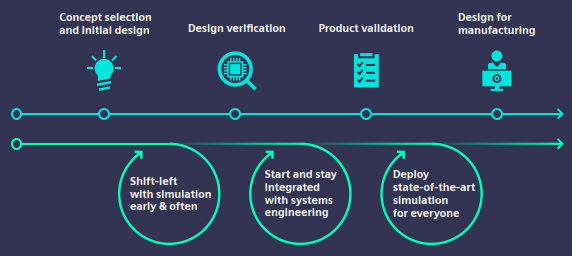
Reason 1 – Early design validation
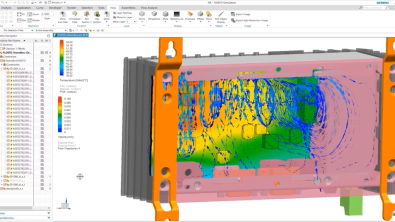
Simulation tools enable design engineers to explore numerous design options virtually, accelerating iteration and optimization without the need for physical prototypes. By integrating concurrent multi-physics simulation workflows early and often into the design process, potential issues arising from interactions among different physical phenomena can be identified and addressed sooner.
Reason 2 – Multi-physics integration
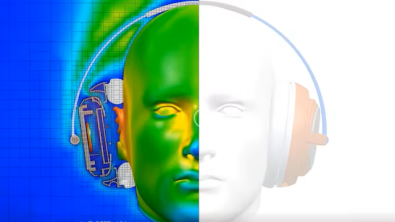
This integration maps to unified workflows by allowing engineers to simulate and balance performance requirements across various solution domains within a single, integrated environment. This means that instead of analyzing different physical phenomena (such as thermal, electromagnetic, or structural behavior) in isolation, they can be considered together, enabling a more complete and accurate virtual representation of electronic products and leading to more robust, reliable, and innovative designs.
Validated simulation processes reduce the cost of design saving time and reducing number of prototypes for thermal cameras
Atsushi Ishii, Director, Sensor and Systems Functions, FLIR Systems
Reason 3 – Collaboration enablement
Hardware and design engineers face mounting pressure to deliver increasingly complex but often struggle with design complexity, limited tool access, and collaboration barriers. Providing a shared cloud-based environment and data for design engineers and simulation experts, streamlining communication, and empowering global design teams with accessible simulation tools. This enables the strategic deployment of expert knowledge to address complex challenges and promotes holistic problem-solving. The benefits include faster design cycles, higher quality designs, increased innovation, and reduced development costs.
Reason 4 – Cost/time reduction
By validating designs virtually and reducing the need for physical prototypes, simulation helps lower design and development costs. The “shift-left” approach Integrates simulation early in the design process, helping verify designs earlier and significantly reduces costly late-stage changes and reduces the time it takes to bring new electronic products to market faster.

Reason 5 – Innovation acceleration
Simulation-driven design plays a pivotal role in advancing electronics innovation. It empowers design engineers to virtually explore a wide range of design possibilities, enabling rapid iteration and optimization without the need for physical prototypes. This flexibility fosters creativity and innovation by giving engineers the freedom to experiment with diverse concepts and ideas.
Ensure your company is fully leveraging the advantages of a simulation-driven design workflow in your digital engineering process. Download the checklist now.
The Solution: Simcenter
Simcenter simulation and test solutions provide valuable insights into the performance, reliability, and efficiency of designs, helping engineers make informed decisions and identify potential issues early in the development process, and balance performance requirements across all solution domains.
Want the visual summary? Get the infographic here.
FAQs
• What is simulation-driven design in electronics?
Instead of building a prototype and then testing it, simulation-driven design flips the process. Engineers run virtual tests throughout development, thermal, electromagnetic, and structural, before anything gets built. It’s like having a digital twin that tells you what will actually happen in the real world. You catch problems early when they’re cheap to fix, not after you’ve already manufactured thousands of units.
• What does “shift-left” mean in product development?
It’s exactly what it sounds like: move testing earlier. Instead of discovering issues during prototyping or manufacturing (when fixing them costs a fortune), catch them during design when changes are quick and cheap. Simulation is what makes this possible, it lets you validate ideas before you commit resources.
• How does simulation reduce electronics prototyping costs?
Physical prototypes are expensive. You build one, test it, find problems, redesign, build another one, it’s a cycle that drains budgets fast. Simulation lets you test hundreds of design variations digitally first. You only build the prototypes you’re confident about. Companies like FLIR Systems have cut development costs significantly by validating designs earlier and avoiding those painful late-stage redesigns.
• What is multi-physics simulation and why does it matter for electronics design?
Real products don’t experience one force at a time. A component might handle heat fine on its own, but fail when you add electromagnetic stress and mechanical vibration into the mix. Multi-physics simulation analyzes all of these together in one environment, so you see how everything actually interacts. It’s the difference between testing in isolation and testing in reality.
• How do global engineering teams collaborate on complex electronic designs?
Modern electronics projects span continents. Cloud-based simulation platforms solve this by giving everyone, design engineers, simulation experts, and teams in different time zones access to the same data and tools in real time. No more emailing files back and forth or waiting for one specialist to finish before another can start. It breaks down silos and keeps projects moving.
• What is the difference between thermal simulation and electromagnetic simulation?
Thermal simulation shows you how heat moves through your product and whether components will overheat. Electromagnetic simulation models electric and magnetic fields, which are critical for signal integrity and regulatory compliance. Both matter individually, but they’re most powerful together, where you can see how thermal and electromagnetic effects influence each other.
• How does AI improve simulation workflows in electronics engineering?
AI doesn’t replace physics-based simulation; it supercharges it. Machine learning can predict simulation outcomes faster than traditional methods, cutting computational time and cost. It also spots patterns in your data and surfaces optimal designs more quickly. The result: you explore more design options in less time and make better decisions faster.
• How does simulation help reduce electronics time-to-market?
Late-stage surprises kill schedules. By running simulations early and continuously, you catch problems before they become crises. You eliminate the back-and-forth between design and validation teams. Engineers make faster, more confident decisions because they have data backing them up. That compression adds up to real time savings.
• What simulation tools do electronics companies use for PCB design?
Simcenter is Siemens’ integrated simulation platform that helps PCB designers validate designs before manufacturing. The suite includes Simcenter Flotherm for thermal analysis and cooling optimization, Simcenter FLOEFD for CFD thermal simulation, PSPICE for circuit and signal integrity analysis, Electromagnetic for EMI/EMC compliance, Simcenter Hypermesh for meshing and model preparation and Simcenter Nastran for mechanical stress and reliability evaluation. Together, these tools help designers catch issues early, reduce prototyping costs, and accelerate time-to-market.
• How does cloud-based simulation improve engineering team collaboration?
Simulation used to require expensive hardware and specialized expertise locked in one team. Cloud platforms democratize it. Design engineers can run simulations themselves without being simulation experts, while specialists still provide oversight. You remove the bottleneck, accelerate cycles, and improve designs. Everyone wins.