Blog series: Smart factory insights: Opcenter IPL in action, Part 4
Part 4: The ROI of seamless workflow in electronics manufacturing
In our series so far, we’ve explored how Opcenter IPL revolutionizes manufacturing operations, the power of reduced side inventory and ways to master intralogistics challenges. Now, let’s examine the tangible returns of implementing seamless workflow in electronics manufacturing.
Industry insights driving change
According to McKinsey’s 2023 Global Semiconductor Industry Report, electronics manufacturers implementing advanced workflow solutions are seeing efficiency gains of up to 30% in their operations [1]. This trend reflects the growing importance of seamless workflow in maintaining competitive advantage.
The numbers behind the transformation
These industry trends are backed by real results. ASM Pacific Technology (ASMPT), a leading semiconductor equipment manufacturer, achieved a 40% reduction in production bottlenecks and 50% improvement in planning efficiency through digital workflow optimization [2]. In an industry where every percentage of efficiency matters, these gains demonstrate the significant impact of optimized workflows.
Breaking down the benefits
Our infographic reveals a comprehensive framework for achieving these improvements through several key workflow enhancements:
· Comprehensive logistics process orchestration
· Automated material flow management
· Integrated quality control and replenishment processes
· Synchronized production planning and replenishment planning
· Smart logistics resource allocation
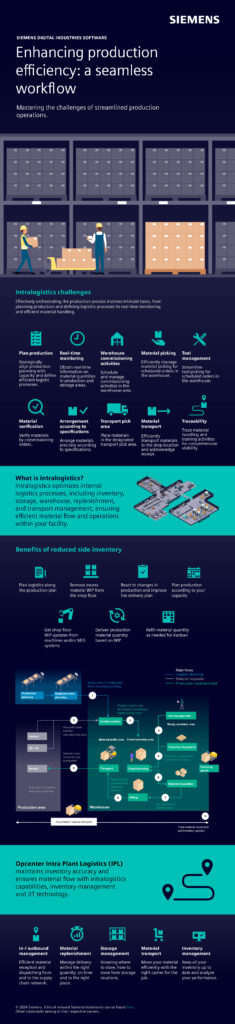
Want to see exactly how these elements interconnect? Our infographic provides a detailed visualization of the complete workflow process, from initial planning to final execution.
From implementation to impact
The path to these returns follows a strategic workflow that our infographic maps out in detail. While each manufacturer’s journey is unique, the core elements consistently drive specific improvements:
1. Production Efficiency
o Elimination of stockouts in production and optimize shopfloor layouts for improved performance
o Immediate response to disruptions with integrated planning processes for production and replenishment
o Data-driven decision making based on a comprehensive logistics dataset
2. Material Flow
o Automated tracking and routing for complex logistical flows involving materials, containers, carriers, tooling, etc.
o Seamless operation of automated and manual logistics processes including manual delivery, forklift, automated guided vehicle (AGV), and automated storage and retrieval systems (ASRS)
o Optimized inventory movement, reduced manual handling, and balancing of logistics resources
3. Quality Integration
o Quality control built into the replenishment process ensures that quality requirements are enforced for the material supply including storage, handling, and consumption
o Reduced rework, scrap, and waste through improved usage of materials
o Consistent product quality through systematic improvement of inventory execution
Curious about how these elements work together? See the step-by-step workflow visualization that’s helping leading manufacturers transform their operations.
Transforming potential into performance
Leading manufacturers aren’t just implementing new technologies – they’re revolutionizing how work flows through their facilities. Through Opcenter IPL’s seamless workflow capabilities, electronics manufacturers can turn efficiency potential into measurable performance gains. This optimized workflow creates the perfect foundation for our next challenge: mastering the complex journey of materials from warehouse shelves to production lines – where efficiency truly impacts your bottom line.
In our final installment of this series, we’ll reveal how streamlining the material flow from stores to production can eliminate bottlenecks, reduce waste and drive unprecedented operational
efficiency. Stay tuned to discover the strategies that are helping leading electronics manufacturers optimize this critical process. Meanwhile, download our infographic to explore how a seamless workflow sets the stage for manufacturing excellence.
[1] McKinsey & Company. (2023). Global Semiconductor Industry Report. [2] Siemens. (2023). ASM Pacific Technology Digital Enterprise Case Study.