Single Event Effects (SEE) in Rad-Hard components with HyperLynx AMS

Imagine a single, high-energy particle (like a cosmic ray or proton) striking a semiconductor. This causes a localized electrical disturbance or hardware malfunction known as a Single Event Effect (SEE). What makes SEEs particularly challenging is that they can’t be stopped by traditional physical shielding, making Radiation-Hardened (Rad-Hard) components essential for systems operating in harsh environments like space or military applications.
Under these conditions, particle bombardment can:
- Flip a memory bit (Single Event Upset (SEU))
- Cause a transistor to latch up (Single Event Latch-up (SEL))
- Trigger a transient voltage spike (Single Event Transient (SET))
So, how do you design and rigorously verify circuits to ensure they can withstand these extreme conditions before the irreversible commitment of launching them into space?
This is where advanced simulation tools, like HyperLynx AMS, become invaluable in predicting and analyzing these elusive events.
HyperLynx AMS (Analog/Mixed-Signal) from Siemens allows you to simulate mixed-signal designs with analog and digital components, which is powerful for rad-hard design. This kind of simulation can replace or reduce expensive radiation beam testing (which requires particle accelerators) and catch design weaknesses early, saving enormous cost in space or defense programs.
HyperLynx AMS allows you to:
- Inject fault models: model a particle strike as a current pulse injected into a node and simulate how the circuit responds: does it recover, latch up, or corrupt data.
- Mixed-signal co-simulation: Rad-hard designs often mix analog (power regulators, sensors) with digital logic. HyperLynx AMS handles both simultaneously, so you can see how a SET in an analog block propagates into digital logic.
- SPICE-level accuracy: Radiation effects happen at the transistor level. HyperLynx AMS supports SPICE modeling, so you get accurate device-level simulation.
- Power integrity under radiation: Latch-up events cause sudden current spikes. You can simulate how your power distribution network responds and whether protection circuits (current limiters, fuses) react in time.
Because HyperLynx AMS sits inside the Siemens Xpedition ecosystem, this means
- You can simulate board-level rad-hard effects, not just IC level.
- Work alongside Questa One for digital verification.
- Model a particle strike on a PCB trace or passive component and co-simulate with the IC models simultaneously.
This board + IC + digital combination in one flow is rare and very valuable for space/defense system designers.
Rad-hard components often come with older or limited SPICE models, and custom behavioral models from suppliers. HyperLynx AMS accepts multiple model formats (SPICE, Verilog-AMS, VHDL-AMS, PCB parasitic/extracted models), so you can mix whatever models your rad-hard component supplier provides without needing to rewrite them.
Rad-hard PCB design unique challenges
Rad-hard PCB design presents unique challenges such as altered impedance and coupling due to heavy shielding, signal behavior changes from component derating, and sudden power rail load shifts caused by latch-up events. HyperLynx AMS can simulate how a latch up-induced current spike travels through the power distribution network and affects signal quality in one environment.
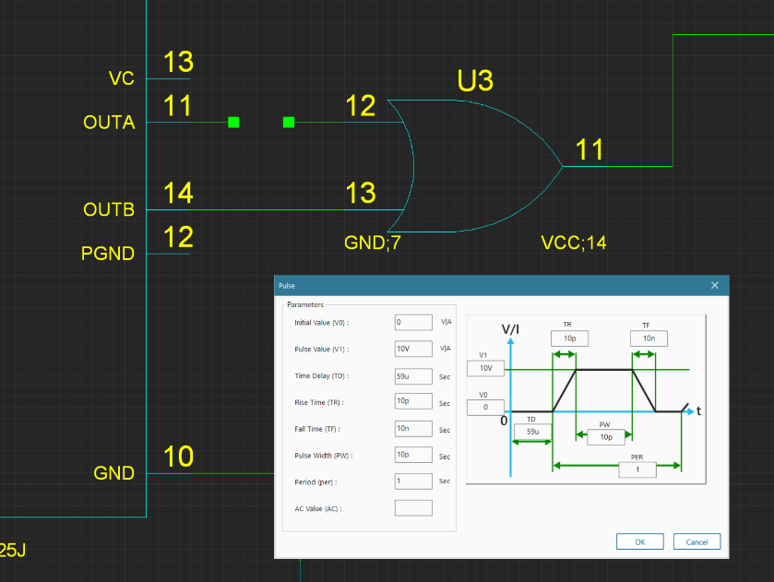
HyperLynx AMS allows you to inject current pulse models (representing particle strikes), or a voltage spike more directly into the schematic environment, lowering the barrier for board-level engineers who may not be deep SPICE experts.
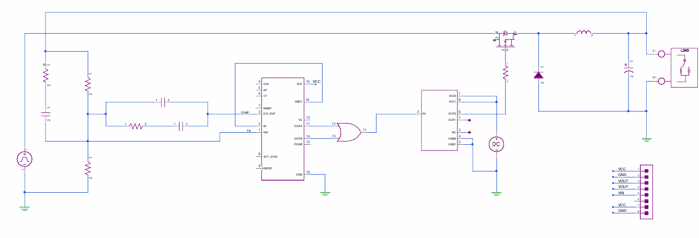
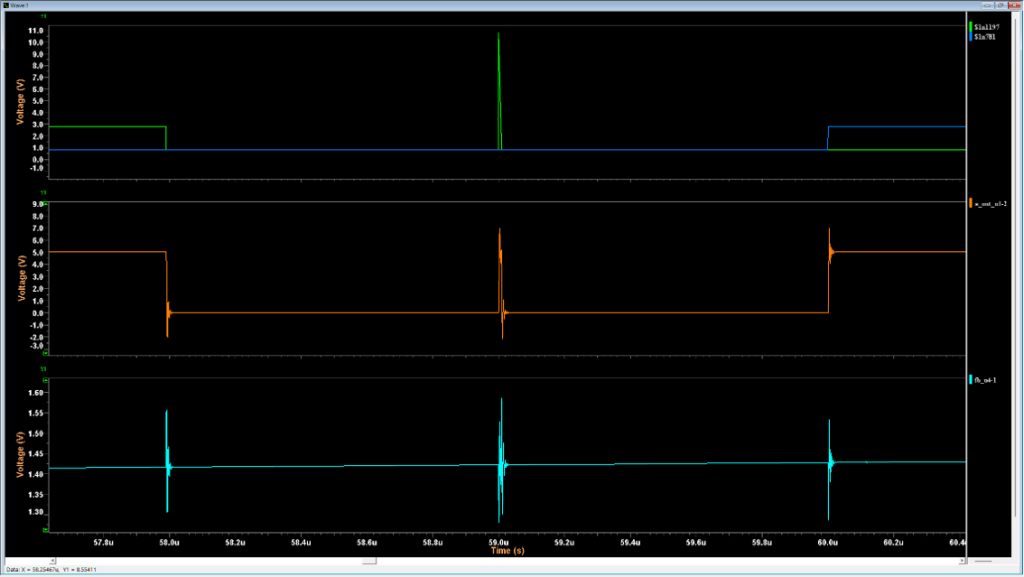
For example, let’s use the power converter circuit shown in figure 1 to illustrate the far-reaching consequences of the SET. In figure 2, we injected a voltage spike at the OUTA to mimic SET using HyperLynx AMS. This spike didn’t stay contained and propagated through the logic gate U3, appearing as a glitch on its output (figure 3).
This localized event induced significant ringing on an entirely unrelated net, which demonstrates how parasitic coupling from a suboptimal board layout can transform a minor transient into a system wide disturbance, even between traces that are not directly connected.
HyperLynx AMS is one of the few system and PCB-level tools that lets you simulate the full effect chain from a particle strike at the component level, through the analog circuit response, into the digital system behavior, across the PCB power network all in one connected flow making it the perfect fit to rad-hard system and board level analysis.