Beyond the drawing board: why the future of E/E systems design is generated, not drawn

As products become smarter and more connected, the inherent complexity of modern E/E systems combined with the complexities of orchestrating the design processes are reaching a stage where the traditional methods of E/E systems design are challenged to their limits.
Companies are no longer just drawing wiring harnesses in a silo, they are architecting the nervous systems of future sophisticated products such as autonomous vehicles, software-defined products and next-generation aerospace. In this competitive space, the winners need to lead the pace in releasing innovative products on the market first.
Siemens Capital redefines this journey through three core pillars:
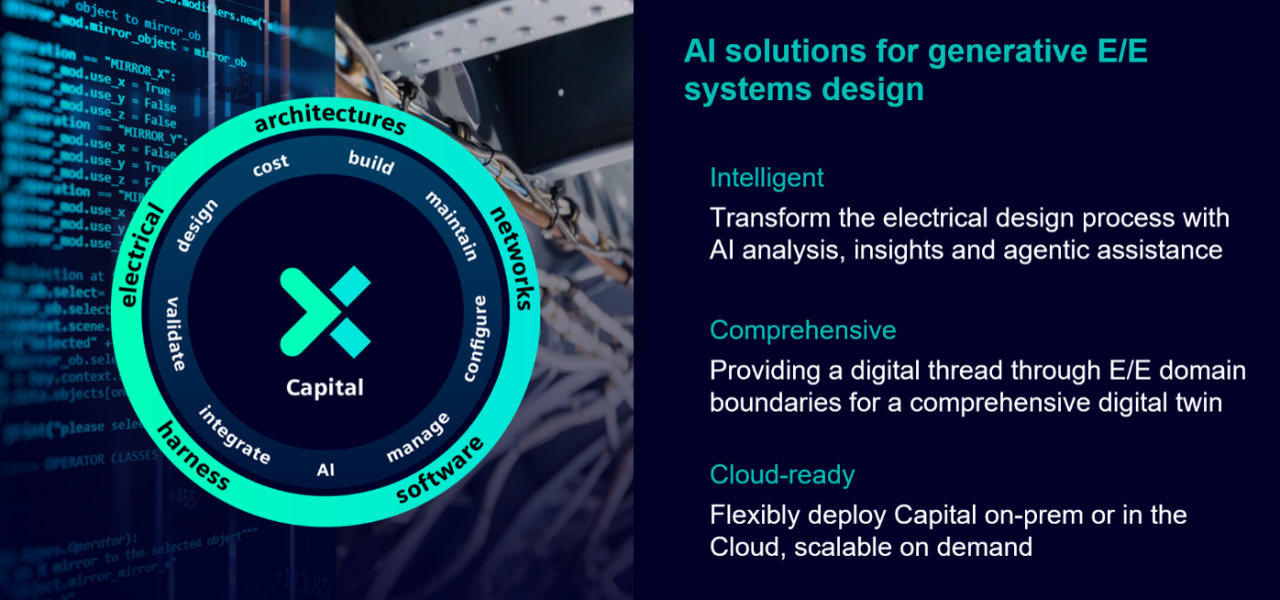
1. Intelligent: transform the electrical design process with AI analysis, insights and agentic assistance
The most disruptive force in engineering today is the introduction of AI. This disruption isn’t just about speed and automating manual design activities in a silo, it’s about centralizing design intelligence serving engineers. For decades, engineering knowledge has been locked in static documents or the minds of individual senior designers.
Siemens Capital utilizes deep AI integration from automating the repetitive and time-consuming tasks of authoring or routing wires or middleware configuration, to capturing and applying design intelligence, to ensure every decision is backed by institutional knowledge and best practices.
With agentic assistance, customers can even use AI to take proactive action such as identify risks and offer insights that a human might miss in a complex system. This transforms the design process from a series of manual checks into a collaborative, intelligent workflow where the AI acts as an advisor, ensuring that your most valuable engineering knowledge is scaled across every project.
2. Comprehensive: providing a digital thread through E/E domain boundaries for a comprehensive digital twin
The aerospace industry is undergoing rapid transformation driven by electric and hybrid aircraft, advanced avionics, and increasingly complex E/E systems. To keep pace, aerospace OEMs and suppliers must balance innovation, regulatory compliance, and cost efficiency, often across globally distributed teams. Cloud‑based Software‑as‑a‑Service (SaaS) models are emerging as a critical enabler of this shift.Innovation cannot happen in a vacuum, yet many teams still operate in silos. A truly comprehensive digital twin requires a seamless digital thread that spans every domain boundary.
Consider the risks of a disjointed vehicle development process: for example a controls team might request more data over the networks to support additional functions without awareness of the product-wide impact. This could lead to capacity bottlenecks and unexpected behavior once the vehicle is on the road.
Linking the domains together enables predicting the impact of such design change across domains, such as with the previous example, left shifting the discovery of excess loading of networks, gateways or processing, otherwise found in late development or worse after product release. Hidden failures undetected at design time can cost millions in late-stage fixes.
Capital ensures that every change is reflected across the entire E/E ecosystem, preventing these failures before they occur.
3. Cloud-ready: flexibly deploy Capital on-prem or in the cloud, scalable on demand
In a modern engineering environment, infrastructure should be an accelerator, not a constraint. Being cloud-ready is about providing the flexibility to work where your team is most effective.
The pace of change is accelerating: ever more powerful software capabilities, compute resources, team sizes are in constant evolution so that staying relevant with these constant changing variables becomes challenging and requires time, resources and experience. SaaS helps alleviate the load across these aspects so that teams can focus on their design rather than on the environment
Shifting to a cloud-based software environment fundamentally changes how operations scale and innovate. Cloud delivery ensures continuous access to the most up-to-date features leading to a critical advantage given the rapid evolution of artificial intelligence, while providing elastic scaling to match growing compute demands and expanding teams. Coupled with robust, enterprise-grade security coverage and lower upfront implementation costs, cloud-based solutions offer a leaner, more resilient path to digital transformation.
The challenge: drawing the past or generating the future?
Siemens Capital does more than help engineers draw circuits and harnesses: it empowers organizations to generate the future of E/E systems.
The question for every engineering lead today is simple: does the current toolset merely facilitate keeping up, or does it enable true leadership? When complexity is still managed manually (rather than through AI and a comprehensive digital thread), organizations aren’t just losing time, they are forfeiting their competitive edge.


