Building supply chain resilience when critical routes are under pressure
How Siemens Digital Logistics and Portcast help companies turn transport visibility into faster decisions
Global supply chains continue to face a wide range of disruptions, from shifting trade flows and severe weather to capacity constraints, late milestone updates and unexpected rerouting. In this environment, resilience is no longer a theoretical ambition; it is a practical requirement for keeping production, logistics and customer commitments aligned.
When transportation networks become less predictable, companies need more than a status snapshot. They need timely insight into what is likely to happen next, which shipments are at risk and what the operational impact will be if a delay continues to develop. This is especially important for supply chains carrying time-sensitive, seasonal or production-critical goods, where even a short delay can affect procurement, planning and downstream delivery commitments.
That is why Siemens Digital Logistics and Portcast work together to help companies move from reactive shipment tracking to proactive decision-making. By combining AX4’s digital control tower capabilities with Portcast’s AI-powered ETA predictions and milestone intelligence, logistics teams can identify risks earlier, focus on exceptions that matter and act with greater confidence across the supply chain.
Why resilience matters now
Supply chain resilience has become a board-level topic because disruptions are more frequent, more complex and more interconnected than in the past. Siemens’ supply chain resilience materials highlight the growing influence of trade uncertainty, cybersecurity incidents, climate-related events and labor disruption on logistics networks. At the same time, customer expectations keep rising: companies are expected to deliver reliable service, maintain transparency and respond quickly when conditions change.
The challenge is not simply that disruptions exist. The challenge is that they often appear first as small delays, late updates or inconsistent milestone data, and then quickly escalate into planning problems across functions. Without a reliable flow of transport information, teams spend time chasing updates instead of making decisions.
This is where visibility becomes a core capability. A resilient supply chain is one that can detect deviation early, understand its impact on connected processes and adjust before the issue spreads into production, warehousing or customer service. In practice, that means connecting transport execution, status intelligence and planning context in one consistent environment.
The fertilizer supply lens
Fertilizer supply is a strong example of why this matters. Urea, ammonia and sulfur are important inputs for agriculture and other industrial value chains, so when shipping becomes less predictable, the pressure moves quickly from transport into procurement, production planning and customer service. These flows are often seasonal, time-sensitive and dependent on precise coordination across suppliers, carriers, terminals and inland logistics.
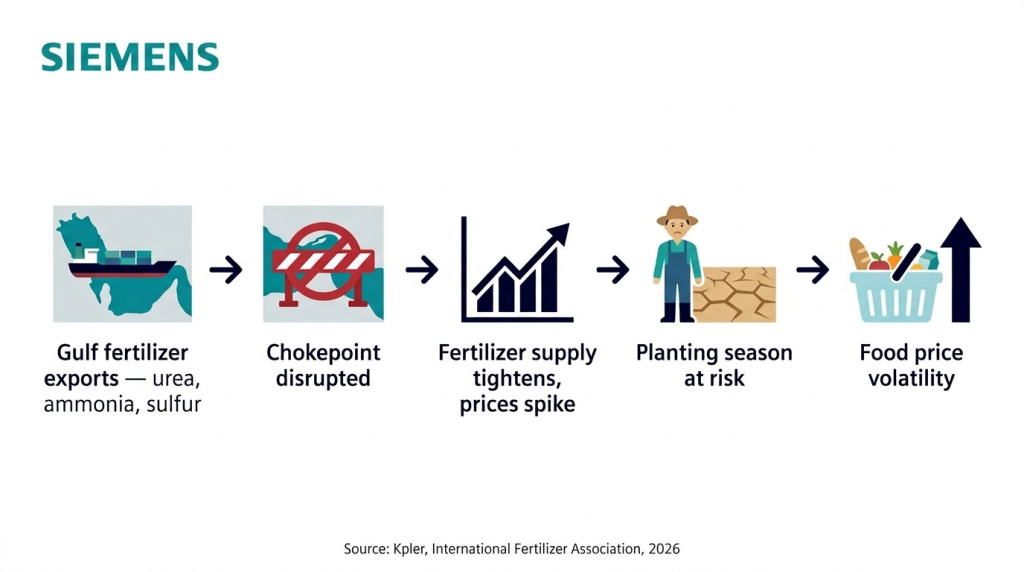
The issue is rarely just about physical movement. It is about timing, sequencing and certainty. If a shipment arrives late, is rerouted or misses a handover, the effect can extend beyond logistics and into operational planning, inventory decisions and customer commitments. For that reason, fertilizer logistics illustrates a broader truth: resilience depends on the ability to see risk early and act before it becomes a shortage.
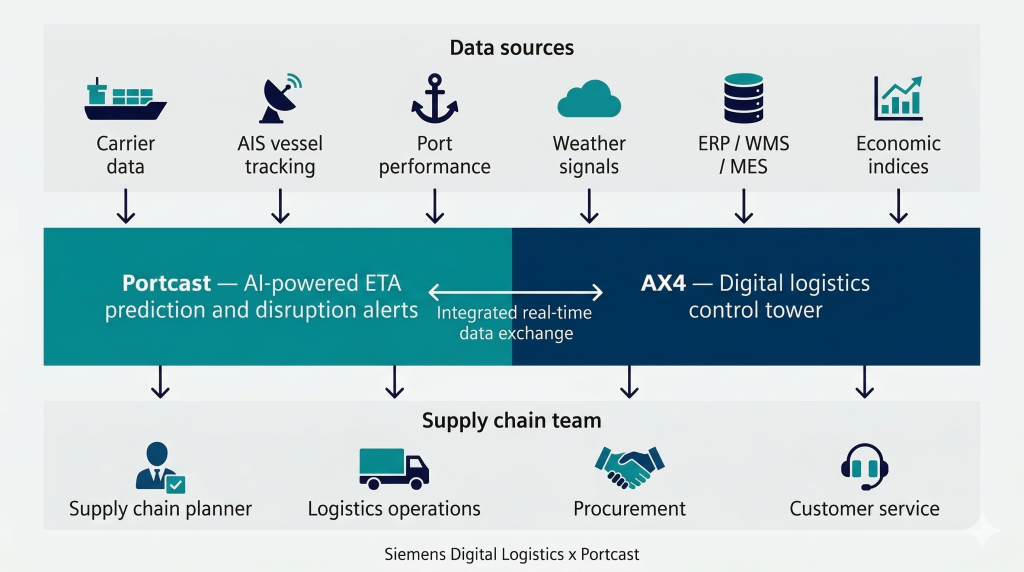
Siemens Digital Logistics supports that need by providing end-to-end visibility, transport execution and decision support through AX4. The platform serves as a single source of truth for logistics processes, data and stakeholders, helping companies manage inbound and outbound transportation, monitor milestones and respond faster to disruption. When that is combined with Portcast’s predictive ETA intelligence, teams gain a clearer view of which shipments are likely to slip and which internal processes are affected.
For logistics and supply chain organizations, the value is not only in better tracking. It is in better prioritization. Instead of treating every delay as equally important, teams can focus on the shipments that carry the highest operational risk and take targeted action before the issue reaches production or the customer. That improves coordination across logistics, planning and customer-facing functions.
From tracking to action
Many companies already have shipment visibility tools. The real challenge is turning that visibility into usable operational insight. Siemens and Portcast address this by combining live milestone data, enriched exception logic and AI-based ETA predictions inside a logistics control tower environment.
Portcast enriches shipment data with alternative signals such as carrier updates, vessel movement information, port performance indicators and other contextual data sources, helping teams separate routine noise from genuine exception risk. AX4 then brings that information into a collaborative execution environment where stakeholders can work from the same version of the truth.
This matters because small delays often have system-wide consequences. A shipment that looks acceptable at first glance may still threaten a production order, a delivery sequence or a seasonal planning window. The combination of predictive intelligence and control tower orchestration gives teams more time to respond and more confidence in the decision they make.
The practical result is a shift from reactive escalation to proactive management. Teams spend less time checking status manually and more time managing exceptions, communicating accurately and maintaining service continuity. That is a meaningful step toward resilience, especially in networks that depend on timely raw material inflows and coordinated production schedules.
What AX4 adds
AX4 is designed to help organizations streamline logistics collaboration and execution across their supply chain network. According to Siemens Digital Logistics, the platform provides real-time visibility, seamless execution and proactive decision support, while connecting suppliers, freight forwarders, customs agents and production planners on one centralized platform.
In practical terms, that means AX4 can support inbound transportation, outbound transportation, shipment tracking, event management, freight cost processes and collaboration across multiple stakeholders. It also helps companies reduce complexity by consolidating logistics processes and improving transparency across the network.
The platform is especially relevant when companies need to react quickly to disruption. AX4’s control tower approach supports proactive monitoring of milestones, early identification of bottlenecks and faster troubleshooting, which helps keep operations aligned when transport conditions change. Siemens’ resilience materials also emphasize the importance of digital twins, cloud-based processes and integrated decision support as part of a broader resilience strategy.
For supply chains under pressure, this means one thing: the organization is not relying on isolated updates or manual coordination. It is using connected data to understand what is happening, what it means and what needs to happen next.
Why the partnership matters
The Siemens Digital Logistics and Portcast combination is valuable because it addresses two different layers of the same problem. AX4 provides the collaborative execution layer and control tower environment. Portcast adds predictive intelligence that improves the quality and relevance of the status information inside that environment.
Together, they help companies improve shipment traceability, reduce manual follow-up and strengthen decision-making across logistics and planning functions. The webinar materials shared by Siemens and Portcast point to concrete operational benefits, including reduced manual updates, improved data quality and better user productivity. Those are not just IT improvements; they are operating-model improvements.
This is particularly relevant for companies with complex inbound supply chains, including chemical, industrial and agricultural input flows. In those environments, the ability to anticipate delay, protect production continuity and inform stakeholders early can make the difference between a manageable exception and a broader operational disruption.
The strategic value of the partnership is therefore clear. It helps companies move beyond simple visibility and toward resilient orchestration, where transport intelligence, milestone data and logistics execution work together to support better decisions.
A broader resilience lesson
The fertilizer example is only one illustration of a much broader pattern. Supply chain resilience today depends on the ability to connect data across transport, planning and execution, and to use that data before disruption turns into business impact.
Siemens Digital Logistics has long emphasized that digitalization is the foundation for better resilience. End-to-end visibility, cloud-based collaboration, simulation and control tower capabilities all help companies make faster and more reliable decisions in volatile conditions. Portcast complements that foundation by adding predictive ETA intelligence and shipment-level context that make those decisions more precise.
For supply chain leaders, the message is straightforward. Resilience is not built when the disruption starts. It is built by having the right tools, data and operating model already in place. That is what allows organizations to respond faster, coordinate better and keep their supply chains moving under pressure.
Learn more
If you want to understand how Siemens Digital Logistics and Portcast help companies strengthen resilience across complex supply chains, the joint webinar Beyond the Buzz: How AI Is Powering Supply Chain Resilience Today is a useful starting point. It shows how a digital control tower, combined with AI-powered ETA predictions, can improve visibility, reduce manual work and support better decisions when supply chains become less predictable.
For companies handling critical material flows, the same approach can support more robust planning, earlier exception handling and more reliable coordination across the supply chain network.
Ready to improve supply chain resilience with better visibility and predictive intelligence? Explore how Siemens Digital Logistics and Portcast can help your teams move from reactive tracking to proactive execution together to help customers advance on this journey — from gaining transparency on today’s disruptions to building supply chains that are better prepared for whatever comes next.
More information on AX4, Portcast, resilient shipping
- Read our white paper: Supply Chain Resilience
- Read our fact sheet AX4 real-time transportation visibility for sea freight
- Learn more about our partner portcast: How Portcast and Siemens Digital Logistics create resilient, transparent supply chains
- Portcast website: https://www.portcast.io/
- Portcast Blog: Strait of Hormuz Shipping Disruption: Live Information on Port Congestion – Portcast Blog