From “What-If” to “What’s Next”: How advanced digital twins master manufacturing volatility
The era of static manufacturing network design is over. As we explored in Part 1 of this series, relying on a “black box” approach in today’s volatile environment leaves organizations vulnerable to sudden supply chain disruptions. You must navigate unprecedented shifts in demand, evolving regulatory landscapes, and unexpected supplier outages. To manage this complexity, supply chain leaders require more than just spreadsheets and periodic reviews.
The engine behind the twin: Supply Chain Suite
At Siemens, we utilize the Supply Chain Suite (SCS) to tackle these exact challenges. Featuring built-in optimization modules, it allows companies to model production and logistics as a unified, interdependent system. This delivers a true end-to-end environment, providing total supply chain visibility from initial data input to precise network and cost modeling.
SCS serves as the technological foundation that enables the Digital Twin. While a standard digital twin allows for basic “what-if” experimentation, a Digital Twin goes a crucial step further. It acts as a prescriptive engine that not only mirrors current reality but prescribes the exact strategic shifts required to maintain resilience and profitability.
Executing the 4 core strategic imperatives
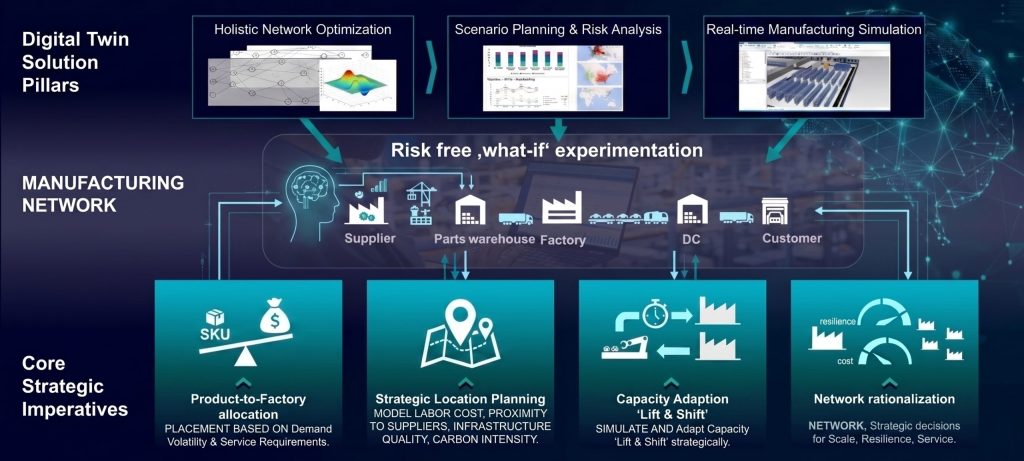
Given the wide variation in manufacturing processes across industries, advanced digital twins must be highly flexible. Powered by the Siemens Supply Chain Suite, they empower supply chain leaders to move beyond theory and execute data-driven decisions across the four core imperatives of modern Manufacturing Network Design (MND):
- Product-to-Factory Allocation: Balancing demand volatility and regional service requirements goes beyond simple capacity matching. The Advanced Digital Twin analyzes thousands of product-location-customer combinations to optimize total landed costs.
- Strategic Location Planning: When selecting new sites or consolidating existing ones, the digital twin precisely models complex variables, including local labor costs, proximity to suppliers, infrastructure quality, and the carbon intensity of regional energy grids.
- Capacity Adaptation (‘Lift & Shift’): Relocating production lines is risky. Digital simulation allows companies to test the implications of relocating production capacitiesof production capacities within an existing network virtually, preventing downtime and cost overruns before any physical assets are moved.
- Network Rationalization: Executives must make strategic choices between consolidating into mega-facilities for economies of scale or distributing production for market resilience. The digital twin models these scenarios holistically to guide capital deployment for decades to come.
Holistic network optimization
Effective supply chain optimization requires balancing competing objectives such as cost, risk, sustainability, and service levels. Advanced digital twins enable organizations to evaluate these trade-offs by modeling the interdependencies across production, warehousing, and distribution within an end-to-end network.
Supply chain leaders can then evaluate strategic alternatives and make informed decisions regarding:
- Production locations that minimize total landed costs.
- Capacity additions or strategic relocations of production lines.
- Make-vs-buy decisions for critical components and finished goods.
- Inventory positioning across raw materials, work-in-progress (WIP), and finished goods.
- Transportation mode selection that perfectly balances cost, speed, and carbon impact.
“What-If” scenario planning
Optimization models frequently identify ideal solutions, but these must translate into practical, real-world insights. A true Digital Twin allows you to simulate disruptions before they impact your operations.
🎯 Risk-Free “What-If” Scenario Planning
A true Advanced Digital Twin allows you to simulate disruptions before they impact your operations. Supply chain leaders can precisely evaluate:
- What happens if a primary component supplier goes offline for 8 weeks?
- How will CBAM carbon pricing affect optimal production locations?
- What is the true ROI of automating Line A versus adding capacity at Site B?
By moving beyond theoretical models, organizations gain a dynamic sandbox for strategic planning. This virtual environment empowers decision-makers to stress-test their supply chain against extreme market fluctuations. You can confidently optimize inventory buffers, reconfigure distribution flows, and validate capacity investments. Ultimately, this proactive approach transforms potential vulnerabilities into competitive advantages. It ensures your physical operations remain agile and robust.
Connecting strategy to the shop floor (IT/OT Convergence)
Strategic manufacturing network design accounts not only for supply chain impacts, but also for operational feasibility on the shop floor. Advanced digital twins enable the evaluation of proposed network changes through detailed discrete-event simulation of production and logistics processes, providing insight into operational impacts before implementation.
By connecting the Siemens Supply Chain Suite (IT) with Siemens Plant Simulation (OT), macro-level network adaptations are directly translated to the micro-level shop floor environment. This integration enables a detailed examination of network-wide changes and their direct impact on work centers and material flows. It facilitates precise line balancing to identify bottlenecks before they occur, and provides accurate throughput modeling under various demand scenarios. Ultimately, this early-stage assessment helps avoid suboptimal or biased capital investments.
⚙️ Tech Spotlight: Bridging Strategy and the Shop Floor
Strategic supply chain decisions mean nothing if they fail on the assembly line. By integrating the Siemens Supply Chain Suite with Siemens Plant Simulation, companies can translate macro-network adaptations (like relocating production across borders) directly into micro-level shop floor simulations. This identifies bottlenecks and optimizes line balancing before capital investments are made.
Real-world impact: The data speaks for itself
Consider a recent manufacturing client facing a complex 5-to-10 year planning horizon. They needed to decide exactly where to invest in—or divest from—factories and warehouses across the continent. Their ultimate goal was to cut total operations costs by completely reshaping their manufacturing and distribution model.
Using the Supply Chain Suite, we developed a comprehensive simulation model to map their entire network, incorporating specific constraints like factory capacities and service specifications. Network Flow Optimization then iteratively assigned production volumes to specific factories and determined the most efficient distribution routes.
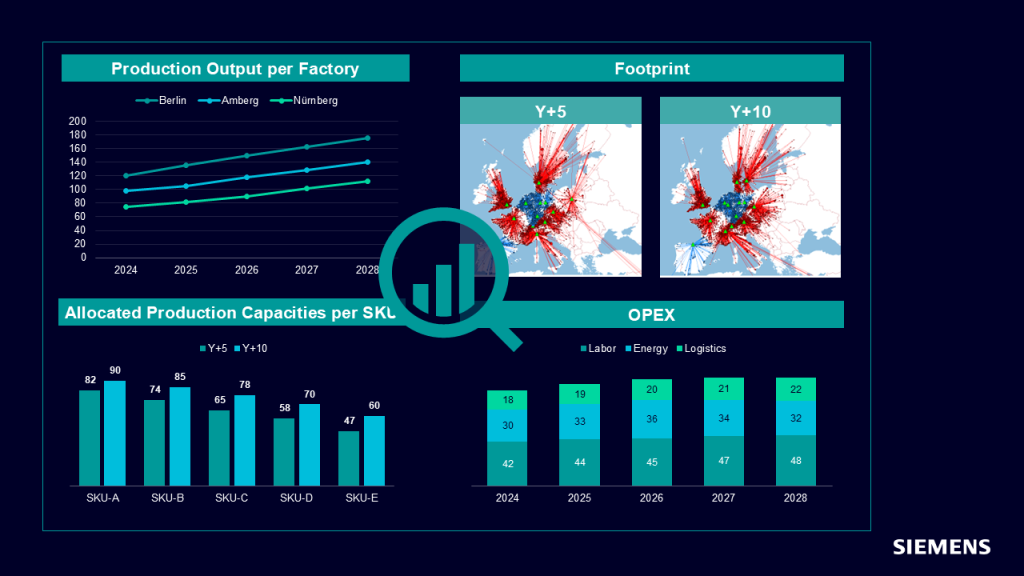
The results were substantial. The optimal future network design promised operational cost reductions of up to 8%. Additionally, optimizing their current setup identified immediate quick wins that delivered 5% savings.
📈 Case Study Impact at a Glance
Through Network Flow Optimization and digital simulation, a recent manufacturing client achieved:
- Up to 8% projected operational cost reductions in their future 5-to-10 year network design.
- 5% immediate savings identified through quick-win optimizations of their current setup.
The path forward: Operating as One Tech Company
The imperative to transform manufacturing networks is permanent. Continuous, data-driven monitoring and adaptation have become essential for modern organizations. Looking ahead, current co-pilot-style assistance tools are expected to evolve into agentic solutions, allowing supply chain experts to focus primarily on orchestrating and validating AI agents.
Mastering these challenges requires more than isolated software tools—it requires a partner capable of bridging the digital and the physical worlds. By operating as one tech company, Siemens seamlessly connects strategic supply chain planning (IT) with real-world shop-floor execution (OT). This integrated approach enables organizations to cultivate a dynamic, data-driven environment, turning operational complexity into a sustainable competitive advantage.
Missed part One? Catch up here: Manufacturing Network Design: Moving Beyond the Black Box

Head of Consulting
Siemens Digital Logistics
Ready to rethink your manufacturing network? Reach out to Martin Schindler, Head of Consulting at Siemens Digital Logistics, to start the conversation.