Manufacturing Network Design: Moving Beyond the Black Box

Manufacturing Network Design (MND), optimized for efficiency in stable environments proved very vulnerable when stability disappeared. The global supply chain disruptions that occurred more frequently in recent years didn’t just inconvenience businesses—they fundamentally exposed the fragility of traditional manufacturing networks.
In an era defined by geopolitical fragmentation, strict sustainability mandates, and unprecedented volatility of supply and demand, manufacturing redesign has evolved. It has shifted from a periodic optimization exercise into a continuous strategic imperative. Today, executives face a critical question: Is it no longer about whether to redesign manufacturing networks, but whether the organization can afford to delay any longer?
💡 What is modern “Manufacturing Network Design” (MND)?
Modern Manufacturing Network Design (MND) goes beyond determining where products should be made. Once a one-off exercise focused on factory locations and transportation, it has evolved into an always-on, data-driven approach to orchestrating manufacturing, sourcing, capacity, product allocation, and logistics decisions across the end-to-end supply chain. Through scenario simulation, digital twins, and advanced analytics, organizations can evaluate trade-offs, compare alternatives, and balance cost, sustainability, resilience, and lead times while adapting to changing market conditions.
The limits of traditional network modeling
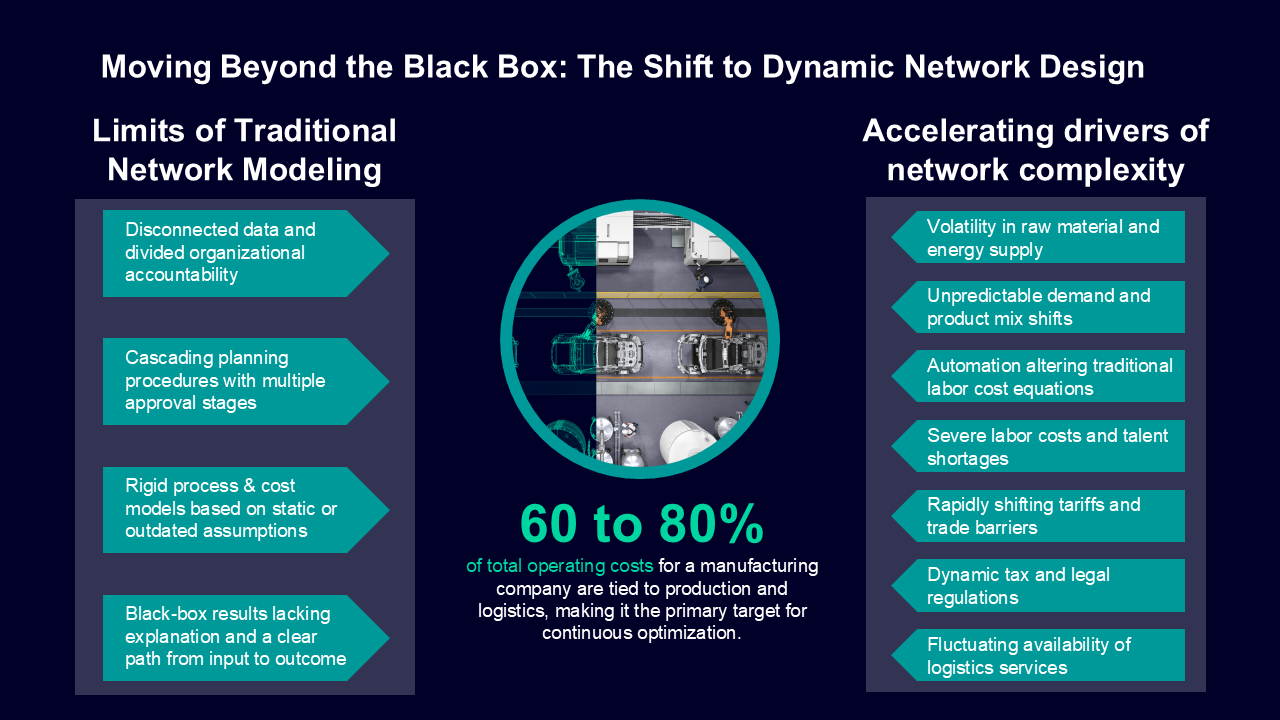
Conventional network design modeling focuses primarily on logistics optimization, such as warehouse locations, transportation modes, and inventory positioning. It treats manufacturing as a black box with fixed capacities and costs.
This traditional approach was designed for a more stable operating environment. However, it often falls short in capturing the dynamic reality of modern manufacturing networks. Production constraints constantly shift due to equipment uptime, labor availability, and material shortages. At the same time, manufacturing costs vary significantly with production volumes and product mix, while lead times directly influence inventory requirements and customer service levels. As supply chains face increasing disruption and demand volatility, organizations need a more dynamic approach that can continuously evaluate these trade-offs and adapt to changing conditions.
The hidden but substantial cost of inaction
It is no surprise that production cost is among the biggest spend categories. It ranges from 25% to 60% of total sales depending on the industry. Add to this logistics costs, which typically represent 10% to 25% of sales. Combined, production and logistics costs represent 60% to 80% of total operating costs for most manufacturers, making them the primary targets for optimization.
However, most organizations continue to operate reactively. Cost-optimization is typically implemented as an ad-hoc measure to meet operational expenditure targets. Companies that treat manufacturing network optimization as an ongoing, “always-on” process perform better. They are more successful in achieving their savings targets compared to those relying on time-limited programs.
📊 The Value of Continuous Optimization
- 60% to 80%: The combined production and logistics costs as a share of total operating costs for most manufacturers, making them the primary targets for optimization.
- 1 to 3 Percentage Points: The potential EBITDA boost for companies that shift from time-limited programs to a proactive, “always-on” network optimization approach.
The 4 strategic imperatives of structured redesign
In our daily work with clients across various industries, we observe four main fields that demand consistent and impactful manufacturing network design:
1. Product-to-Factory Allocation Optimization Strategic SKU placement based on demand volatility, production complexity, and regional market requirements represents a high-impact optimization opportunity. This goes beyond simple capacity matching. It requires analyzing thousands of product-location-customer combinations to identify configurations that balance cost, service, and risk while accounting for production constraints.
2. Strategic Network and Location Planning Modern site selection integrates multiple variables. These include labor costs, proximity to suppliers and customers, infrastructure quality, and the carbon intensity of local energy grids. Driven by the reshoring trend, companies must offset higher inventory and labor costs through automation and scale efficiencies, requiring sophisticated financial modeling of total landed costs.
3. Capacity Adaptation and “Lift-and-Shift” Execution Relocating production lines is extraordinarily complex. Equipment must be decommissioned, transported, reinstalled, and validated, often while maintaining production continuity. Poor planning leads to extended downtime, quality issues, and cost overruns. Structured approaches using digital simulation enable companies to test relocation scenarios virtually before committing resources.
4. Network Rationalization Should you consolidate into mega-facilities for economies of scale, or distribute production for resilience and market proximity? This strategic choice impacts capital deployment, operating costs, and competitive positioning for decades. The answer depends on product characteristics, demand patterns, and supply chain risks, variables that must be modeled holistically.
🔍 Quick Check: Is your network strategy reactive or proactive?
Can your current network design models accurately account for:
- Highly dynamic production constraints (like equipment uptime and labor shortages)?
- Manufacturing costs that vary drastically by volume and product mix?
- The direct impact of production lead times on inventory requirements?
If not, your network is operating as a “black box.”
How can organizations move beyond supply chain visibility to orchestrate end-to-end supply chain decisions and respond effectively to unexpected change? In Part 2 of this series, we will explore how Supply Chain Digital Twins enable continuous trade-off analysis, scenario simulation, and network optimization across the manufacturing ecosystem.