From menu to meal: Cooking up a safer hybrid-electric aircraft faster
Introduction
Imagine planning a big family dinner. You start with the big picture: deciding the menu, balancing flavors, and making sure you have enough ingredients for everyone. That is what engineers call system-level thinking. While this seems a bit of overkill for planning a family dinner, such a structured system-level approach is absolutely vital for complex engineering projects, e.g. hybrid-electric aircraft design – mapping out the architecture, energy flows, and performance targets to ensure everything fits together.
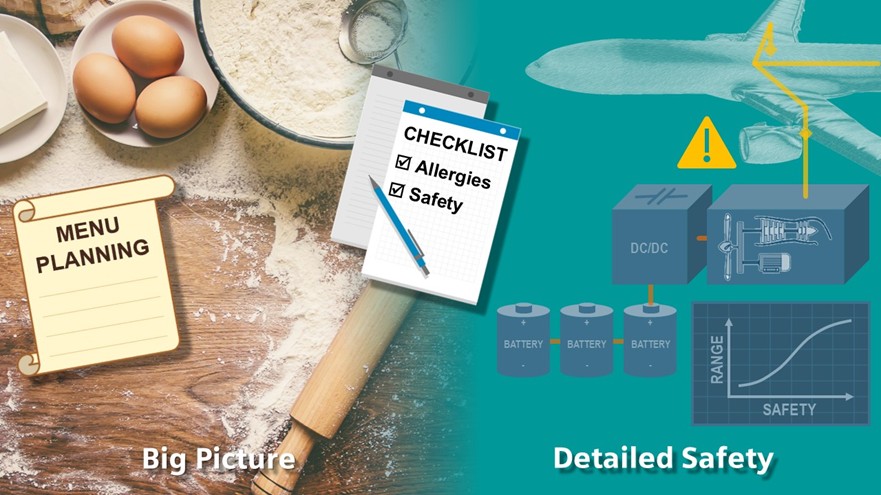
But a great menu isn’t enough. You also need to dive into the details: checking for allergies, ensuring food safety, and planning what happens if the oven fails halfway through. This is your failure-effect simulation – the domain-specific analysis that ensures resilience and safety when things go wrong.
Without connecting these two steps, you risk serving a beautiful meal that nobody can eat – or worse, that causes harm. Similarly, in aircraft design, the big picture gives you efficiency, but the details guarantee safety. The challenge is bridging these worlds so that early conceptual sizing and detailed safety analysis work hand in hand. In this post, we’ll explore why this integration matters and how it can transform the way we design next-generation hybrid-electric aircraft.
From concept to confidence: A multi-fidelity approach for hybrid-electric aircraft
The funded project DIREKT focuses on enabling a digital development process for hybrid-electric propulsion systems. One of the methods developed in the project tackles a fundamental challenge in hybrid-electric aircraft development: how to combine early system-level sizing with detailed safety analysis without slowing down the design process. To truly understand why this integration matters, it helps to look at the underlying technical challenge. In hybrid‑electric aircraft design, engineers must balance two competing objectives from day one:
- Achieving an efficient and lightweight propulsion architecture: minimizing energy consumption, component mass, and thermal load across the mission profile.
- Ensuring that the system remains safe and resilient under realistic failure conditions: for example, maintaining sufficient power after a battery string disconnects, a DC/DC converter degrades, or unexpected thermal limitations occur.
Traditionally, performance optimization and safety assessment are handled in separate phases because they operate at different levels of fidelity. Early sizing uses simplified, fast-running models to evaluate hundreds or thousands of candidate architectures. Detailed safety evaluation, on the other hand, requires high‑fidelity electrical and thermal models that are far too slow to be included in these initial optimization loops. As a result, early designs often ignore critical failure effects – and when safety evaluation finally occurs, it can reveal constraints that force engineers to revisit and rework earlier sizing decisions.
The goal of the multi‑fidelity optimization approach is to break this cycle. By selectively combining low‑fidelity mission-level performance models with high‑fidelity electrical safety models only where they matter, the workflow enables engineers to optimize not just for efficiency, but also for fault tolerance, redundancy requirements, voltage stability, and energy availability under failure scenarios. In other words, the method helps identify propulsion architectures that are not only light and efficient, but also robust enough to meet certification-level safety expectations – all during the earliest design iterations. The proposed approach shifts this paradigm by bringing safety considerations into the earliest design loops through an integrated simulation and optimization workflow implemented in Simcenter HEEDS.
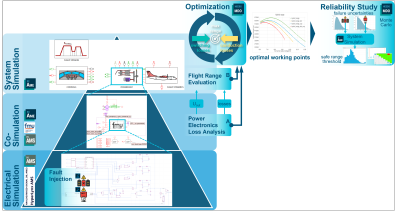
At the heart of this approach is a multi-fidelity simulation strategy. A system-level Simcenter Amesim model captures the aircraft mission profile, flight dynamics, and electric propulsion system behavior, while a detailed HyperLynx AMS model represents the electric power supply, including three redundant batteries and a DC/DC converter. These models are coupled via FMU-based co-simulation (Functional Mock-up Interface), allowing engineers to precisely study how critical failures such as battery disconnect or capacitor leakage affect overall mission performance. This integrated connection ensures that both efficiency and resilience are evaluated holistically, not in isolated stages.
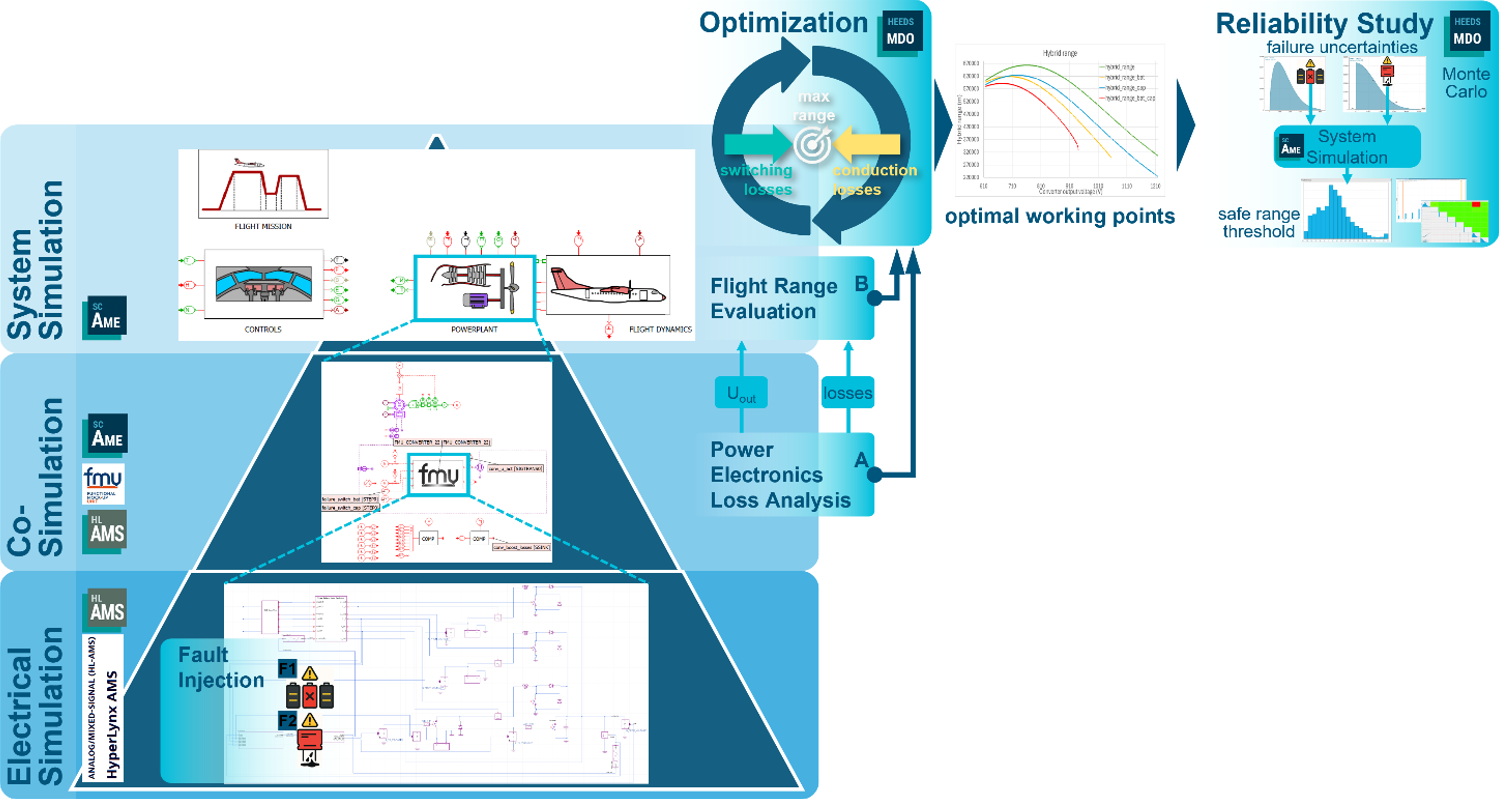
To make this practical, the workflow must effectively handle fault injection, automate design space exploration, and deliver results fast enough for iterative design. Simcenter HEEDS provides all the necessary ingredients to achieve this efficiency. The simulation workflow is orchestrated through a two-stage optimization process. In the first stage (A), high-fidelity co-simulation evaluates converter losses and voltage behavior under fault scenarios. In the second stage (B), system-level simulation estimates flight range using surrogate models fed with results from the first stage. This decoupling achieves accuracy without sacrificing speed, allowing hundreds of design variants to be explored across normal and faulty conditions. Furthermore, enabling cloud-based parallel execution in the project significantly accelerates the process – up to about 5 times faster than sequential execution with 8-way evaluation concurrency. In the sequential workflow, each design variant is evaluated one after another, meaning only a single configuration is processed at any given time. In contrast, parallel execution distributes multiple design evaluations across cloud resources simultaneously, allowing several configurations to be analyzed in parallel and dramatically accelerating the exploration process. Simcenter HEEDS’ powerful API and flexible architecture thus facilitates the seamless integration of complex analysis workflows, including custom FMU-based co-simulation, at scale.
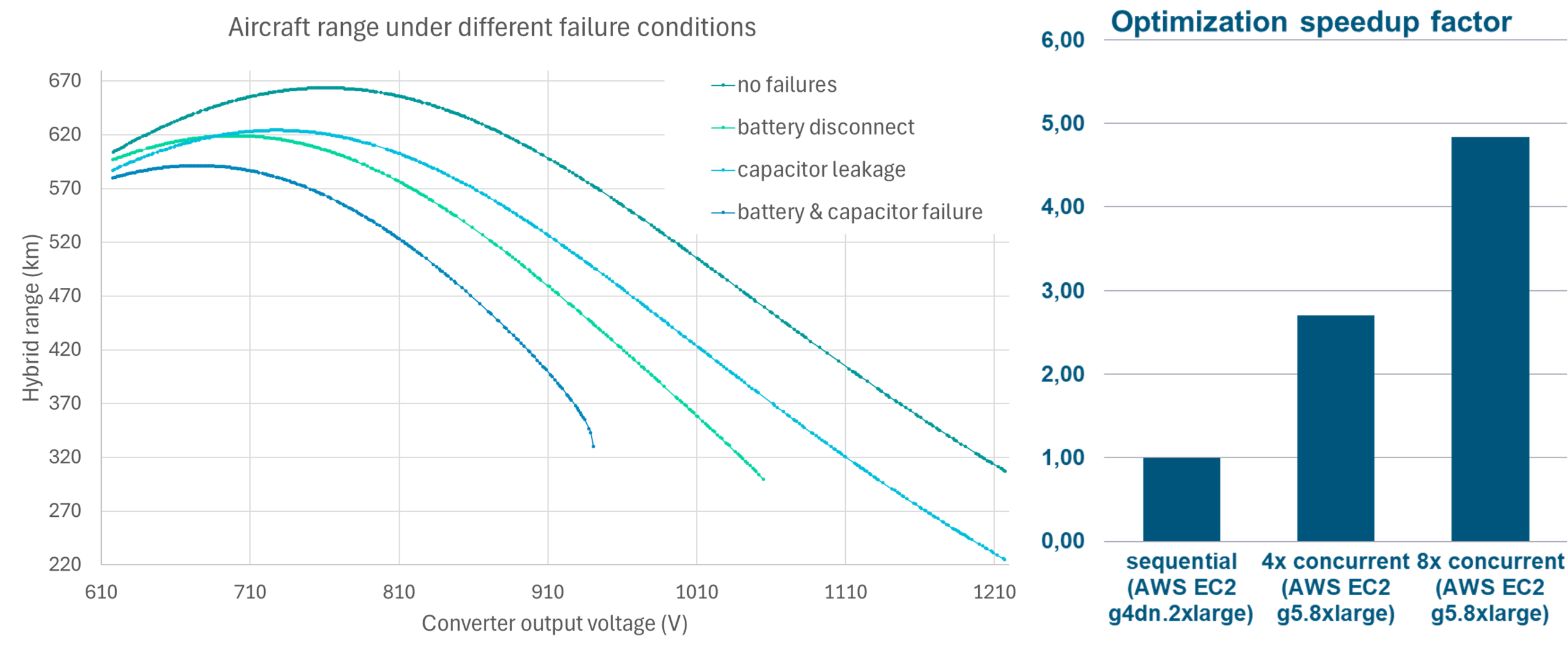
The results speak for themselves. By tuning the DC/DC converter output voltage, the workflow maximized hybrid flight range while accounting for failures. Optimal voltage shifted from about 762 V in the nominal case to around 674 V under combined faults, and losses increased by up to 60 percent in worst-case scenarios – insights that would be missed without fault-aware optimization. To quantify robustness, a Monte Carlo reliability study introduced probabilistic fault injection based on Weibull and exponential distributions for battery and capacitor failures. The analysis revealed only a 0,7 percent chance that the flight range would fall below the safe threshold of 320 km, thereby confirming strong fault tolerance. These vital findings directly inform safety processes like FMEA (Failure Mode and Effect Analysis) and FTA (Fault Tree Analysis), effectively bridging the gap between initial design and streamlined certification.
Conclusion: Bringing it all together
Designing a hybrid-electric aircraft isn’t just about creating an elegant concept – it’s about ensuring that concept works safely under real-world conditions. Just like planning a family dinner, the menu (system-level sizing) sets the stage, but the details – checking allergies, planning for oven failures – make the big family dinner a guaranteed success.
In the same way, combining early conceptual design with domain-specific failure-effect simulation allows us to shift safety analysis left without sacrificing accuracy. Projects like DIREKT exemplify how this integration can optimize performance and resilience, whether it’s adjusting DC-DC converter voltages under battery disconnects or handling capacitor leakage.
The recipe for success, and indeed, the art of the possible in modern aerospace engineering? A unified workflow that seamlessly blends design optimization and safety analysis, component details and overall flight mission, powered by tools like Simcenter HEEDS, so engineers can explore, validate, and innovate confidently. Because in aircraft design – just like in cooking – the big picture matters, but the details keep everyone safe.
Acknowledgement: This research was funded by the German Federal Ministry for Economic Affairs and Energy (BMWE) under the research project DIREKT, grant number 20L2108D2.
Disclaimer
This is a research exploration by the Simcenter Technology Innovation team. Our mission: to explore new technologies, to seek out new applications for simulation, and boldly demonstrate the art of the possible where no one has gone before. Therefore, this blog represents only potential product innovations and does not constitute a commitment for delivery. Questions? Contact us at Simcenter_ti.sisw@siemens.com.