“Just reduce it” – Predict nonlinear structural mechanics accurately and efficiently

This blogpost presents innovative parametric model order reduction (pMOR) methods, which provide both efficient and accurate predictions of nonlinear structural mechanics behavior of complex industrial products, in aviation, automotive sector and beyond. This research originates from a Baekeland PhD research project1 at Siemens Digital Industries Software and KU Leuven, supported by the Flanders Innovation & Entrepreneurship Agency (VLAIO).
1. The challenge of accurate prediction in a feasible time
Complexity in today’s industry is rapidly increasing. Modern industrial design engineering aims to deliver mass-customization of smart complex products, which must also meet constraints on sustainability, safety and shorter time-to-market. Complex structural systems should be safe2, reliable and efficient, supporting our everyday lives; this is valid not only for aircraft and cars, but also for energy sector, maritime sector, consumer products, etc. To make this possible, engineers must rapidly evaluate thousands of design variations across multi-physics domains before physical prototyping begins.
Fast innovation is ongoing and progressing to meet this engineering demand, with new methods being deployed in industry. Next to new production techniques as additive manufacturing, this includes virtual commissioning powered by real-time digital twins to virtually design, manufacture and operate complex industrial systems. Artificial Intelligence and Machine Learning (AI/ML) further increase the capabilities, with generative design3 and efficient surrogate modelling4, with the note that black-box models may be hard to interpret physically and may not have safety guarantees.
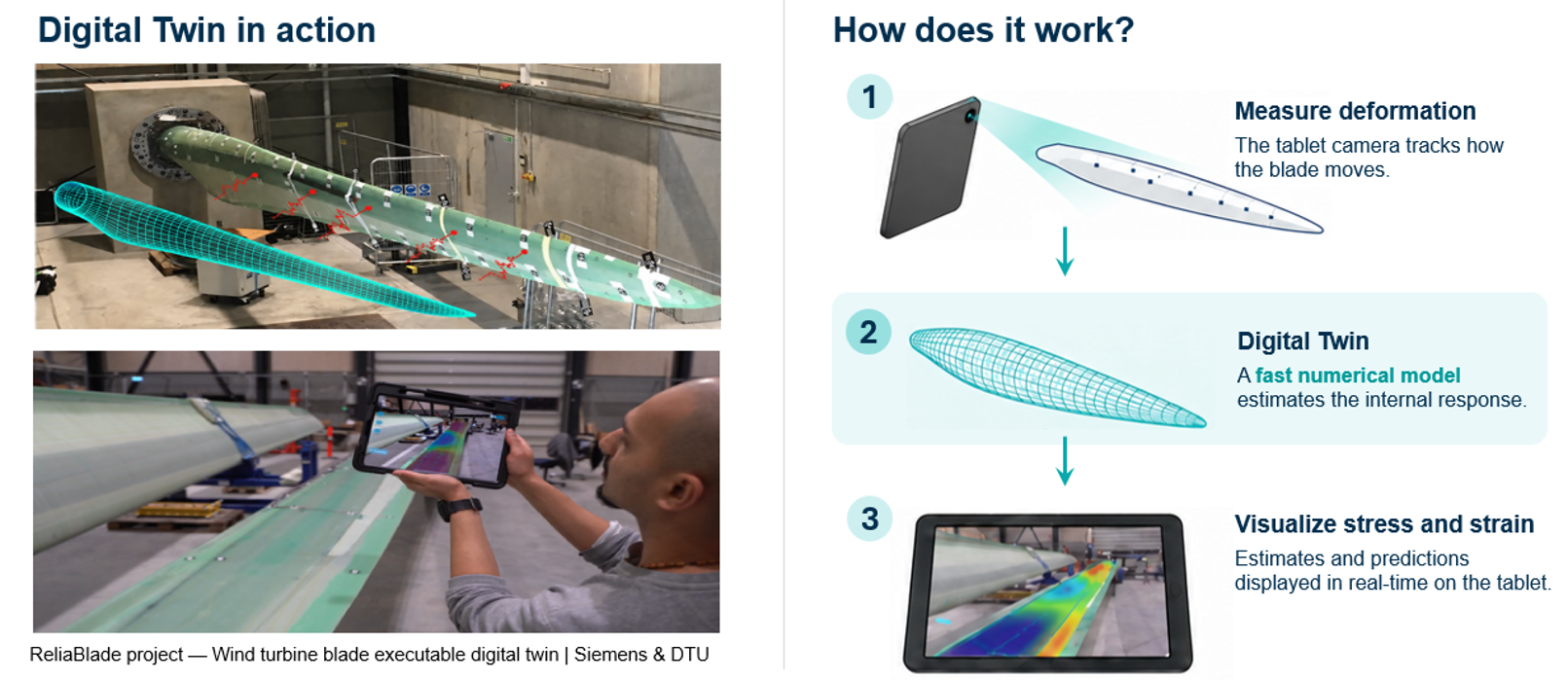
Figure 1 shows the digital twin of a wind turbine blade5 in action: deformation is measured with a tablet; a fast numerical model is used to estimate the internal response; these internal responses (stress and strain) are finally visualized on the tablet. In this digital twin setup, the typical bottleneck is the calculation time of the full order model (FOM) that is used to represent the blades and calculate its behavior.
Indeed, we can already simulate and optimize many standard engineering tasks on computers, but running huge simulations still can take long time, so that doing real-time design engineering is still on a future ‘wish list’ for the future. There’s still need for more efficient reduced order models (ROM) that are sufficiently accurate to model/predict the reality of the smart and complex industrial system they represent. Each of the two main solution families has its benefits and limitations:
- Physics-based ROMs: (+) preserve physical properties but (-) require intrusive solver-level access (to internal forces, operators, element contributions), which may not always be possible in industrial applications.
- Purely data-driven ROMs: (-) no inherent physical guarantees, but (+) non-intrusive as they only rely on data.
It would be great to combine the advantages of both solution families! That has precisely been the aim of this research work. An innovative approach is adopted to create structural digital twins with an innovative approach to achieve high reduction while preserving accuracy1.
2. Solution strategy – A parallel with image compression!
Let’s first look into another application domain: image compression, which will serve to visually explain the challenge and some key concepts adopted in this work.
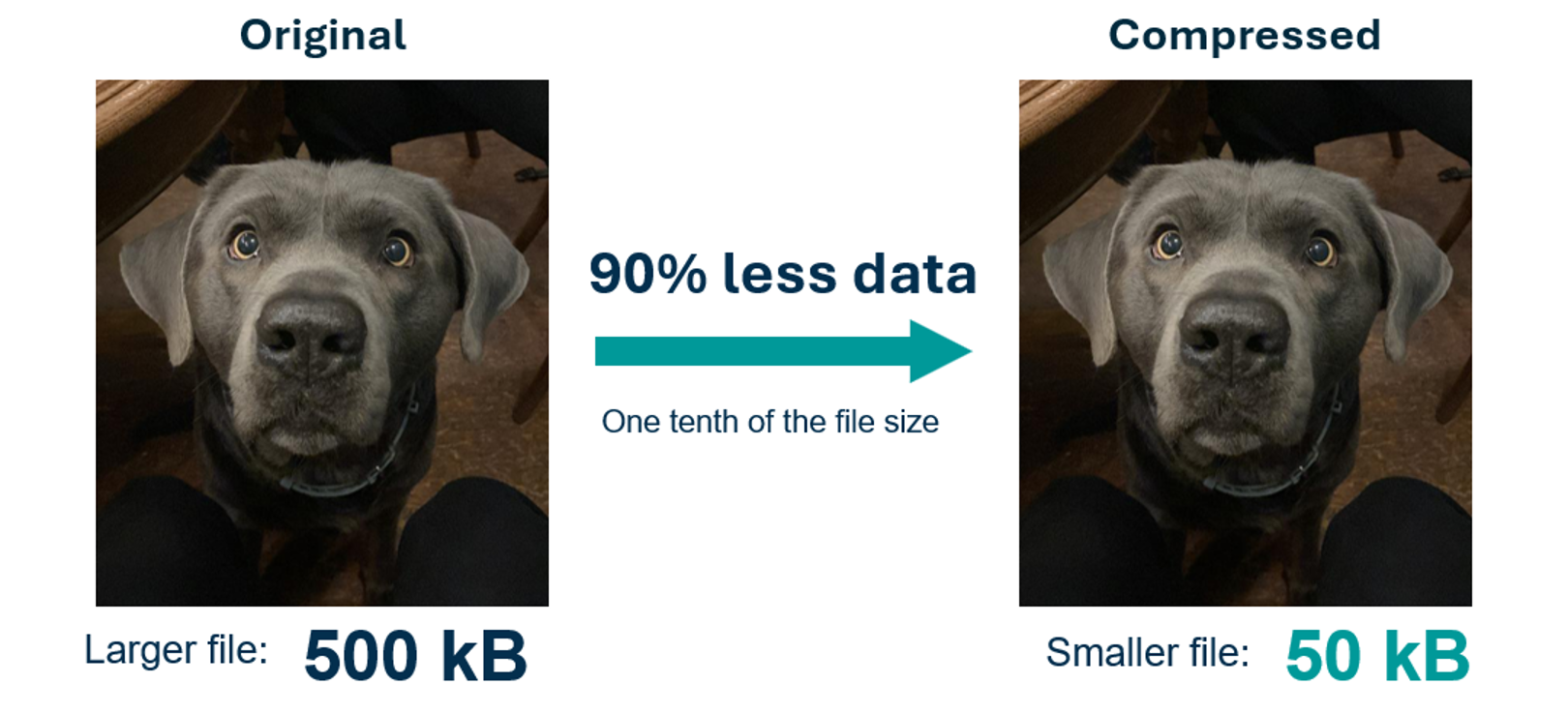
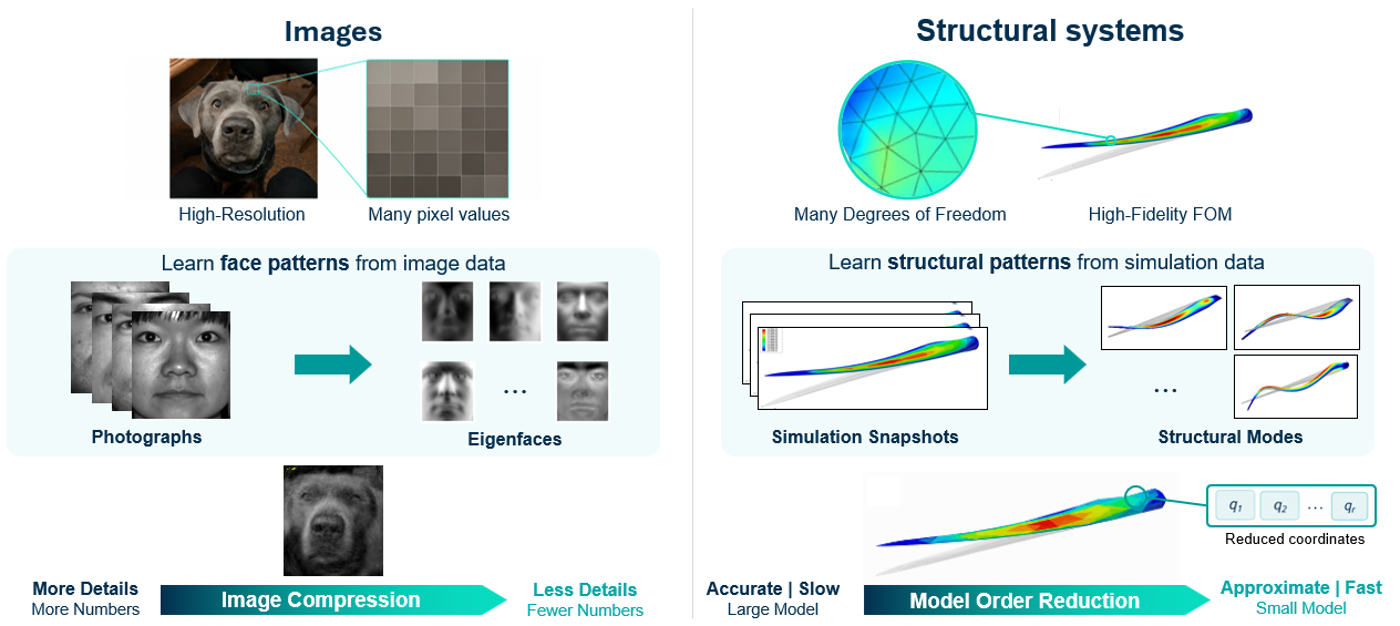
We are all familiar with image compression and its value in daily life. A larger original photo will take a longer time to digitally send and may involve a higher cost. Luckily, you can “Just compress it” to get a small photo file that is easier, faster and cheaper to send. Figure 2 shows that you can compress an image significantly, while maintaining the image accuracy: the dog face remains recognizable even with significant image compression, so that you can easily share it with family and friends.
And indeed, “a picture is worth a thousand words”, as a picture can express complex ideas, stories and emotions much more effectively than any long text could do. After significant image compression, the compressed picture may still add up to hundred(s of) words, so that it can be easily understood.
As humans we do not think and interpret in terms of pixels, but recognize patterns and key features in a picture, to recognize and interpret it. Patterns are everywhere in natural systems, from the sun, the earth’s atmosphere and clouds, in collective motion of animals and humans, in chemical reactions etc. These patterns can be exploited to give a more compact representation of an image, such that the structures that matter are revealed, and the key patterns can be understood.
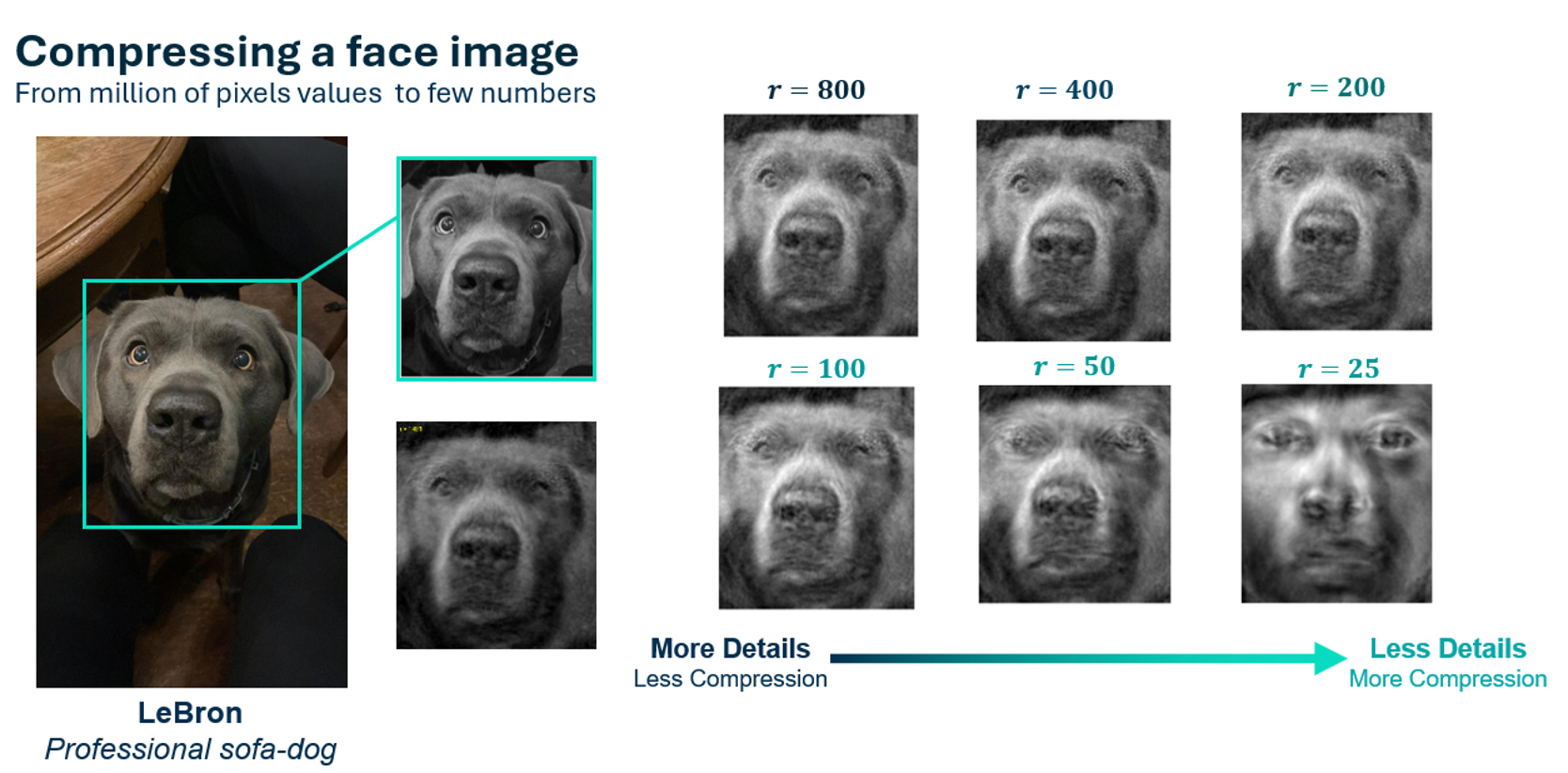
This principle is exploited by compression techniques based on Singular Value Decomposition (SVD), which identifies the dominant patterns within a collection of images. A well-known example is the Eigenfaces method, illustrated by Brunton and Kutz6, where each image is represented as a linear combination of a limited number of dominant patterns, commonly referred to as eigenfaces. Originally developed for human face recognition, these same patterns can also be used to approximate images of other subjects, such as the dog shown in Figure 3, following the Eigenfaces Example presented and discussed by Brunton and Kutz in (Section 1.6 of) reference6.
Instead of storing every pixel independently, an image can therefore be represented by only (r) coefficients describing the contribution of each retained pattern. For instance, assuming an original grayscale image of (1000 x 1000) pixels, retaining (r=100) coefficients reduces the representation from one-million-pixel values to just 100 numbers, corresponding to a nominal compression ratio of 10,000:1. As illustrated in Figure 3, increasing the number of retained patterns improves reconstruction quality, while fewer patterns provide greater compression at the expense of image details.
3. Structural system: “Just reduce it” into reliable and accurate digital twin
Figure 4 shows that the key concepts for image compression can also be used for MOR in structural systems, towards structural digital twins, which is the focus of this work. Indeed, you can exploit structural patterns from simulation data to create efficient and accurate structural digital twins. If you have a complex model, “Just reduce it” and predict the nonlinear structural mechanics accurately and efficiently.
This work adopts a nonlinear parametric Model Order Reduction (pMOR) approach, developing robust ROMs that maintain fidelity across varying physical parameters in real time. A methodological framework has been developed to address the complexity of structural systems encountered in industrial and everyday applications. The following aspects are considered:
- Parameterization: Known material parameters with deterministic values.
- Nonlinearities: Geometric nonlinearities and nonlinear hyperelastic material behavior (e.g., Neo-Hookean).
- Conservative structural response: Internal forces derived from an energy potential.
The proposed methodology, named POD–pICNN, combines Proper Orthogonal Decomposition (POD) for dimensionality reduction with a novel physics-augmented neural network, the parametric Input Convex Neural Network (pICNN), to learn the reduced nonlinear structural behavior. Rooted in Scientific Machine Learning (SciML), the approach combines data-driven learning from simulation data with the hard enforcement of physical constraints by construction, delivering a physics-preserving ROM that is both non-intrusive and physically consistent. Further methodological details and numerical results are available in the paper7 and the PhD thesis1.
4. Results for structural benchmarks
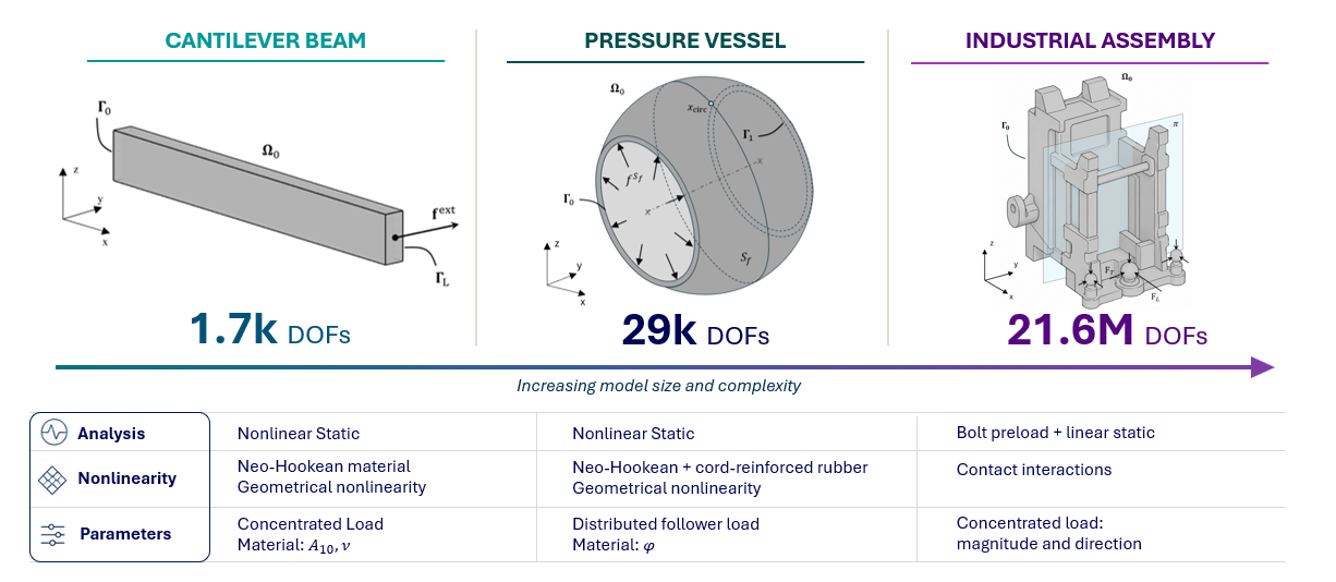
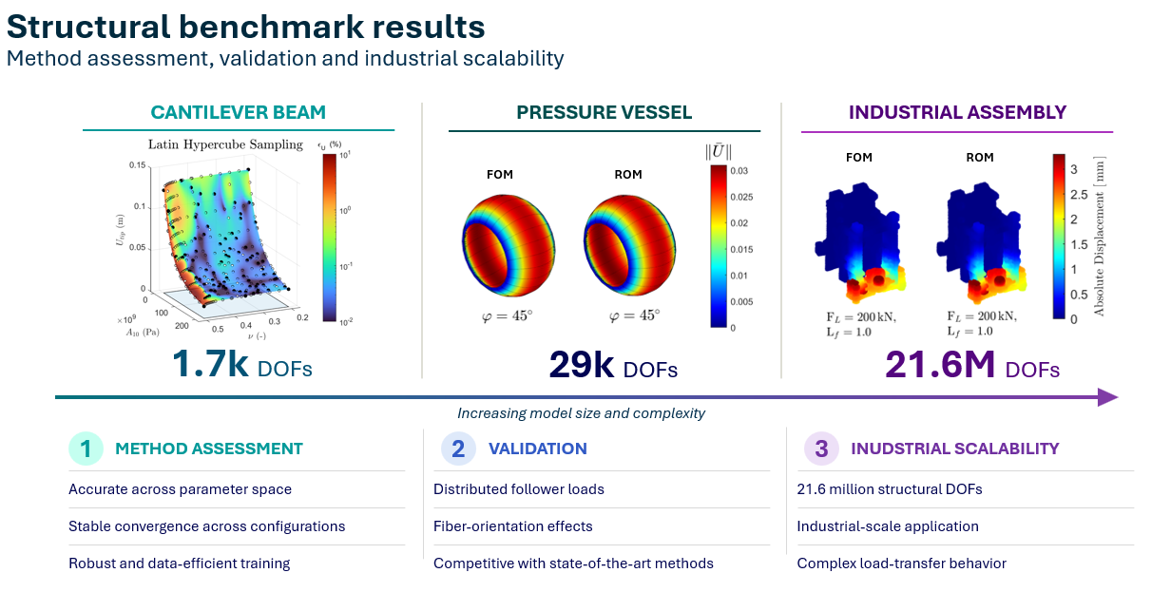
The methodology formulation has been researched and developed for static and dynamic systems. The numerical validation has been performed on static benchmarks. Figure 5 shows the structural benchmark models, ranging from academic examples to industrial scale structures. Figure 6 presents the results obtained for the three structural benchmarks, demonstrating the accuracy, robustness, and scalability of the proposed methodology:
- The cantilever beam benchmark was used to systematically assess the method across different loading and material configurations, demonstrating accurate predictions throughout the parameter space, stable convergence, and robust, data-efficient training.
- The pressure vessel benchmark provided further validation under more complex nonlinear conditions, including distributed follower loads and fiber-reinforced hyperelastic material behavior, showing good agreement between the FOM and the ROM, with accuracy competitive with state-of-the-art approaches.
- Finally, the industrial assembly benchmark allowed demonstrating the scalability of the methodology to a large-scale structural model with 21.6 million degrees of freedom, accurately reproducing the displacement field and complex load-transfer behavior.
Together, the results in Figure 6 demonstrate the potential of the proposed methodology framework to deliver accurate and computationally efficient reduced-order representations of nonlinear structural systems, from academic benchmarks to industrial-scale applications.
Further numerical validation results are available in the paper7 and the PhD thesis1. The methodology framework has been shown to meet the objectives, by delivering reliable and efficient structural digital twins up to industrial-scale structures.
Conclusion and outlook
The challenge of developing efficient yet accurate ROMs for industrial structural systems has been addressed through the proposed POD–pICNN methodology, combining non-intrusive MOR with physics-preserving SciML. The resulting framework has demonstrated its accuracy, robustness, and applicability across structural benchmarks ranging from academic examples to industrial-scale structures. These results represent an important step forward, demonstrating that even for a complex industrial structural system, you can “Just reduce it” to obtain reliable, accurate, and efficient structural digital twins for industrial engineering applications.
Future work will focus on the further industrialization of the POD–pICNN framework, with potential integration into the Simcenter portfolio8. Further research directions include extending the methodology to dissipative and history-dependent material behavior, improving parametric scalability through adaptive sampling strategies, and integrating the proposed ROMs into nonlinear structural state estimation frameworks, enabling the estimation of structural states from limited measurement data. Additional research perspectives are discussed in the PhD thesis1.
Acknowledgements
The research work leading to this publication has been performed by Dr. Davide Fleres in the frame of the project “PHANTOM – Parametric Hybrid AI-based Nonlinear Thermomechanical reduced Order Modeling” which is a Baekeland mandate supported by VLAIO (Flemish government agency Flanders Innovation & Entrepreneurship), with project number HBC.2021.0812, at Siemens and KU Leuven.
A Baekeland PhD mandate provides individual researchers the opportunity to carry out a PhD in close cooperation with the business / industrial sector. Siemens has a close partnership with KU Leuven already for decades, which has seen academic researchers and students work alongside Siemens engineers on multiple important research projects.
In 2024, Siemens donated a Chair for Digital Twins for Smart and Sustainable Products9,10 to further support research and innovation at KU Leuven. “This is really important as it gives us a base funding to support the collaborative research we carry out,” says Professor Frank Naets, chairholder, KU Leuven Department of Mechanical Engineering.
“With this Chair, we can further strengthen the ecosystem around developing and using Digital Twin in the manufacturing industry. Through these Digital Twin technologies, we can ensure that mechatronic products are designed, deployed, and managed more effectively“.
References
- Davide Fleres, Physics-Preserving Non-Intrusive Model Order Reduction for Nonlinear Structural Mechanics, PhD Thesis, KU Leuven, Lirias, October 2026. ↩︎
- Roberta Cumbo, Daniel De Gregoriis, Abhishek Kumar and Frank Naets, Accurate virtual sensing for complex aviation structures, Simcenter Blog, September 15, 2025. ↩︎
- Robin Bornoff, Dirk Hartmann, Generative Engineering and the role of simulation, The Art of the Possible, November 10, 2023. ↩︎
- Adrien Scheuer, Onur Atak, Stijn Donders, ML for Industrial CAE – “Just scale it”, The Art of the Possible, April 7, 2026. ↩︎
- Silvia Vettori, Wind turbine blade xDT wins JEC Award 2024 – Digital, AI & Data Category, Simcenter Blog, August 27, 2024. ↩︎
- Brunton, S. L., & Kutz, J. N. Data-Driven Science and Engineering: Machine Learning, Dynamical Systems, and Control. DataBookV2, Cambridge University Press, 2019. ↩︎
- Davide Fleres, Daniel De Gregoriis, Onur Atak and Frank Naets: Non-intrusive parametric hyper-reduction for nonlinear structural finite element formulations, Computer Methods in Applied Mechanics and Engineering 434 (2026), 117532. ↩︎
- Siemens Digital Industries Software, Simcenter, Retrieved 2026. ↩︎
- Siemens Digital Industries Software, Siemens and KU Leuven collaborate to research Digital Twin for Smart and Sustainable Products, Press Release, June 11, 2024. ↩︎
- KU Leuven, Siemens Chair Digital Twin for Smart and Sustainable Products, KU Leuven website, Retrieved 2026. ↩︎