Why Industrial AI Is Rising Now
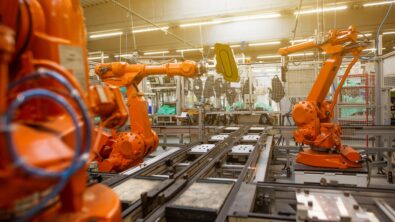
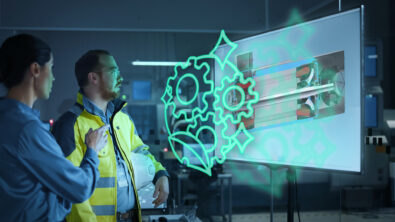
Artificial intelligence isn’t new. What is new is the speed and scale at which AI is transforming every corner of industry. While consumer AI has captured public attention, behind the scenes a more consequential shift is happening across manufacturing, engineering, and operations: the rise of Industrial AI.
In a recent podcast, host Conor Pieck is joined by guests Matthias Loskyll, Senior Director of AI and Robotics at Siemens Digital Industries and Samir Desai, Senior Director and Global Program Head for Data and AI at Siemens Digital Industries to answer the questions of what is Industrial AI and why is it coming to the fore now.
The right time for change
Industrial companies have always been under pressure to deliver high‑quality products efficiently and at low cost. On top of existing challenges, today’s manufacturers face persistent labor shortages, ongoing supply‑chain volatility, and an explosion in product variants driven by customization and global competition. At the same time, engineering and production cycles are expected to move faster than ever.
At the same time, technology has continued to advance with complex AI algorithms backed by next generation hardware that allows for automation in a way that was impossible before. This convergence has created a tipping point, with new challenges being addressed by new and emerging technologies. Traditional automation and incremental optimization are no longer enough. Industrial AI has emerged as a way to not only address these challenges but, improve resilience, and help organizations adapt to disruption without sacrificing quality or reliability.
Industrial AI is not consumer AI in a factory
Much of the public conversation around AI is shaped by consumer tools that work with text, images, and video but, while these modalities exist within an industrial setting, the broader context and even the content itself are drastically different, Samir explains.
Engineering and manufacturing rely on highly specialized, deeply structured data, including CAD models, simulations, electrical schematics, production parameters, and operational telemetry. This data is often fragmented across different systems and must be interpreted in precise, domain‑specific ways that rely on knowledge of everything from physics to engineering to PLC programming.
As a result, Industrial AI requires models that understand the language of engineering and manufacturing, not the language of the internet. This has necessitated the need to develop industrial foundation models designed specifically for complex industrial data, enabling AI capabilities that can support design, simulation, production planning and operations in ways consumer AI simply cannot. While at the same time, supporting systems are put in place to ensure data is accessible for both training and inference to these Industrial AI models. This is the key to differentiating between AI and Industrial AI, rather than being trained on the sum total of all human knowledge, it is far more important that the models be trained to understand specific industrial data and context, and how that is then applied to real-world problems.
The importance of reliable results
Perhaps the most important distinction of Industrial AI is what’s at stake. In consumer applications, an incorrect AI response might be inconvenient or amusing but in industrial environments, a wrong prediction or uncontrolled action can shut down a production line, damage expensive equipment, or create serious safety risks.
Industrial AI often operates in the physical world either directly, by interacting with machines, factories, and safety‑critical systems or indirectly by advising users on real-world scenarios. This demands a level of reliability, transparency, and predictability that goes far beyond typical AI use cases.
To meet these requirements, Industrial AI must be deployed with the right guardrails Matthias explains — combining AI’s predictive and generative strengths with deterministic, rule‑based systems and safeguards that engineers trust. The goal is not autonomy at all costs, but controlled intelligence that enhances human decision‑making while maintaining safety and compliance.
The rise of Industrial AI isn’t about chasing trends, rather, it is about embracing new technology to tackle real problems. As pressures continue to mount, organizations that successfully integrate AI into their engineering and operational workflows will be better positioned to compete, adapt, and grow.
Industrial AI represents the next phase of digital transformation: one grounded in domain expertise, built for trust, and designed to operate where the consequences truly matter.
To learn more, check out the full podcast here.
Siemens Digital Industries Software helps organizations of all sizes digitally transform using software, hardware and services from the Siemens Xcelerator business platform. Siemens’ software and the comprehensive digital twin enable companies to optimize their design, engineering and manufacturing processes to turn today’s ideas into the sustainable products of the future. From chips to entire systems, from product to process, across all industries. Siemens Digital Industries Software – Accelerating transformation.