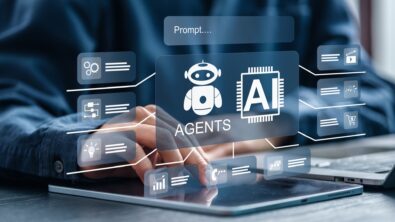
Understanding Agentic AI

Generative AI has taken the world by storm over the last several years, changing the way people do everything from use software to access information but these applications of AI are best described as reactive – a user prompts them for something, and they respond. In many ways though, the idea of artificial intelligence is one of autonomy, software that can replicate a humans ability to respond to and reason through a task or problem without the need to prompt it every step of the way. This type of complex, multi-step problem solving is where AI agents or agentic AI come into play.
What is an AI agent?
Agentic AI builds upon the base that are large language models (LLMs) to go beyond a system that just reacts to user input to one that actively or even proactively engages with tasks and problems. AI agents function using a four-step process:
- Perceive: AI agents collect information from a variety of sources, such as vector databases or shop floor sensors to identify relevant information.
- Reason: An LLM sits at the core of an AI agent, acting as a reasoning engine that orchestrating data retrieval and actions, generates solutions and calls on specialized models and tools.
- Act: Once a solution is found, the LLM can connect to external tools and software to implement its solution, this step also includes guardrails to ensure the models actions fall within expected and appropriate bounds.
- Learn: Using the solutions generated from past problems, the AI agent can be finetuned to keep learning and enhance its ability to complete the tasks it’s assigned.
These four steps, combined, are what form an AI agent, allowing AI to seamlessly tackle more complex problems from a user or even monitor one of its inputs for changes then automatically work toward a solution – no human input required. For very complex tasks spanning multiple disciplines or tool chains, multiple AI agents could even be orchestrated to work in in concert, further increasing their capabilities.
Applying virtual agents to real problems
Compared to just applying generative AI, agentic AI has a far greater breadth of potential applications, especially in an industrial setting. Take, for example, a machine experiencing a problem in a factory. After being notified of a problem through a dashboard, a technician using a generative AI assistant, in this case an Industrial Copilot, could quickly identify the problem by prompting a chatbot with error codes or problem descriptions, followed by receiving stored information on likely diagnosis and relevant repair documentation. By comparison, a monitoring and maintenance AI agent would notice the error state by connecting directly to the dashboard, automatically access relevant documentation and sensor data to diagnose the problem, then generate a solution before creating a ticket to have the machine repaired while providing the detailed set of repair instructions.
In the above example, while the final result is the same, the amount of manual effort required is reduced to simply repairing the problem while monitoring, diagnosing and developing a repair procedure are all completely automated. This is just one example of what agentic AI is capable of but emblematic of its capabilities as a whole, which is an autonomous system capable of proactively addressing complex, multi-step problems.
As the agentic AI platform continues to develop, more and more tools and systems will be accessible through intuitive natural language interfaces, both reducing the learning curve for new users and enhancing the capabilities of experienced ones. Agentic AI builds a powerful new framework around LLM technology, helping it to expand beyond natural language processing with enhanced data handling, tool calling and reasoning capabilities.
It is still early days for AI agents but they already show significant promise when it comes tackling complex tasks and reaching the goal of autonomous artificial intelligence. Going forward, agentic AI systems will be a key technology companies must adopt to not only improve the productivity of their workforce but achieve the dream of the true digital enterprise.
Siemens Digital Industries Software helps organizations of all sizes digitally transform using software, hardware and services from the Siemens Xcelerator business platform. Siemens’ software and the comprehensive digital twin enable companies to optimize their design, engineering and manufacturing processes to turn today’s ideas into the sustainable products of the future. From chips to entire systems, from product to process, across all industries. Siemens Digital Industries Software – Accelerating transformation.