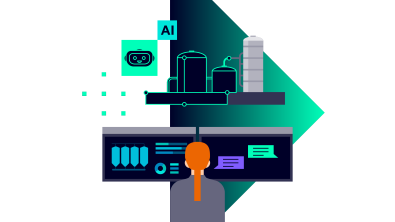
Industrial operations are growing fast with software
Running a factory from day to day, from outside the industry, can seem like the most mundane part of production and manufacturing. So much of what people know comes down to the costs they see or maybe the regulations established around certain materials. But making production smooth is not trivial and the growing pressures from customers and competition are not making it easier. This is in part why the market for operational software – what keeps shop floors effective – is expecting to double in the next five years from $30 billion (or about €13 billion).
To dive into this market shift, we sat down with Mark Hindsbo – Head of Operations Software at Siemens – for the Future-Ready Podcast. Together, we walk through the growing need for flexibility on the shop floor, how businesses should approach software solutions as a means to tackle increased complexity and where these digital solutions fit into the wider production environment. You can listen to the full conversation below or keep reading to get some of the highlights from our discussion.
The market for operational software is not doubling because of what we offer at Siemens, it is doubling because of what our customers and other players in the industry are starting to encounter on the shop floor. That might be continuous process companies starting to spot batch manufacturing as a means of flexibility or manufacturers looking to optimize material flows through a floor with autonomous guided vehicles between stationary units. Businesses could be looking to integrate sustainability requirements into operations to meet regulation. Or a manufacturer might be trying to scale operations into a new region to align with near shoring initiatives around the world. All of them are looking at software as at least a part of how they meet these needs and balance them.
Not every shop floor or business is at the same stage on their journeys and it is extremely important to recognize that very few implementations will be a moonshot, encompassing everything. Instead, implementation and scaling should be done pragmatically and incrementally. This skew towards seeing the biggest solutions as the only option is not new, and how we explain the history of revolutions does little to lessen the impulse. But as with the industrial revolutions and the rise of the internet, no one woke up to a new world completely changed. It happened over time. Even we don’t have everything implemented in our factories, we’ve built out as it has made sense. We do have goals of what we want to achieve and we are constantly building towards them, adding new goals along the way. But once something is built in and deployed, it can be learned from and scaled even faster.
Software is often the realm of the virtual. And it can be great for understanding how a system might run without investing in the capital expenditures right away. But a big value when we talk about the increasing amount of software in operations is connecting the digital world to the real world. It is incredibly important in an industry making physical goods. We might be a big player in software for industry, but we’ve also been making the parts that make manufacturing possible – with PLCs, power equipment and motors. Being able to talk across both and working on making both talk to each other is our unique strength. We know industrial equipment needs to have a failover condition take over in milliseconds. We’ve worked with customers around meeting regulatory requirements for products like pharmaceuticals. We learn at every chance we get. And when something is beyond our expertise, we partner with the businesses that can help deliver.
There was so much more in our conversation with Mark, like example cases for AI co-pilots for operations and how to become proactive with data from the shop floor. We are always uploading new conversations to the Future-Ready Podcast, from conversations like these with Mark and talking about the automation side of production with Rainer Brehm or broader discussions around AI. There are even some deep dives on specific industries, like pharmaceuticals which can be a great way to learn about what other businesses are doing on their digitalization journey.