How to secure Life Sciences without hindering user experiences – Transcript
To read the podcast show notes on how to secure Life Sciences, click here.
John Nixon: Well hello, and welcome to this episode of the Industry Forward Podcast! On this program we explore the key trends, transformative technologies and real-world innovations that are reshaping fields from aerospace to energy and beyond.
You can call me “the host,” or you can call me John Nixon, Global Vice President of Process Industries at Siemens Digital Industries Software. Giggles.
For this discussion, I’ll be speaking to Patrick Ansems, the Global Head of Life Sciences at Siemens Digital Industries Software.
Our talk will focus on the importance of cybersecurity and composable architectures when producing the simulation, digital twin and artificial intelligence (AI) systems that secure Live Sciences technologies.
In [secure Life Sciences], of course, there’s the dual challenge of bringing that digital twin at scale and manufacture, but then also the complementary digital twin of the individual patient.
Now, what comes to mind, there’s kind of an undercurrent of conversation that’s pervasive throughout that. And that’s one of security, patient data, product development data, all that security around it.
I want to share with you some of my thoughts on that. I’d like to get your commentary because this is a critical point. Because in Life Sciences, data security isn’t just an IT issue. As I said, it’s about patient safety and it’s about product integrity. It’s about regulatory compliance. And from a Siemens perspective, the approach is very deliberate and it’s layered.
So first, it’s built on what I call a defense in depth model. Which means security is applied across multiple layers, at the plant, the network, system integrity, rather than relying on it like a single control point.
Second, Siemens aligns to global standards like IEC 62443[1] and ISO 27001,[2] just to name a couple. Which are foundational for protecting both IT and operational technology, OT environments in regulated industries.
And thirdly, there’s really a strong move towards zero trust architectures, you know, where every user, every device and connection is continuously authenticated and monitored rather than, implicitly trusted.
And then importantly, in Life Sciences specifically, you’re [going to] build-in security data handling, audit trails and electronic signatures. So, you’re not just protecting data, you’re ensuring, it’s traceable, compliant and tamper evident. I’ll call it that, right, under FDA requirements.[3]
So, the net of it is, I don’t see security as – having it bolted on is not [going to] work, right? It [must] be embedded across the digital thread. It [must] enable companies to innovate and scale while still maintaining [trust], compliance and [control].
Patrick Ansems: No, I agree, right?
I mean, fundamentally, security is always central to that conversation. As you mentioned, we’re dealing with patient information. That is probably the most sensitive type of information that you can find.
There are all kinds of regulations around … medical devices and pharma that are centric around say the security of information, the exchange of information, all that’s [around that], who has access to pieces of information. So that is something that you need to recognize and acknowledge and have systems and processes in play to make sure that we protect that [highest] level of sensitive clinical, real world or research information.
But I would also [say]: “this is a conversation that’s brought up regularly by customers as well. Is data safer? Is it secure?” I would also say is “not to frame that security as a barrier.” So, good security should enable trust, and it should enable … data protection. Access should be controlled and identity should be managed and lineage should be traceable. And especially when we start thinking about AI, right? We want to make sure that that’s all controlled and [that] has the right access to the right pieces of information. Not every patient or person or model should have access to all pieces of information.
So, for me, it’s all about … balance within the Life Sciences industry. We need to protect patient information, intellectual property, and regulated processes, but still have the ability to innovate. So, my kind of commentary would be on that topic is, “yes, very important key aspect of platforms that we as vendors need to deliver, but we also need to make sure that the security barrier is not hampering innovation.”
So, threading that balance between those two aspects will be extremely important. It is important that we as organizations also work with regulatory bodies like the FDA and the EMEA to kind of also get them on the same bandwagon: That it is about digital a lot more than it was in the past.
So can we also move these types of organizations to accept much more digital information and accept much more simulation-based information. So as a species, we can innovate much quicker but also respect the privacy or the policies in this highly regulated industry.
John Nixion: Absolutely.
And in addition to security concerns that Siemens addresses, we’ve also looked at, as we’ve been discussing here, the environment is becoming ever more digital.
And of course, that’s driven some recent acquisitions and partnerships. we’ve acquired Altair, we’ve acquired Dotmatics, we’ve partnered with NVIDIA. I’d like to share my thoughts with you on that. And again, get your commentary. These aren’t really disconnected moves. I mean, they’re actually very intentional in building an end-to-end capability for [secure Life Sciences].
For example, if you look at Dotmatics, which of course most importantly brought you and I together. That brings us deep, deep into the science. It gives us the ability to manage multimodal R&D data and connect research flows. [It’s] essentially creating a digital thread from discovery through development. That was a huge acquisition for us.
And then when you layer in Altair, which is all about advanced simulation, high-performance computing (HPC) and AI. That then allows us to know, or let’s say, move from just managing data, to actually predicting and optimizing outcomes. Whether that’s formulations or processes or manufacturing conditions.
And I would say, finally, the partnership with NVIDIA, that’s all about scale, right? It provides the accelerated computing and the AI infrastructure to turn [all] that data that we’re getting from Dotmatics, you know, tied in with what we have as a stack here at Siemens. And it turns that data and the simulations – hello Altair – into real-time insight and decision-making.
So, when you put it together, what Siemens is really building is, [as] you mentioned this before, it’s that closed loop from lab to factory where data simulation and AI, they really are fully connected. And that’s the key to modernizing [secure Life Sciences]. I mean, not just digitalizing steps in isolation, but actually linking the science, the engineering and the manufacturing into a single intelligent system!
Patrick Ansems: No, absolutely right.
And if you look at that end-to-end workflow from research to manufacturing, and in the end towards the patient, there’s a couple of things that stand out. We kind of mentioned the acquisitions of Dotmatics and Altair.
So first of all, if you look at that R&D space and the digital thread that we have right there, right? And what Dotmatics provides is an extreme amount of value adds to the existing seedlings portfolio. But what is interesting in that context is that if you look at R&D specifically, it’s very, it’s very diverse, right? You’re testing a lot of different conditions, but what we don’t necessarily have a need for, at this point in time, is having, let’s say, a high regiment around compliancy.
Where you start to go into manufacturing, that amount of variability will actually reduce substantially because you’re just making a finalized product and batch of the products. But the compliancy angle is much tighter because in the end, you’re giving that to patients. So, having tools in the entire paradigm from being able to address the diversity and the variety of experimentations really early on in the process to having tools that allow you to address the needs around compliance manufacturing in a batch are really important, right?
And there’s not many or not many providers that I’m aware of that can provide that end to end. And add on top of that, and I really consider that as kind of the icing on the cake is that … when you have [all] that information in a structured and contextualized way, but you still want to enrich that with information potentially from other sources, right? Think about publications or articles or from systems that might not be provided by Siemens. That’s really where that knowledge graph comes into play.
So, I always talk about what I consider a composable architecture, where you have [all] these layers that are built on top of each other, but they are not dependent on each other. And I think that is also an additional notion which is important to mention to our listeners is that if customers have decided to go select a different tool or look at a different capability to capture information, that’s all fine. In the end, it’s an ecosystem of information and data that’s being generated.
Then it’s generating information from instrumentation, that’s generating information from potentially outsource partners, right? So, to think about CROs (contract research organizations) or [CDMOs] (contract development manufacturing organizations), but you want to enrich all of that information to a data fabric and apply, let’s say, knowledge routes on top of that. And then potentially even having a presentation and an agentic AI layer where you can start to actually ask it very knowledgeable questions and it doesn’t start to hallucinate, but it actually is utilizing that information that’s sitting within that infrastructure to actually to provide value towards your scientists, for your operating engineers to actually start improving the process and develop a better experiment.
I think that is what’s driving this industry forward. And you see a lot of that happening in the industry already, just where five years ago a lot of the vendors would be closed, meaning that they were not willing to collaborate that much. But nowadays, I mean, look at the Eli Lilly Intune Lab[4] or look at initiatives that some of the instrument providers are delivering where information is available in JSON[5] and you can approach that from anywhere and tools or ontologies are being developed for CMC as part of the Pistoia Alliance.[6]
So, there’s much more initiatives ongoing to decouple data from its application and having that available in a very broad ecosystem where you can tap information from a knowledge farm and utilize it further downstream or even upstream. I think that is what’s a fundamental change in this industry compared to let’s say five years or so ago.
I’m really grateful that we as an industry have kind of endeavored on that path. And that’s now opening up the doors for tools like, or solution providers like Anthropic, Microsoft, Google, AWS (Amazon Web Services) or NVIDIA to kind of start applying that information in ways that we’ve never been able to do before.
So, I think it is really important that we have those composable layers that we can utilize. It is really important that [all] these vendors are now singing the same song, all about openness of information.
And that as an industry, we’re coming to ontologies that we can utilize across the board. So, we’re talking about the same things in a similar way. What is really key and I want to add that to the conversation is kind of the last aspect to that is that even as we are applying [all] these capabilities, what it should not do is it should actually not make the work of the operating engineer or the scientist much harder.
So, what is important is that it is done in a very non-invasive way. So, by applying technology and making sure that layering of information is done in a way that is almost, let’s say, not visible to the people who are utilizing these tools is becoming critical.
That’s what you see now is a trend in this industry is that the contextualization of that information is done by systems and not by people. That makes that information much more trustworthy and easier to abstract, as well as also easier utilized downstream for some of these very sophisticated tools.
John Nixion: Well, Patrick, thank you for joining today’s podcast. I’ve enjoyed discussing how secure Life Sciences technologies intersect digital transformation, cybersecurity, AI and the comprehensive digital twin.
What really stands out is that the optimal strategy isn’t about deploying isolated technologies. It’s about creating, connecting and composing ecosystems where data move securely and multidirectionally between development, manufacturing, patients and more. This strategy will only prove successful, however, if information flows between these systems without complicating the day-to-day lives of the people in-the-loop. I mean that’s what we got to really zero in on.
Whether you are a first-time listener, or you’re returning to visit us, thank you for spending this time with the Industry Forward Podcast. Be sure to subscribe and share the episode with your colleagues. Or maybe give a previous episode a listen to learn more insights into the technologies and trends shaping the industry.
Until next time, I’m John Nixon. And as always, keep processing your process industry knowledge
Thanks for listening.
For more on how to secure Life Sciences technologies, read: Cybersecurity for pharmaceutical production.
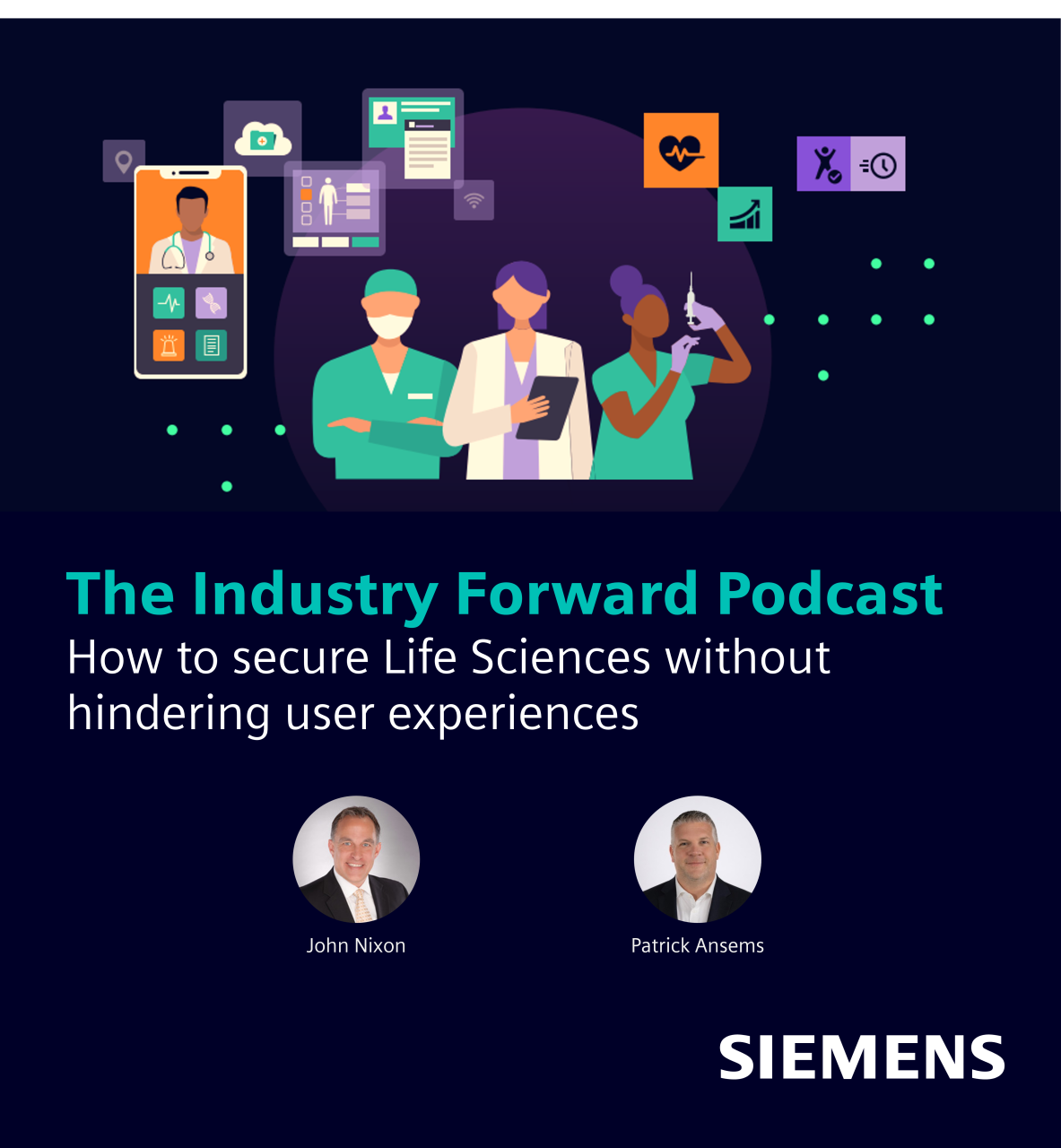
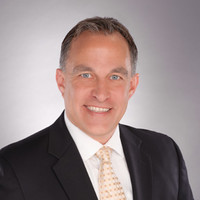
John Nixon – Global Vice President of Process Industries at Siemens Digital Industries Software
As Group Vice President for Process Industries at Siemens, John leads a global team that helps process industries leverage digital solutions that enhance efficiency, accelerate innovation and achieve sustainability goals.
John has over three decades of experience in strategy, operations and technology deployment for energy, chemicals, Life Sciences and CPG. He is well versed in the operational and business pressures of industry, including regulatory demands, decarbonization, talent gaps and the push for innovation.
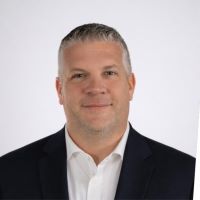
Patrick Ansems – Global Head of Life sciences at Siemens Digital Industries Software
As Global Head of Life Sciences at Siemens, Patrick helps pharmaceutical and medical device organizations build comprehensive Digital Twin technology that spans development to manufacturing, and beyond. These tools accelerate innovation and deliver better therapies to patients.
Patrick has 25 years of experience ranging from wet labs to digital transformation. He understands the complexity of scientific workflows and how to translate them into strategies that deliver business outcomes.
Connect with Patrick on LinkedIn
All trademarks are property of their respective owners.
[1] International Society of Automation (ISA), ISA/IEC 62443 Series of Standards, available at: https://www.isa.org/standards-and-publications/isa-standards/isa-iec-62443-series-of-standards (accessed September 29, 2026).
[2] International Organization for Standardization (ISO), ISO/IEC 27001:2022 – Information Security Management Systems, available at: https://www.iso.org/standard/27001 (accessed September 29, 2026).
[3] U.S. Food and Drug Administration (FDA), Cybersecurity, available at: https://www.fda.gov/medical-devices/digital-health-center-excellence/cybersecurity (accessed September 29, 2026).
[4] Eli Lilly and Company, Lilly TuneLab, available at: https://tunelab.lilly.com/ (accessed September 29, 2026).
[5] Rush, E.N., Danciu, I., Ostrouchov, G., Cho, K., Mayer, B.W., Ho, Y.-L., Honerlaw, J., Costa, L., Linares, F. and Begoli, E., JSONize: A Scalable Machine Learning Pipeline to Model Medical Notes as Semi-structured Documents, available at: https://pmc.ncbi.nlm.nih.gov/articles/PMC7233081/ (accessed September 29, 2026).
[6] Pistoia Alliance, Home – Pistoia Alliance – Collaborate to Innovate Life Science R&D, available at: https://pistoiaalliance.org/ (accessed September 29, 2026).