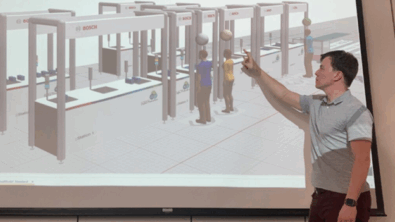
How Bosch Mobility accelerates material flow innovation with Plant Simulation

From standardized model libraries to automated line builders, discover how Bosch Mobility is transforming factory planning with a unified, human-centred approach to material flow simulation with Tecnomatix Plant Simulation.
Few manufacturing environments evolve as quickly, or as globally, as Bosch. With four major business sectors and sites spread across continents, Bosch’s mobility division faces constant pressure to plan, validate, and optimize production lines faster than ever. But with speed comes an enduring challenge: consistency.
Models must be shared between teams, new colleagues must be trained continuously, and simulation projects often shift hands multiple times. Without a common framework, this complexity becomes a bottleneck, slowing productivity and doubling work. And at the center of that mission is Plant Simulation, Bosch’s central tool for material flow simulation and digital factory modeling.
For Carsten, Material Flow Simulation Specialist at Bosch Mobility, a simulation specialist who has spent eight years at Bosch, solving this challenge has become both his mission and his passion.
“We always need to train new colleagues, and we often have to move models from one colleague to another. Standardization saves an enormous amount of time.
— Carsten, Material Flow Simulation Specialist, Bosch Mobility
Building a global standard with Siemens Plant Simulation
Within Bosch Mobility, Carsten wears many hats: trainer, tool developer, and core member of a central working group focused on simulation standardization. His goal: to ensure that every engineer, regardless of background or experience level, can build models quickly, consistently, and at a world-class level.
His team’s solution is a standardised simulation library built within Siemens Plant Simulation, designed to harmonise manufacturing and logistics modelling across the organisation.
“Plant Simulation is the right choice because the interface possibilities help us interact with already existing planning tools. That’s essential for how we work at Bosch.”
— Carsten, Material Flow Simulation Specialist, Bosch Mobility
The library doesn’t just make models easier to build, it ensures that knowledge stays within the organization even as teams evolve. New colleagues ramp up faster. Experts share work seamlessly. And large-scale projects no longer risk inconsistencies caused by different modeling styles.
A game-inspired simulation model: the automatic line builder

One of the most impactful developments Bosch introduced is the Automatic Line Builder, a tool that enables users to create entire production lines with just a few clicks.
Surprisingly, the idea came from an unusual place.
“It was inspired by a computer game I played in my early days,”
“You could build machines and logistics paths really easily. We wanted the same simplicity for our engineers.”
— Carsten, Material Flow Simulation Specialist, Bosch Mobility
By embedding years of manufacturing and logistics know-how directly into the tool, the Automatic Line Builder reduces manual modeling work dramatically. What used to take hours, or days, can now be generated almost instantly.
And Bosch engineers have noticed.
A recent internal survey highlighted the impact clearly: 50% reduction in modeling effort using the standardized library. For a company operating at Bosch’s scale, that’s transformative.
Connecting manufacturing and logistics in one Plant Simulation environment
Carsten is especially proud of the team’s most recent achievement: enhancing the library so that manufacturing and logistics models live within one standardized framework.
“It shows that we’re not only able to simulate manufacturing lines, we’re now able to connect logistics and manufacturing in a whole standardized factory simulation.” This combined modeling environment reflects how real factories operate, and it prepares Bosch Mobility for the next generation of optimization. With standardized foundations now in place, the team’s next focus to advance its team’s simulation capabilities to the next level includes automating better decision-making, speeding scenario studies and pushing toward truly intelligent factory simulation.
The future of digital factory planning with Plant Simulation

After eight years at Bosch and three years leading central standardization efforts, Carsten has helped create a scalable, high impact simulation ecosystem powered by Siemens Plant Simulation. The results speak for themselves:
- 50% reduction in modeling effort
- Faster onboarding for new colleagues
- Consistent model structures across global teams
- Seamless integration with planning tools
- Unified manufacturing + logistics simulations
- A future-ready foundation for optimization
What began as a standardization effort is now driving significant gains in efficiency, collaboration, and digital maturity across Bosch Mobility. With Siemens Plant Simulation at the center of its strategy, Bosch is building a smarter, more connected approach to material flow simulation, one standardized factory at a time.