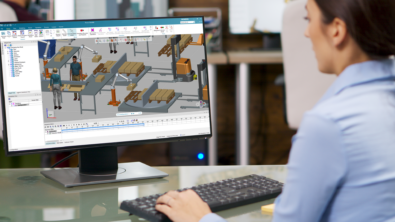
Plant Simulation Drives Predictive Planning in HD Hyundai Mipo’s Digital Shipyard

Plant Simulation was our entry point into predictive planning. Now we’re taking the next step.
OhUk Kwon, Team Leader of the Manufacturing Innovation Platform, HD Hyundai Mipo
Reducing lead time while improving productivity is a key priority in modern shipbuilding. HD Hyundai Mipo is addressing this by using Plant Simulation (Tecnomatix portfolio) as the foundation for predictive planning across its shipyard, reducing lead‑time generation by 32 minutes (approximately 2.6 percent) on a key panel line and shortening ramp‑up and roll‑out time.
Founded in 1975 and based in Ulsan, South Korea, HD Hyundai Mipo delivers over 50 midsize vessels annually and leverages Siemens Digital Industries Software, particularly Plant Simulation, to modernize production and improve end‑to‑end flow amid evolving industry demands.
Digitalization accelerates shipbuilding production
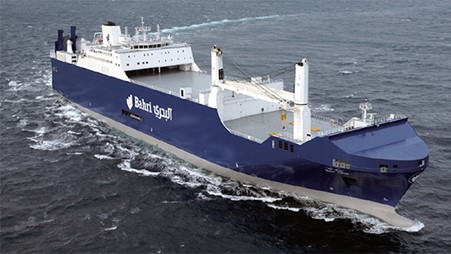
To support its digital transformation, HD Hyundai Mipo established a Digital Manufacturing Innovation Center (DMIC) to respond to key industry challenges, including tightening environmental regulations, growing demand for smart ship technologies, and the need to replace aging vessels.
With strong cost and quality pressures, the company adopted a clear principle: “Digital enables production.” The DMIC focused on high‑impact, labor‑intensive processes such as welding and grinding, where automation could deliver the greatest benefits. At the same time, the team addressed a siloed data challenge by connecting software systems and using simulation to optimize production decisions before implementing changes on the shop floor.
Plant Simulation as an Entry Point to Predictive Planning
HD Hyundai Mipo’s approach is built on unifying engineering and production data to support a transparent and repeatable planning process. Starting from 3D design data, engineers structure product information and transfer it into Teamcenter, creating a consistent backbone for downstream applications.
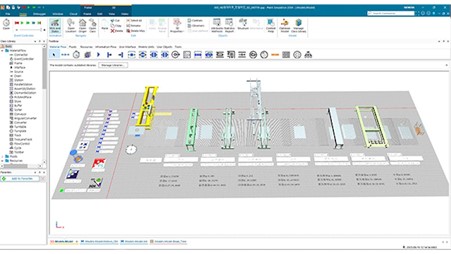
By integrating Teamcenter and Plant Simulation,HD Hyundai Mipo can build a virtual production environment that incorporates plant resources, product structures and manufacturing constraints. This creates a digital model that supports:
- material flow and routing evaluation
- takt time and throughput analysis
- resource utilization and capacity checks
- earlier bottleneck detection
- more informed layout and investment decisions
This predictive planning loop helps reduce the need for late-stage adjustments and supports faster rollout of new or optimized production areas—contributing directly to decreased ramp-up and roll out time.
Optimizing Subassembly Welding with Plant Simulation
To improve productivity in subassembly welding, HD Hyundai Mipo used Plant Simulation to model two parallel conveyor lines—one operated by robotic systems and the other by manual labor using carriage. Carriages are movable mechanical platforms or carts used to transport large steel blocks, panels, or subassemblies through different processing stations. The objective was to balance workloads and synchronize cycle times, ensuring smoother flow between automated and manual operations.
The simulation model included key process steps such as loading, arranging and attaching components, fixing, grinding and unloading. By comparing configurations and evaluating their takt time and throughput, the team identified optimal task distribution and routing strategies that reduced bottlenecks and improved overall production flow.
Although shipyard operations are inherently nonlinear, the panel line often sets the pace for downstream work. Improvements identified through simulation can therefore create a multiplier effect across upstream and downstream processes—supporting more stable and predictable production behavior.
Reducing Lead Time Generation by 32 Minutes (~2.6%) with Genetic Optimization
To optimize panel processing routes and identify the most efficient processing sequence, HD Hyundai Mipo applied a genetic algorithm using Plant Simulation. Genetic algorithms help optimize production sequences, buffer sizes, or scheduling by simulating various scenaros to find the best value, helping manufacturers automate optimal parameters. By iterating through generations of routing variants, the algorithm converged on increasingly efficient solutions and reduced lead time generation by 32 minutes, which the shipyard estimates as approximately 2.6 percent.
While 2.6 percent may appear incremental in isolation, its impact grows at scale. Panel lines involve dozens of workers, and because these lines strongly influence takt time for downstream processes, even small reductions can compound across the broader production system.
For HD Hyundai Mipo, genetic optimization is not simply a mathematical technique—it is a structured way to evolve toward the best operational outcome, building a reliable foundation for further automation and long term productivity improvements.
Coordinating Robots and Cobots with Plant Simulation

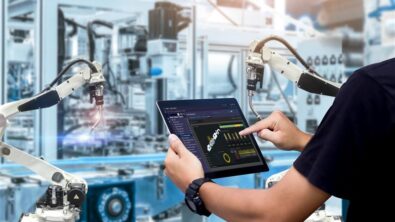
HD Hyundai Mipo is also testing collaborative robots (cobots) for welding tasks in confined spaces—areas that can be challenging from both an ergonomic and efficiency standpoint.
Before deployment, technicians simulate each cobot’s motion paths and process timing in Plant Simulation, validating reach envelopes, identifying potential collisions and verifying realistic cycle times. Live monitoring then complements simulation by providing real-world performance data such as utilization and on-time arrivals.
This combined approach supports improved efficiency while reducing physical strain, reinforcing the shipyard’s strategy of automation supported by trusted simulation models.
Results Enabled by Plant Simulation
By applying Plant Simulation to predictive planning and process optimization, HD Hyundai Mipo achieved measurable and operationally meaningful outcomes:
- Reduced lead time generation by ~2.6 percent (32 minutes) on a key panel processing optimization
- Decreased ramp up and roll out time through earlier validation and more reliable planning
- Coordinated robots, cobots and manual work to minimize cycle times and balance workloads
- Avoided bottlenecks and significantly improved production flow by identifying constraints earlier in the planning stage
From Plant Simulation to the Digital Shipyard Vision
Looking ahead, HD Hyundai Mipo is advancing toward a fully digital, centrally managed shipyard where planning, execution and optimization operate as a single connected system.
We are considering the Siemens Industrial Metaverse as the platform where our entire digital shipyard will come to life.
OhUk Kwon, Team Leader of the Manufacturing Innovation Platform, HD Hyundai Mipo
What lies ahead is more than digitalization, it is the reinvention of shipyard building itself. By potentially rendering the entire shipyard in the Industrial Metaverse, planners, engineers, and operators can step inside a living digital twin where intelligent simulation, real-time production data, and immersive visualization come together—allowing decisions to be tested, optimized, and aligned across the full shipbuilding lifecycle before they ever reach the physical yard.