Smart Manufacturing Features Siemens on Humanoids in Manufacturing

Smart Manufacturing, a leading publication that focuses on advanced manufacturing technologies and tools that are driven or enhanced by integrated information technology, recently featured Siemens in a new article examining the real role humanoid robots may play in industrial environments. The message is straightforward: humanoid robots have potential, but success will come from realistic expectations and careful planning.
Hear from Siemens Alex Greenberg, Director Advanced Robotics Simulation Program, at Siemens Digital Industries Software, as he discusses how manufacturers can prepare for humanoids on the factory floor and where the technology stands today.
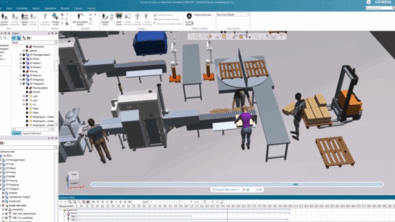
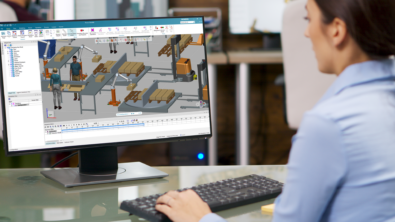
In the article, learn how Siemens simulation software like Process Simulate, enables manufacturers to assess what makes sense now, what doesn’t, and how to prepare as the humanoid technology matures.
Why manufacturers are paying attention
Interest in humanoid robots is being fueled by persistent labor and skills shortages, rising product complexity, and the need for more flexible operations. Greenberg notes that humanoids stand out because they can operate in spaces designed for people, using existing tools, workstations, and layouts. Still, most deployments remain experimental, and meaningful gains will depend on better dexterity, perception, and task-specific training.
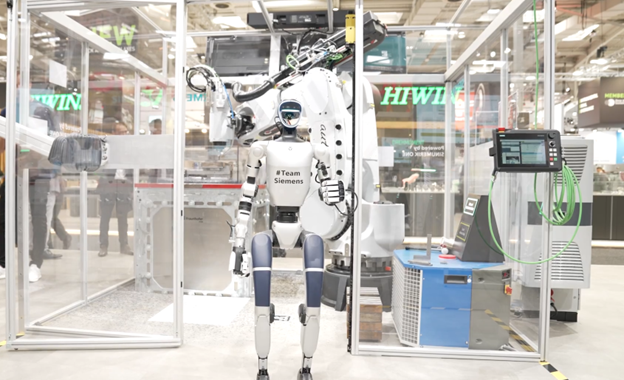
A key insight from the article is that not all humanoids need to walk. In many factory environments, wheeled humanoids may be the more practical option. They can move faster, stay stable while carrying heavier loads, and are often better suited for tasks like material handling, part delivery, and machine tending in high-volume facilities.
Simulation before deployment
Integrating humanoids is far more complex than installing traditional industrial robots. They must navigate shared spaces, adapt to legacy equipment, and work safely alongside people. Greenberg emphasizes the role of simulation tools such as Process Simulate in testing feasibility, ergonomics, workflows, and safety scenarios long before equipment is deployed. This early validation helps reduce risk and avoid costly changes later.
Preparing for what’s next
To dive deeper into Alex Greenberg’s perspective and see how these ideas apply on the shop floor, explore the full article on Smart Manufacturing. It’s a worthwhile read for anyone thinking seriously about the future of automation, and how to get there without the hype.