Why AI-powered product development depends on connected product data

Here’s a question worth asking before you invest another dollar in AI. If your engineers could get instant, trustworthy answers to any product question, what would they do with the extra time?
That’s the real conversation happening in manufacturing right now. Not “should we use AI,” but “why isn’t AI delivering what we expected yet?” A recent interview with Diego Tamburini, Executive Consultant and Director of the AI practice at CIMdata, gets at exactly this question. And the answer often has less to do with AI models themselves and more to do with the quality, accessibility and context of the data behind them.
If you’re evaluating AI-powered product development for your engineering organization, the findings from this discussion are worth a closer look.

Why AI works best inside the engineering environment
Before evaluating new AI tools, it’s worth looking at where AI can deliver the most immediate value. Increasingly, manufacturers are finding that AI capabilities embedded directly in engineering, PLM, and simulation environments where they already work can help teams increase productivity and reduce time to value.
Instead of navigating multiple applications and repositories, engineers can leverage the power of AI in their working context and get results that are grounded in the underlying product lifecycle data.
For many organizations, this is where AI is delivering tangible value today – removing the friction between engineers and the trusted product information they need to make decisions, solve problems and move work forward. Not surprisingly, those information- and knowledge-centered use cases are also where manufacturers are reporting the greatest AI success today.
Where AI is actually earning its keep today
When companies report real, current AI use, a clear pattern emerges. Requirements management, concept development and ideation, and search and knowledge access lead the list, all clustered in the mid-40% range of adoption. Mechanical design and technical documentation follow close behind.
The list is notable for what it does not include. AI autonomously making engineering decisions is not at the top of the list. That’s not where the value is being captured yet, and it’s not where it needs to be. CIMdata notes that these knowledge-focused applications free up engineering resources from “drudgery work” so people can focus on actual innovation and design.
That distinction matters for how you think about ROI. The organizations getting value from AI aren’t chasing a flashy demo. They’re targeting the unglamorous but expensive problem of engineers spending hours searching for information that already exists somewhere in the company. Reduced manual work and faster access to information are consistently the top realized benefits, and they’re also the benefits companies say they want more of over the next two to three years.
AI doesn’t yield results not because the model isn’t smart enough; it fails because the data underneath is incomplete, inconsistent, or locked away where AI just can’t reach it.
— Diego Tamburini, Executive Consultant and Director of the AI practice, CIMdata
Most AI failures are data failures
CIMdata highlights a challenge many manufacturers are discovering firsthand.
“AI doesn’t yield results not because the model isn’t smart enough; it fails because the data underneath is incomplete, inconsistent, or locked away where AI just can’t reach it.“
Diego Tamburini, Executive Consultant and Director of the AI practice, CIMdata
This lines up exactly with what the survey data shows. Data quality is the single most-cited barrier to AI adoption, and it isn’t close, named by 60% of industrial companies as a top-three challenge. Right behind it, at 44%, is data access and integration across siloed systems. Two data problems, feeding each other.
And engineering data isn’t static. Designs change. Parts get replaced. Requirements shift mid-project. If your AI is working off last month’s snapshot, it’s not just unhelpful, it can actively mislead. As noted in the CIMdata interview, the moment you copy product data into a separate location for AI to use, “you start an expiration clock” on how accurate those answers will be.

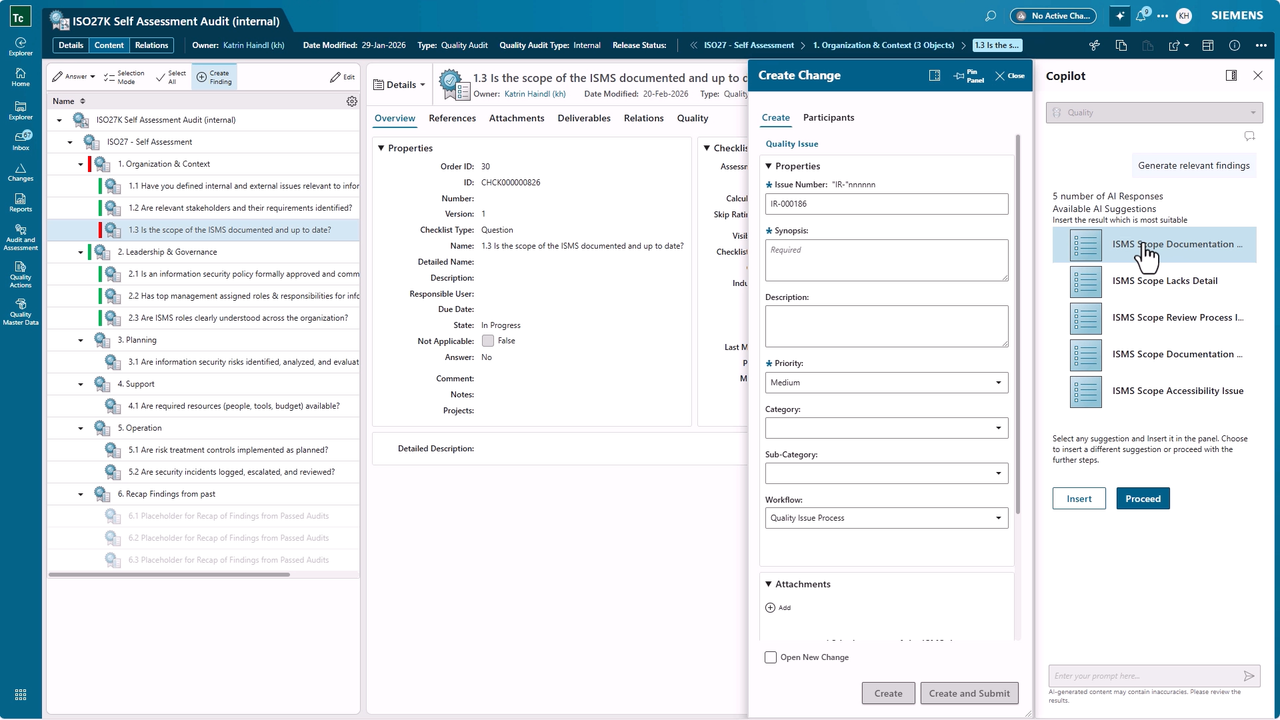
AI-powered product development is most effective when it operates on live, governed, connected product data. That’s a core reason a strong PLM foundation like Teamcenter matters more as AI adoption grows. Teamcenter Copilot builds on this foundation by connecting AI directly to trusted product lifecycle information rather than isolated data sets.
Why a single system of record isn’t enough anymore
Consider a common engineering change request (ECR). An ECR gets logged in your PLM system. Ask AI who created it or which parts it touches, and you’ll get a clean answer, since that data lives in one place.
But if you want insight into a deeper question, like “what’s the downstream impact of this change?”, you need visibility into other systems where this data lives, such as ERP, manufacturing, and CRM. One system of record can only answer from its own limited vantage point.
Historically, the digital thread has connected product information across systems and disciplines. But as Diego discusses in the interview, this is now evolving. In the age of AI, an ontology adds another layer by defining how data from different sources relates and translating between different terms and structures. This gives AI the context it needs to reason across disciplines rather than treating each source as a separate silo.
CIMdata’s findings point to an important conclusion. The more connected your product lifecycle data is, the more useful every AI investment on top of it becomes. That’s the compounding value of a unified PLM backbone.
Want to hear this straight from the source? Watch the full CIMdata interview with Diego Tamburini to see him walk through the digital thread concept, the ECR example, and what “AI-first” really means for engineering teams.
Integration beats everything else at selection time
When industrial companies evaluate AI-enabled PLM solutions, one factor clearly ranks higher than every other consideration: integration with existing systems, cited by 62% as a top selection factor.
That’s not a surprising statistic once you think about how engineering actually works. Engineering decisions rarely exist within a single application. “Any question or decision that engineers need to make spans multiple systems,” says Diego. “That’s the rule, not the exception.”
This is also driving a shift in how software providers think about openness. APIs are table stakes now. The industry is now moving toward towards Model Context Protocol (MCP), a standard that makes it easier for AI applications to connect with systems and access relevant information without requiring a custom integration for each connection. Manufacturers increasingly value solutions that allow AI to access information across systems rather than keeping data isolated in individual tools.
Building trust in AI-assisted engineering
One statistic should give every AI vendor pause. Only 5% of industrial companies say they’re very confident in their ability to validate AI outputs. That’s the real gap between a pilot that looks great in a demo and a capability your engineers actually rely on in production.
Accountability remains a critical consideration.
Humans will be accountable for the design decisions, even if they are assisted by AI
— Diego Tamburini, Executive Consultant and Director of the AI practice, CIMdata
That means explainability isn’t a nice-to-have feature. It’s the mechanism that lets an engineer trust, verify, or override an AI recommendation. The same logic applies to AI agents completing multi-step tasks: people need the ability to see the reasoning, check the sources, and step in when something looks off.
Security follows the same logic. Many manufacturers won’t even consider an AI solution unless it can be hosted inside their own secure environment. And access controls need to be airtight: AI should allow users to view only data to which they’re entitled.
Help engineers focus on higher-value work
Manufacturers consistently want the same outcomes from AI. They want shorter design cycles, fewer manual and repetitive tasks, and faster access to information. Those are the top three priorities, consistently, across the research.
Manufacturers largely view AI as a tool for improving productivity rather than reducing headcount. Companies expect AI to help engineers focus on higher-value work, cut repetitive tasks, and become more productive, not to shrink headcount.
The goal of AI-powered product development is not to replace engineers. It’s about helping engineers to become more productive and spend more time innovating. That’s the outcome manufacturers are working toward.
Frequently asked questions
What is AI-powered product development?
AI-powered product development combines artificial intelligence with connected product lifecycle data to help teams increase engineering efficiency and accelerate innovation across the product lifecycle.
Why does AI fail in engineering environments?
Most AI shortfalls trace back to data. Incomplete, inconsistent, or siloed product data, combined with information that changes constantly, undermines AI’s ability to give accurate, up-to-date answers.
What should manufacturers look for in an AI-enabled PLM solution?
Integration with existing systems, explainable and validated outputs, strong data security and access controls, and a connected digital thread across the full product lifecycle.
Where this leaves you
If there’s one idea to take from this research, it is that AI-powered product development requires both advanced AI and trusted product data. As CIMdata’s research highlights, organizations are realizing that the quality, accessibility and connectedness of their data often determines how much value they ultimately gain from AI.
🧠 Make smarter decisions with AI-powered PLM
🚀 Start fast and grow with Teamcenter X
🚗 Take the Teamcenter X 30-day test drive
🌟 Learn more about Teamcenter solutions
Table of Contents