Requirements verification in the age of engineering complexity

When engineers discuss requirements, the conversation often focuses on definition and management. But defining requirements is only the beginning.
The real challenge is verification.
Requirements verification is the process of confirming that every requirement is measurable, testable, traceable, and can be objectively verified through analysis, simulation, inspection, demonstration, or testing. Done properly, this improved process helps organizations reduce risk, improve compliance, and ensure systems perform as intended.
How do you prove a system will perform as intended? How do you ensure a requirement is measurable, testable, and fully covered by verification activities? And as products become more complex, how do you accomplish that without creating bottlenecks that slow innovation?
These questions are becoming increasingly important across aerospace, automotive, defense, industrial machinery, and other industries developing sophisticated systems. Products are expected to operate in more conditions, satisfy more stakeholders, comply with more regulations, and adapt to changing mission requirements.
In this environment, requirements verification can no longer be a disconnected activity that occurs late in development. Verification must be built into the engineering process from the beginning.
This is where AI can help.
With Teamcenter Copilot, organizations can apply AI directly within the requirements management process. Teams can improve requirement quality, identify measurable verification criteria, recommend test coverage, and maintain traceability in a connected engineering workflow. The result is a more efficient path from requirements to verified outcomes.
Watch the video to see what AI-powered requirements verification in Teamcenter looks like in practice.
Why requirements verification is more important than ever
A requirement is only useful if it can be proven.
That sounds straightforward, but a well-defined verification plan often involves a series of manual activities spread across multiple tools and teams.
Engineers must determine whether a requirement is clearly written and testable. They must also determine the appropriate verification methods, which can include testing, simulation, inspection, analysis, or demonstration—for example. They also need to define key KPIs and targets as parameters. And the test cases they create must define success, establish appropriate test coverage, maintain traceability, and ultimately verify that a design can meet performance targets under real-world conditions.
The complexity grows as systems become more interconnected.
A single requirement can influence mechanical, electrical, software, and systems engineering disciplines. Small ambiguities can create downstream challenges, while gaps in verification can introduce risk that remains hidden until testing begins.
The result is an engineering reality many organizations recognize: requirements verification frequently consumes significant time and effort while still leaving uncertainty about coverage, traceability, and compliance.
Reimagining requirements verification with Teamcenter Copilot
What if the verification plan could begin the moment a requirement is created?
In Teamcenter Copilot, AI-powered requirement verifications support engineers throughout the process, helping transform requirements into measurable, verifiable engineering outcomes while maintaining continuity across engineering and verification activities.
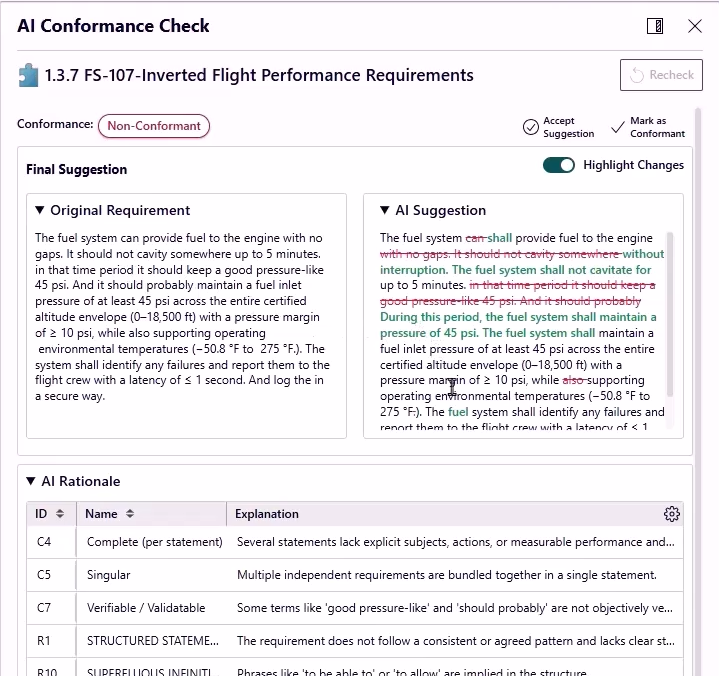
Consider an aircraft that must support sustained inverted flight while maintaining safe fuel delivery. Before engineers can verify changes to the design, they must first ensure that the requirement itself is complete, measurable, and testable.
This seemingly simple requirement becomes the foundation for a much broader verification process.
Building better requirements before verification begins
The success of any verification effort depends on requirement quality.
Poorly defined requirements are a leading source of downstream verification challenges. If a requirement contains ambiguity, lacks measurable criteria, or does not clearly define success, every downstream verification activity becomes more difficult.
Teamcenter Copilot helps address this challenge by evaluating requirements against established INCOSE guidelines. Engineers receive recommendations, explanations, and side-by-side comparisons of proposed improvements, helping them create requirements that are more complete, measurable, and ready for verification.
By improving requirement quality early, organizations can reduce rework and strengthen the foundation of the entire verification process.
Turning requirement text into measurable outcomes
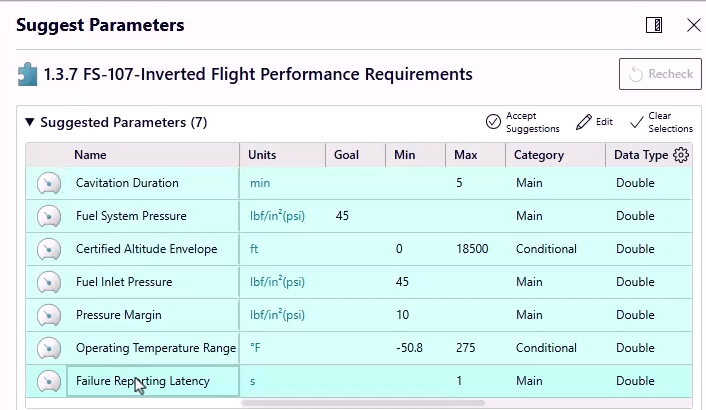
Teamcenter Copilot can automatically identify key performance measures directly from requirement text. In the aircraft example, important parameters such as fuel pressure and duration during inverted flight are extracted and highlighted as measurable verification criteria.
These parameters become managed engineering information connected directly to the requirement, helping maintain traceability throughout the product lifecycle.
Instead of manually interpreting requirements and creating verification metrics, engineers can begin with AI-generated recommendations and focus their expertise where it adds the greatest value.
Closing requirements verification gaps with intelligent test coverage
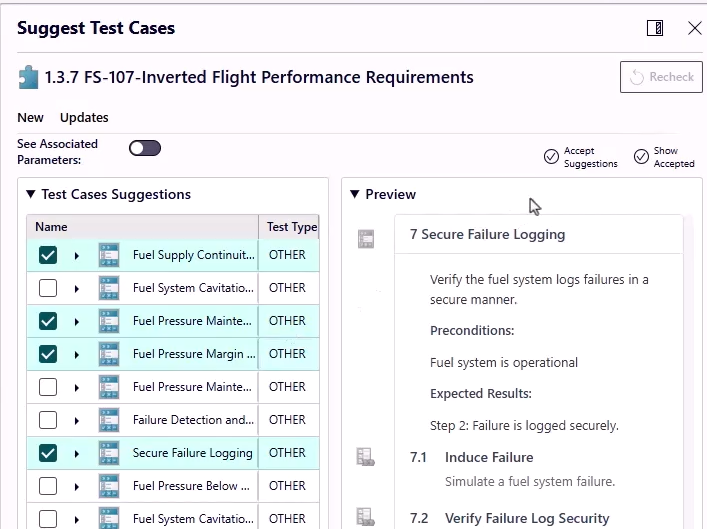
Every requirement must be linked to verification activities that demonstrate compliance. Missing tests, incomplete traceability, or overlooked scenarios can create uncertainty and risk.
Teamcenter Copilot recommends additional standards-based test cases that can be used to verify compliance with a requirement. Engineers can review recommendations, select applicable tests, create new verification activities when needed, and establish traceability links across requirements and tests. This traceability is essential for demonstrating regulatory compliance, supporting audits, and verifying that all requirements have been addressed.
This approach helps organizations build confidence that requirements have been fully addressed and that verification evidence remains connected to engineering intent.
Moving from verification planning to verified performance
Ultimately, requirements verification is about more than creating tests.
Organizations must demonstrate that designs can achieve desired outcomes.
Using simulation and design-of-experiments techniques, engineers can evaluate how critical performance indicators behave across operating conditions. Results can be analyzed to identify optimal parameter values, improve safety margins, and reduce risk before physical testing begins.
Because the simulation results remain connected to requirements and verification activities, teams gain a more complete understanding of whether designs satisfy their intended objectives.
Frequently Asked Questions
What is requirements verification?
Requirements verification is the process of planning, executing, and documenting activities that demonstrate all external and internal standards are met. It includes defining verification methods, ensuring applicable standards are addressed, executing tests or analyses, and capturing the evidence needed to demonstrate compliance.
Why is requirements verification so important?
Requirements verification is the process of planning, executing, and documenting activities that demonstrate requirements have been met. It includes defining verification methods, ensuring applicable standards are addressed, executing tests or analyses, and capturing the evidence needed to demonstrate compliance.
What is the difference between requirements verification and requirements validation?
Requirements verification confirms that requirements have been met, while requirements validation ensures the right requirements were defined to satisfy customer and mission needs. In many industries, verification and validation (V&V) activities work together to ensure products meet both technical requirements and stakeholder needs.
How does AI support requirements verification?
Unlike general-purpose AI tools, Teamcenter applies AI directly within the requirements verification process. AI-powered capabilities help engineers evaluate requirement quality, identify key KPIs and targets as parameters, recommend test coverage, and maintain traceability across verification activities, helping teams move from requirements to verified outcomes more efficiently.
How does Teamcenter support requirements verification?
Teamcenter connects requirements, tests, simulations, traceability relationships, and verification evidence in a unified digital thread. By bringing verification activities and engineering data together in a single environment, Teamcenter helps organizations improve visibility, strengthen compliance readiness, reduce manual effort, and verify product performance more efficiently.
The future of requirements verification
As products become more intelligent, software-defined, and interconnected, requirements verification is becoming both more critical and more complex. Organizations need a connected approach that improves visibility, strengthens traceability, and ensures engineering decisions remain linked to product requirements throughout the lifecycle.
AI will not replace engineering expertise. But it can help engineers work more efficiently by improving requirement quality, identifying measurable verification criteria, recommending verification coverage, and accelerating validation activities.
As engineering complexity continues to grow, organizations that modernize requirements verification will be better positioned to improve compliance, strengthen traceability, reduce risk, and deliver high-quality products with greater confidence.
Learn how Teamcenter connects requirements, verification activities, simulation results, and verification evidence in a unified digital thread.
🧠 Make smarter decisions with AI-powered PLM
🚀 Start fast and grow with Teamcenter X
🚗 Take the Teamcenter X 30-day test drive
🌟 Learn more about Teamcenter solutions
Table of Contents