Aerodynamics of a Simcenter FLOEFD cow – A social media phenomenon
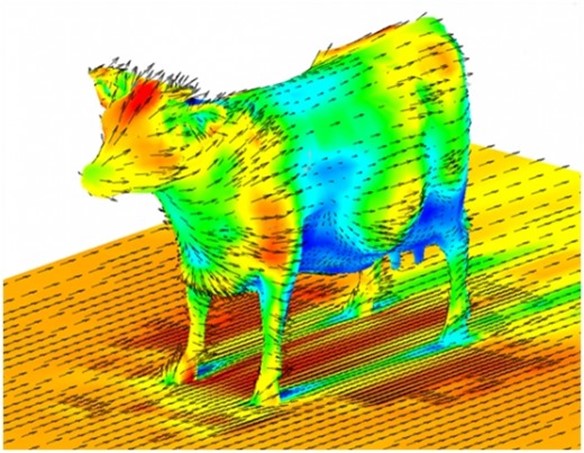
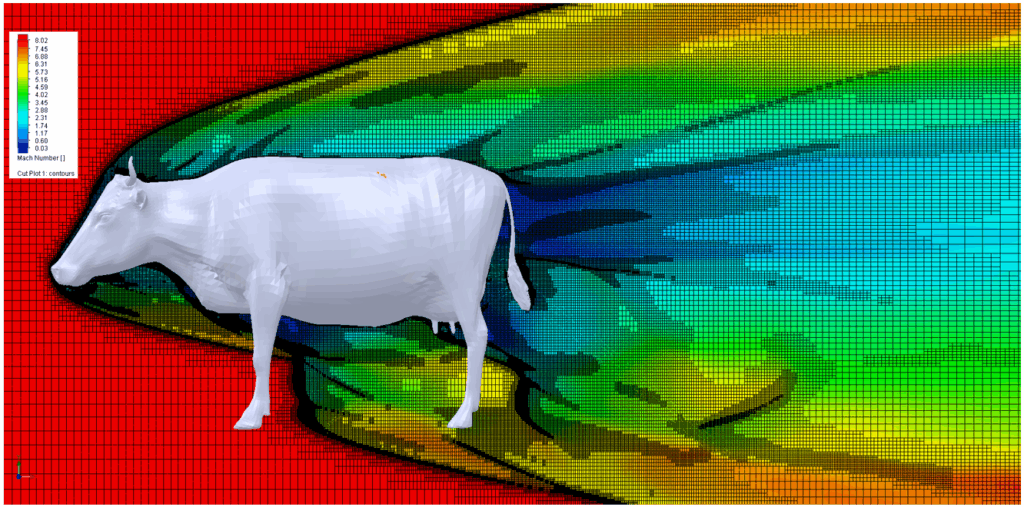
It’s been 25 years since the original Aerodynamics of a Cow CFD image was generated using Simcenter FLOEFD, and 10 years since it was reimagined supersonically. In that time the air flow over a cow simulation has become the most viewed CFD result in history, a CFD Mona Lisa of sorts, spawning countless bovine memes, articles, and posts across social media.
Its appeal isn’t grand or mysterious; it’s simply that it makes people laugh. And in engineering, that’s no small thing. Why? Because our field is dominated by precision, process, and the often-dry seriousness of ‘getting it right.’ Against that weight of rigour, humour is not just welcome but necessary – it breaks tension and restores perspective. Psychologists would call it benign incongruity: the jolt of seeing two things that don’t belong together suddenly collide. Advanced CFD airflow simulation applied to a Cow?? In all honesty it doesn’t really need or deserve such attention. Sometimes that comes as parody, sometimes satire, sometimes sheer absurdity – and sometimes it’s nothing more than the sight of a cow surrounded by CFD air flow vectors.
From the sublime to the redi-cow-less
So why is a cow in an airflow funny? Mainly because it’s so gloriously pointless. We expect engineering visuals to feature cars, planes, or turbines – the serious machinery of industry. Drop a farm animal into that context and the gravitas evaporates. The image becomes parody without words, satire without intent: advanced simulation applied to a subject that would never need it.
Humour often emerges when two things that don’t normally belong together suddenly meet. Here it’s your standard cow meeting the rarefied world of airflow simulation, a perfectly ludicrous pairing. The result is funny not because it threatens or shocks, but because it is so harmlessly absurd. And in a world heavy with pressure, complexity, and suffering, moments like this matter. They let us laugh, stay grounded, and remember the essential value of play.
Memes, but not as Dawkins envisioned
When Richard Dawkins introduced the word meme in his 1976 book The Selfish Gene, he wasn’t thinking about cats, Ohio edits, or cows in a wind tunnel. He described memes as cultural replicators – units of information (like tunes, catchphrases, or fashion trends) that propagate through imitation, evolving as they spread and subject to Darwin’s survival of the fittest.
Fast-forward to the 21st century, and the internet hijacked the word. ‘Meme’ became shorthand for a very specific visual & text joke format that thrives in the endless art of social media doom-scrolling. Yet if you squint, the modern meme isn’t so far removed from Dawkins’ intent. It’s still about cultural transmission, replication, and survival of the fittest idea – only now the unit of replication is often an image with Impact font slapped on top. No more so true than for the aerodynamic cow.
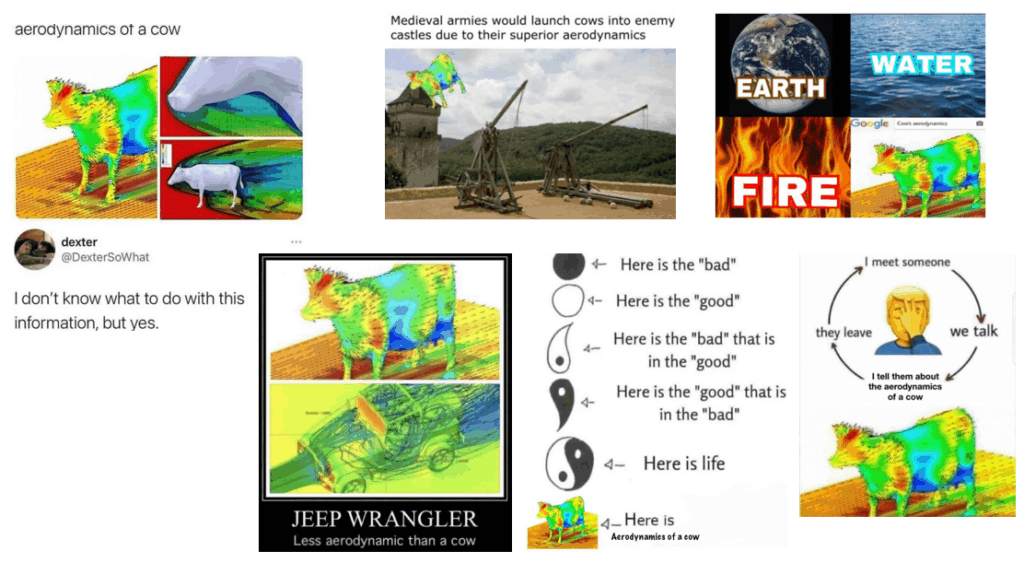
I won’t pretend, as a 54-year-old blogger, to track the rise and fall of internet memes with the same fluency as Gen Z. What I can say is that the Cow has followed the same pattern as many other online phenomena: it goes viral, drifts into obscurity, then resurfaces again – though stubbornly refusing to be forgotten.
Wearing our nonsense with pride
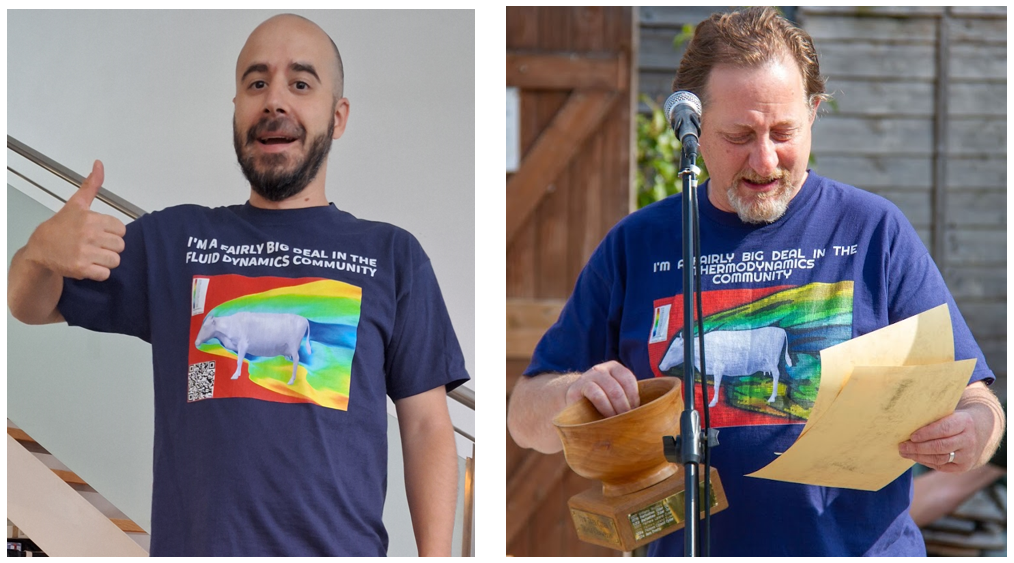
Of course, no meme is truly immortal until it finds its way onto a T-shirt. Sergio Antioquia, my co-author of our ‘Can Cows Fly?’ blog series:
and I benefitted from my brilliant children commissioning these ‘Aerodynamics of a Cow’ T-shirts – wearable proof that we (well maybe just I) may be old farts, but we still know how to have fun within the field we’ve worked in for decades. If you can’t laugh at a CFD cow while running a CAE simulation, then when can you?
Udderly serious
In the end, the Aerodynamics of a Cow isn’t just a meme. It’s proof that industrial engineering has a soul, and that humour is as important to innovation as governing equations and conservation. If you think it’s ridiculous, you’re right. But that’s exactly how humour works: it thrives on exaggeration, on twisting expectations, on making the serious look absurd and the absurd look serious. By doing so it punctures the dryness of process, restores perspective, and creates the mental freedom within which fresh innovations can emerge.
Memes like this aren’t distractions; they’re cultural pressure valves. They let us laugh at ourselves, share these moments of absurdity, and stay connected as a community. And if that means our most enduring legacy is an aerodynamic cow, then so be it – because ridicule, not reverence, is what keeps science, technology and engineering alive.
Finally, and by way of celebration, here’s our beloved virtual cow taking one last victory lap in a virtual wind tunnel – simulated with Simcenter and rendered in full Omniverse glory…
I had fun with the use of a magnifying glass as an asset in the 3D Omniverse USD scene. Placed between the Camera (your viewpoint) and the Cow, the magnification came for free as part of Omniverse’s rendering technology. Simcenter’s visualisation capabilities have come a long way in the last 20 years and, as we adopt NIVIDIA technologies, they will certainly continue to evolve in the future!
So thank you Cow and thank you Simcenter FLOEFD for bringing some udderly necessary silliness to serious CAE simulation.
Moo.