Navigating the future of turbomachinery or what Icarus can teach us about modern engine development

Knowledge-based engineering and the wisdom of the ancients

The future of turbomachinery presents a fascinating parallel to the myth of Icarus. In the ancient tale, Icarus was given wings crafted by his father Daedalus in order to flee a labyrinth prison. He was warned not to fly too close to the sun, as the wings were held together by wax that would melt.
Fast forward ~3,000 years, depending on when you consider this story taking place, and we find ourselves building jet engines. These turbines spin at temperatures exceeding 1,500°C, operating under pressures that would crush most materials, yet somehow they must remain lighter than air. Like Icarus, we too are reaching for the sky. But unlike the mythical figure, we’ve learned something crucial from history, success depends on understanding our creations through careful testing, rigorous simulations and the accumulation of knowledge over time.

In other words, artificial intelligence needs good input data. The difference is that modern AI can process more of it, learn faster from it, and apply those lessons on an unprecedented scale, shaping the future of turbomachinery in ways we’re only beginning to understand.
The hurdles OEMs face in a fast-paced world
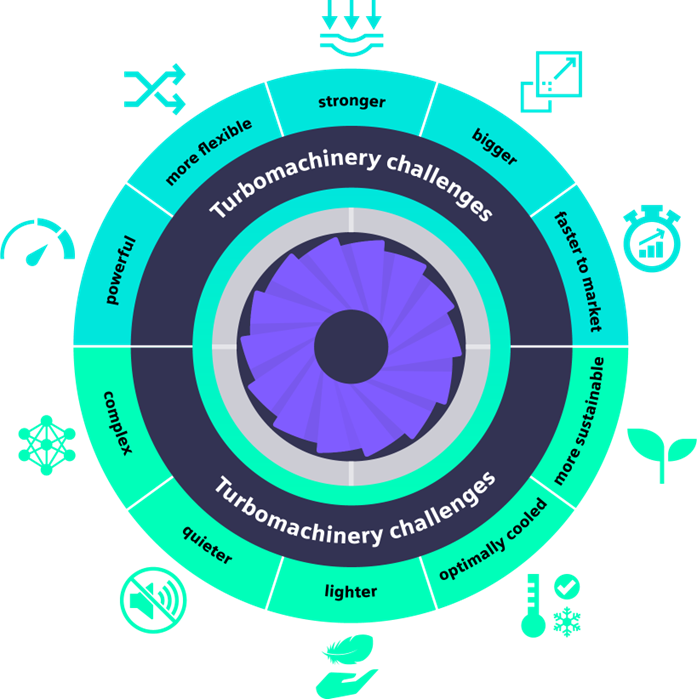
Today’s turbomachinery manufacturers and suppliers are tasked with an ambitious challenge. To design and produce engines that are more flexible, stronger, bigger, faster to market, more sustainable, quieter, lighter and optimally cooled. Optimizing one attribute often means making compromises on another, requiring sophisticated tools and insights to strike the perfect balance. This balancing act will define the future of turbomachinery development.
Furthermore, disconnected design-to-manufacturing workflows create a problem. They break the chain of knowledge that should flow from design to production. When a design team in one location uses different tools and data standards than the manufacturing team in another, insights about performance are lost in translation. This can lead to inefficiencies, rework and costly delays, including project launch delays, due to a lack of seamless information flow.
Unplanned downtime can lead to high costs for everyone involved. Accurately estimating the detailed thermal performance of subsystems, especially for critical components such as cooled turbine vanes and blades, requires managing a complex confluence of CAD, aerodynamics, mechanical integrity, and aeromechanics. Each of these disciplines brings its own challenges, best practices and a need to push the limits through research to make the best possible engine.
Siemens’ blueprint for accelerated innovation and the future of turbomachinery
At Siemens, we believe that overcoming these challenges lies in a holistic approach that integrates cutting-edge technology with intelligent workflows. Our answer is integrated and AI-powered performance engineering, a powerful convergence that dramatically accelerates innovation cycles while honoring the accumulated wisdom of engineering history. What we often refer to as a digital thread is a cornerstone of the future of turbomachinery engineering.
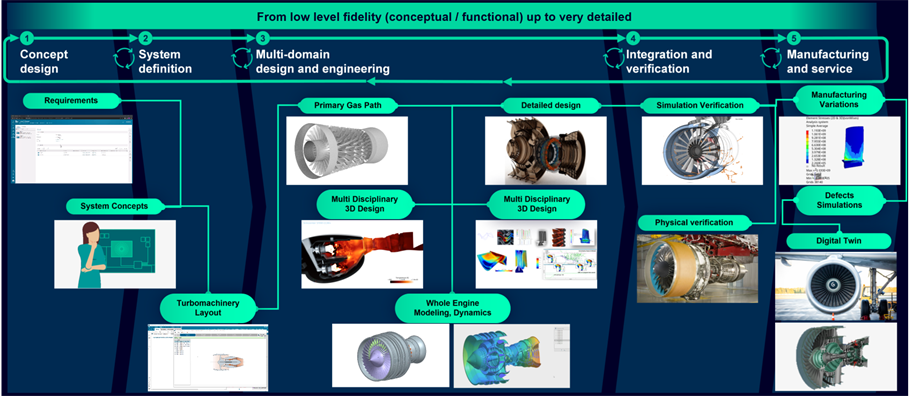
A seamless information across the entire product lifecycle, from concept to manufacturing means connecting the CAE-CAD-CAM chain, drastically shortening manufacturing cycles and fostering a truly collaborative environment. But more fundamentally, it means creating a single source of truth for all the data that matters, the design intent, the simulation results, the manufacturing tolerances, the as-built variations, and ultimately, the real-world performance.
We enable a comprehensive approach where various engineering disciplines converge aerodynamics, structures, thermodynamics, acoustics and materials science, which allows for holistic improvements. We ensure that every design decision is made with a complete understanding of its impact across all domains. An engineer tweaking blade geometry needs to immediately understand not only the aerodynamic benefits but also the structural implications, thermal consequences and manufacturing feasibility. This requires that all relevant data is current, accurate and immediately available.

Gone are the days of siloed tools and fragmented workflows. Our harmonized environment connects tools, enabling analysis automation and exploration at scale. When tools are disconnected, data is translated and re-entered multiple times, introducing errors and reducing the fidelity of the information flowing through the system. Unified tools preserve data integrity.

We empower engineers with fast and accurate simulations, democratizing advanced simulation capabilities that lead to accelerated engineering insights and friction-less part and assembly design. The speed matters, but it’s the accuracy that truly counts. A fast simulation based on poor input data is misleading. Our commitment is to ensure that the simulations engineers run are both fast and reliable, grounded in validated models and high-quality input data.
By combining virtual and physical testing, we build robust proof of compliance. Simulations supplement testing, they don’t replace it. The data from physical tests validates our simulations, and validated simulations allow us to explore designs that we’d otherwise need to test physically. This creates a virtuous cycle of increasingly accurate models and increasingly confident decisions.

Through Siemens Xcelerator, we transform manufacturing with an AI-powered digital thread that creates a complete end-to-end cross-domain connection from design to manufacturing. This encompasses CAD design and multi-physics optimization (noise, vibration, force, fluid, pressure, temperature) through CAM programming, data management, scheduling, CNC machining and inspection.

Want to see an example of how this works for real turbomachinery projects? Watch our webinar demonstrating the complete workflow for micro turbine gas-path design using Simcenter X Advanced.
The transformative power of AI and machine learning. Built on solid data
A machine learning model that predicts turbine blade fatigue life does so because it’s been trained on historical data about blade materials, operating conditions, failure modes and outcomes. The better that data, the better the predictions and the more confidently we can shape the future of turbomachinery.
We combine the power of AI with simulation to deliver better performance faster. AI-enabled design exploration allows automated and intelligent optimization, helping engineers uncover the best designs at every stage.

We leverage surrogate models for complex analyses like 3D finite element creep analysis, providing high accuracy by predicting critical locations and values and significantly accelerating these time-consuming processes. These surrogate models are trained on high-fidelity simulation data essentially, they learn the patterns that detailed physics simulations would capture. But again, their accuracy depends entirely on the quality of the training data.
Industry leaders are capitalizing on every data reuse opportunity by embracing accelerated AI adoption through configuration-managed simulation. Siemens Energy, for example, utilizes HEEDS AI simulator predictor to expedite the integration of CAD and CAE processes across various engineering disciplines.

The lesson from Icarus, reimagined
When Icarus flew too close to the sun, it wasn’t because the engineering was bad. It was because he didn’t listen to his father and understand the physics behind the engineering.
Modern turbomachinery is slightly more complex than wax wings, but the fundamental principle remains unchanged. Artificial intelligence is the newest chapter in this ancient story. It doesn’t replace the need for good data, it amplifies it. A sophisticated AI system that predicts engine performance can process and learn from more data than any human engineer could possibly digest. But that system is only as good as the data it learns from. Garbage in, garbage out, a principle as old as engineering itself.
Like Daedalus crafting wings for his son, we’re committed to building not just tools, but tools backed by the accumulated wisdom of human engineering. However, unlike Icarus, we’re ensuring that those who use them have the data they need to understand exactly what they can do, and where the limits lie. This is how we’re building the future of turbomachinery: with wisdom, precision, and the courage to reach for the sky.


Comments
Leave a Reply
You must be logged in to post a comment.
History definitely teaches us that success lies in the details of testing and knowledge accumulation. Reaching for the sky requires more than just ambition; it requires the precision of modern simulation. This is a great reminder of how far we’ve come since the days of Icarus. I’ve been reading more about these engineering milestones on this site: monster hunter stories 3