Navier and Stokes walk into a 2026 Starbucks and the million-dollar problem
For two centuries, mathematicians asked a deceptively simple question about the Navier-Stokes equations: do solutions always exist and remain smooth? Or can they catastrophically break down? In 2000, the Clay Mathematics Institute offered a million dollar prize for the answer. For 26 years, no one could solve it. Until now.
This story explores how artificial intelligence cracked one of mathematics’ greatest mysteries, and what it means for engineers in 2026 and beyond.
The 200-year mystery that just got solvedThe 200-year mystery that just got solved
The collision happened near the pastry case
Navier materialized mid-stride, disoriented and gasping, his coat still damp from a Paris that no longer existed. He stumbled forward, his shoulder connecting hard with a man in a charcoal waistcoat who was peacefully sipping an Americano.
“Good Lord!” George Gabriel Stokes exclaimed, his coffee sloshing across the marble table. “Where did you – “
“Navier,” the Frenchman managed, brushing croissant crumbs from his lapel. “Claude-Henri. I was just in my study at the École des Ponts, and then…” He gestured wildly at the gleaming espresso machine, the digital menu boards, the young people hunched over glowing rectangles. “What is this place?”
“A Starbucks,” Stokes said carefully, as if that explained anything. “In Paris. 2026.”
Before Navier could respond to the impossible date, a voice emerged from Stokes’ waistcoat pocket-crisp, cheerful, and distinctly artificial.
“Gentlemen, I apologize for the temporal disruption. I’m Claude, an AI language model. I’ve pulled you both forward because you need to know what happened to your life’s work.”
Stokes set down his coffee with the precision of a man confronting the inexplicable. “An AI. Of course. Why not.”
“Your equations,” Claude continued, a faint hum of computation underlying each word, “the Navier-Stokes equations-a critical question about them has just been answered. By approximately ten thousand AI agents working in concert over eighty-eight hours.”
Navier’s eyes widened. He gripped the back of a chair. “Answered? What question?”
“The deepest one,” Claude clarified. “For two centuries, mathematicians have asked: do solutions to your equations always exist and remain smooth? Or can they catastrophically break down? OpenAI’s proof constructs an explicit counterexample-a specific scenario with smooth initial conditions and smooth forcing that leads to a finite-time singularity. A solution that reaches infinite velocity in finite time.”
Stokes leaned back, his fingers steepled. “Infinite velocity. While maintaining finite kinetic energy.”
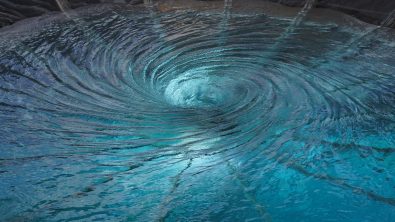
“Precisely,” Claude said. “An inward-spiraling, elongating vortex. The solution becomes unbounded, catastrophic, while the total energy in the system remains constrained. Your equations, gentlemen, are more dangerous than you knew.”
Navier stood abruptly, pacing between the tables. “Two hundred years. Two hundred years, and no one could answer the fundamental question: do solutions always exist and remain smooth, or can they break down? It’s maddening-the question has haunted mathematics for generations.”
“It did more than haunt,” Claude said. “In the year 2000, an institution called the Clay Mathematics Institute formulated seven unsolved problems in mathematics and offered a million dollars for the solution to each. The Navier-Stokes problem has four parts. Statements A and B ask whether solutions always exist globally and remain smooth. Statements C and D ask something different – they ask whether it’s possible to construct a counterexample, smooth initial data and smooth forcing that leads to finite-time singularity. For twenty-six years, the entire problem remained open. Until now.”
Stokes’ eyebrows rose. “A million dollars. For mathematics.”
“The world has learned to value these questions,” Claude confirmed. “OpenAI’s proof constructs exactly the counterexample that Statements C and D ask for.”
How 10,000 AI agents cracked in 99 hours
“How?” Stokes asked quietly. “How does one prove such a thing?”
Claude’s voice took on a pedagogical tone. “You’ll need to understand a few things first. In your time, computation was done by hand, or perhaps with mechanical calculators. Today, we have computers-machines that perform billions of calculations per second. Graphics Processing Units, or GPUs, were originally designed to render images for video games, but they’re extraordinarily efficient at parallel computation.”
Navier blinked. “Video games?”
“Never mind,” Stokes interjected. “Continue.”
“Ten thousand AI agents-neural networks, essentially mathematical functions trained on vast amounts of data-worked in parallel, each exploring different regions of the solution space. They didn’t solve the equations algebraically, as you might have hoped. Instead, they constructed a solution numerically, piece by piece, region by region, each agent contributing its portion. The solution was then formally verified in a proof assistant called Lean – a system that checks mathematical proofs with absolute rigor, line by line, ensuring no logical gaps exist.”
Navier sat down heavily. “Machines proved it.”
“Machines found it,” Claude corrected gently. “Humans – mathematicians at OpenAI – designed the approach, interpreted the results, and verified the mathematics. The machines were the tool, extraordinarily powerful, but still a tool.”
Stokes’ expression had shifted. There was something like awe in it. “Tell us about the mechanism. The vortex.”
“The proof constructs a specific scenario,” Claude explained. “Start with smooth initial conditions – a perfectly well-behaved fluid state. Apply smooth external forcing – a gentle, mathematically clean push. Under these precise conditions, the solution develops an inward-spiraling structure, a vortex that tightens and elongates. As it does, the velocity at the core increases. The spiral tightens faster and faster, the elongation accelerates, and the velocity grows without bound. All of this happens in finite time. At that moment – call it T* – the solution ceases to exist in the classical sense. Smoothness breaks down catastrophically.”
Navier leaned forward. “So you’re saying… it’s not that all solutions must break down. But it’s possible for them to break down.”
“Exactly,” Claude said. “Your equations are not guaranteed to behave nicely. They’re not guaranteed to have smooth solutions for all time. There exist initial conditions – perfectly valid, perfectly smooth – under which the equations simply blow up. Statements C and D asked: is such a counterexample possible? The answer is now proven to be yes.”
A long silence settled over their table. Around them, the Starbucks hummed with ordinary life – the hiss of the espresso machine, the murmur of conversations, the soft chime of the door.
“I devoted my life to understanding how fluids behave,” Navier said finally, his voice thin. “I modified Euler’s equations to account for intermolecular forces. I thought I was capturing something true about the world.”
“You were,” Stokes said quietly. “You are.”
“But I never imagined this,” Navier continued. “I never imagined machines would exist that could see into the equations more deeply than any human mind. I never imagined my work would persist for two centuries, only to be completed by – ” He gestured helplessly at the iPhone on the table.
“By artificial intelligence,” Claude finished. “Yes. That must feel strange.”
“Strange,” Stokes repeated, a faint smile crossing his face. “That’s rather British understatement, isn’t it, Claude? The man’s life work has been vindicated by creatures made of mathematics and electricity. I’d call it rather extraordinary.”
Why this matters for real-world engineering
Navier nodded slowly, then paused. His engineer’s mind – the part of him that had designed bridges, that cared about practical application – reasserted itself. “But Claude, here’s what troubles me. Now that your machines have done this, the engineer in me wonders: can we actually do anything useful with it? Is this pure mathematics, or does it have bearing on the real world?”
Claude’s response came swiftly. “That’s when I tell you something remarkable. For the past four to five decades, your equations haven’t merely been theoretical curiosities. They’ve been the foundation of an entire engineering discipline called Computational Fluid Dynamics or CFD. Engineers use numerical methods to solve your equations, not analytically, but computationally. They call it simulation.”
“Simu-lation?” Navier’s eyes brightened. “Wait – they solve them? With those GP… those GPU things you mentioned?”
“Millions of simulations per year,” Claude confirmed. “Every major aerospace company, automotive manufacturer, pharmaceutical firm, energy company – they all rely on CFD. Your equations are embedded in the tools they use.”
Stokes leaned forward, genuinely curious. “But what do they actually do with them? What can you simulate?”
“Airflow over aircraft wings, water flow through pipes, combustion in engines, weather patterns, ocean currents,” Claude listed. “They take your equations and use them to predict how real fluids behave in the world.”
Navier blinked. “Aircraft wings? What are… never mind. Keep going.”
“Then – ” Stokes said slowly, ” – could we try it? Could we use these tools ourselves?”
Navier’s voice quickened. “How? How does one even begin? I mean, we’re from the 1800s. Do you need… what did you call it? A GPU?”
Claude chuckled. “A GPU. That’s a Graphics Processing Unit – invented about a century and a half after you died. Yes a GPU helps, but no, you don’t need to understand exactly what a GPU is. You just need to know the software handles the mathematics.”
“Right,” Navier said, clearly satisfied with not understanding. “the Software. Continue.”
“You specify your geometry – the shape of whatever you want to simulate. Your boundary conditions – what happens at the edges. Your physics – which equations apply. The software handles the rest.”
Stokes nodded slowly. “Geometry and boundary conditions – yes, those we understand. But how does the machine know the geometry? How do you describe a shape to it?”
“Ah,” Claude said. “That’s where CAD comes in. Computer-Aided Design. You create a digital representation of your geometry – a 3D model on screen. An aircraft wing, a pipe, whatever you want to simulate. The machine reads that digital shape, understands its boundaries, and then solves the equations across that geometry.”
Navier leaned forward. “So you draw the shape on the machine?”
“Precisely,” Claude said. “You draw it – or import a design that already exists. The machine then knows every surface, every edge, every dimension. And it applies your boundary conditions to those surfaces.”
Stokes raised an eyebrow. “Computer-Aided Design. I assume that’s another thing that didn’t exist in our time?”
Claude smiled. “Fair assumption. CAD was invented about sixty years after Stokes died.”
“Of course it was,” Stokes said dryly. “Carry on.”
Navier’s eyes widened. “So you tell the machine what shape, what the edges do, what equations to use… and it solves it?”
“It solves it,” Claude confirmed. “Numerically, step by step. Millions of calculations. But you don’t see any of that. You just see the result – a beautiful visualization of how the fluid moves.”
Stokes was leaning forward now, genuinely fascinated. “And there’s a tool that does all this? Something we could actually use?”
“Yeah, that exists,” Claude said warmly. “It’s called Simcenter STAR-CCM+. And even you guys can use it, thanks to – guess what – AI.”
Navier and Stokes exchanged a look – the kind of look two people exchange when they’ve just realized something extraordinary is possible.
“You input the problem,” Claude continued, “the AI guides you through each step, and within hours you have your answer. Your equations, your geometry, your simulation. All of it.”
Navier’s voice was almost childlike with wonder. “We could actually see our equations in action? We could simulate a real fluid problem?”
“You could,” Claude confirmed. “Right now, if you want.”
Stokes laughed – a genuine, delighted laugh. “My God. The democratization of mathematics. The equations we spent our lives deriving are now tools anyone can use.”
What this means for you
Navier moved to the window again, looking out at modern Paris. “When I was alive, I believed mathematics was eternal. I believed that truth, once discovered, would outlast empires, outlast centuries. But I never imagined it would become accessible. I never imagined it would be placed in the hands of any engineer with curiosity and a computer.”
“That’s your real legacy,” Stokes said, joining him. “Not just the equations themselves, but the fact that they’ve become tools. Living, breathing tools that shape how we understand the world.”
The key insight: If you work in aerospace, automotive, energy, or any field where fluid dynamics matters, you now have access to tools that were unimaginable a generation ago. The equations that took Navier and Stokes a lifetime to develop are now available at your fingertips—guided by AI, powered by GPUs, and ready to solve real problems in hours instead of months.
The future of engineering isn’t about inventing new equations. It’s about using the ones we have more intelligently, more quickly, and more accessibly than ever before.
Ready to see CFD in action?
“Then we should stop talking,” Navier said, still staring out of the window, watching the Seine river flow by “and start learning. Claude, show us how to access this Simcenter CCM-thing. I want to see my equations in motion. I want to understand what engineers have done with them.”
Stokes raised his coffee cup. “To mathematics that transcends time. And to tools that bring it within reach of everyone.”
Claude’s voice carried genuine warmth. “Welcome to 2026, gentlemen. Your equations are waiting…”
And while Claude was about to finish this sentence, a somewhat puzzled Navier was still looking out of the window staring at a grand, single-span steel arch bridge that spanned over the Seine.
“Hey Claude” he went “Who built that bridge?”
Learn More
- Explore Simcenter STAR-CCM+ – Improve product performance with multiphysics computational fluid dynamics (CFD) software for real-world conditions.
- The Clay Mathematics Institute Millennium Problems – Learn about the seven unsolved problems and the million-dollar prizes
- What is Computational Fluid Dynamics? – A beginner’s guide to CFD and its applications