Making every drop count: How simulation continues to address today’s vehicle water management challenges
The text alert from Suffolk County Water Authority was very clear…
“WE NEED YOUR IMMEDIATE HELP TO CONSERVE WATER! Refrain from lawn watering and reduce all outdoor water usage.”
It was another dry, pollen-filled end to a hot and humid summer in Long Island, New York and the water conservation effort was on. In the driveway sat my car, stained a putrid pollen green. But right now my thoughts were on the backyard. My new arborvitae! No one was looking. I grabbed the hose and gave them a quick wash.
In the end the lawn would suffer, the car stayed green and the arborvitae prevailed (no one knows how). Like a stray dog, we shoo the rain away but only for so long. Eventually, we find ourselves wanting it back. Only this time it wasn’t coming back. My car stayed putrid green, for a long time, which among other things led to excessive windshield washer fluid usage. So much so that I found myself one day driving with windshield washer fluid falling on my lap. What was happening? My windows were open. Ugh, where is the vehicle water management!?
For any vehicle, poorly handled water can be a problem, one that is very well known to today’s automotive engineers. Whether a light drizzle or a deep flood, water impacts almost all aspects of a car design, from driver visibility and component longevity to vehicle safety and overall performance. For years, tackling these issues meant costly, time-consuming physical tests. Today, however, car designers are equipped with an ever-growing suite of tools to simulate and mitigate excess water flow and ingress concerns. This growing tool set, coupled with the continuous advancement of high performance computing (HPC), has solidified simulation as the “must have” option for the modern engineer, boosting cost and time savings early in the design cycle.
You’ve Got Options
To help navigate the simulation waters, Simcenter software and services offers both RANS and SPH method-based analysis tools providing efficient combinations of fast, high fidelity solutions. Let’s take a deeper look at what each option can provide.
RANS (Reynolds-Averaged Navier-Stokes)
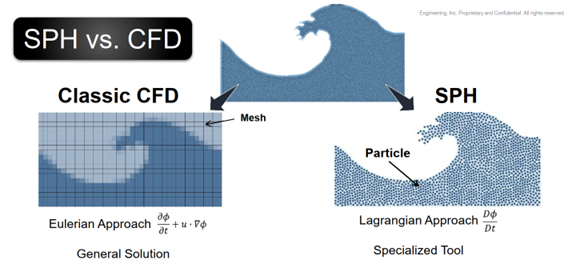
RANS methods are continuum-based, grid-dependent Computational Fluid Dynamics (CFD) methods that solve time-averaged equations for fluid flow, meaning they model the effects of turbulence rather than resolving every turbulent eddy directly. A RANS solver treats fluid as a continuous medium and solves for averaged quantities like velocity, pressure, and temperature on a fixed mesh.
RANS methods have several strengths:
- Computational efficiency for steady-state flows: Generally more efficient for steady-state or quasi-steady flows, making them suitable for larger domains and longer simulation times.
- Bulk Fluid/Air Flow Prediction: Excellent for predicting overall water behavior with aerodynamic interaction of the vehicle (multiphase).
- Pressure Prediction: Provide stable, accurate pressure fields used in coupled deflection and stress predictions, ie – FSI (Fluid/Solid Interaction) or FEA/CFD coupling.
SPH (Smoothed Particle Hydrodynamics)
SPH methods are mesh-free, Lagrangian particle-based methods. Instead of solving on a grid, the fluid is represented by particles that move with the flow, carrying properties such as mass, velocity, and pressure. These particles interact with their neighbors within a defined smoothing length, and fluid properties are reconstructed using kernel-based interpolation from these particle interactions.
SPH methods also have several strengths:
- Computational efficiency for transient flows: Naturally excel at simulating highly transient, violent, free-surface deformation, splashing, sloshing, and complex free-surface dynamics without numerical diffusion.
- No meshing: Eliminate the need for complex meshing and remeshing, simplifying setup for intricate geometries, moving components, and scenarios involving breakup or water fragmentation.
- Localized water ingress and component-level interaction: Well-suited for detailed analysis of water ingress through vents, drains, seals, and small openings, as well as direct water interaction with sensors, cameras, and air-intake pathways.
Let’s explore some common water management issues comprehensively tackled using Simcenter Fluids and Thermal Software and Simcenter Engineering and Consulting Services solutions.
Ensuring Clear Vision and Driver Safety
Everyone knows good visibility while driving is paramount. Even a mild compromise to a driver’s point of view can be aggravating or at its worst downright dangerous. Luckily there are a number of ways simulation can help your car maintain a clear view on a rainy day.
Windshield & Wiper Optimization
Using multiphase CFD modeling, engineers can precisely predict how wiper blades remove water under various rain and wind conditions. This allows for the optimization of blade design, speed, and sweep angle, and helps mitigate issues like water flow and streaking from A-pillars. More advanced coupled simulations (air and water) even analyze aerodynamic effects to ensure wipers remain effective at high speeds, reducing noise and vibration issues from wiper chatter.
Side Mirrors & Windows
Side view mirrors are an essential component of safe driving, one whose design must comply with varying government guidelines (minimum sizes and angles) as well as aerodynamic engineering constraints (minimal drag). For these reasons, a side mirror’s surface area tends to be relatively small and can easily become compromised by water. Fortunately, advanced CFD modeling techniques exist to mitigate these problems before they occur on the road.
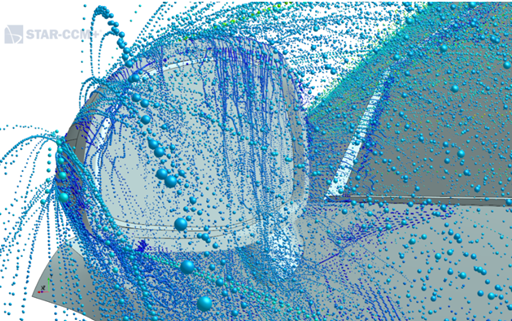
Detailed side mirror simulations often require a hybrid approach using different multi-phase models to approximate different solution domains; air flow, bulk water, water droplets & water film. Transition between domains is dictated by a user defined criteria (ie – droplet impingement, film thickness or blob diameter).
Hydroplaning & Tire Analysis
A properly performed tire analysis can enhance vehicle safety through optimized tire tread designs and significantly reduce physical prototyping time. These complex simulations use advanced methods to model the interactions between tires, water, and air in order to predict when and how a tire loses traction. They can be highly challenging simulations due to the moving and deforming tire geometry, transient flow behavior and the level of detail required to achieve acceptable accuracy.
These challenges can be overcome with Simcenter using a combination of Volume of Fluid (VOF), dynamic or overset meshing and coupled FSI solvers.
Navigating the Deep: Water Wading and Component Protection
Large accumulations of water are common after heavy rainfall, particularly in low-elevation areas, coastal communities and poorly draining roadways. Manufacturers know these events will occur over a vehicle’s lifetime and as a result, controlled water wading tests have become a standard requirement of most vehicle validation programs, particularly for electric vehicles where e-component protection is critical.
Water wading places simultaneous demands on splash management, sealing integrity, and dynamic water channeling around the vehicle. The unique architectures of both combustion-engine and battery-electric platforms create very different exposure paths for water, from air-intake and vent systems to underbody components, high-voltage enclosures, and thermal management hardware. Understanding how water moves, accumulates, and interacts with these systems during a wading event is essential early in the design process, long before physical testing begins.
Underpanel Deflections and Stress
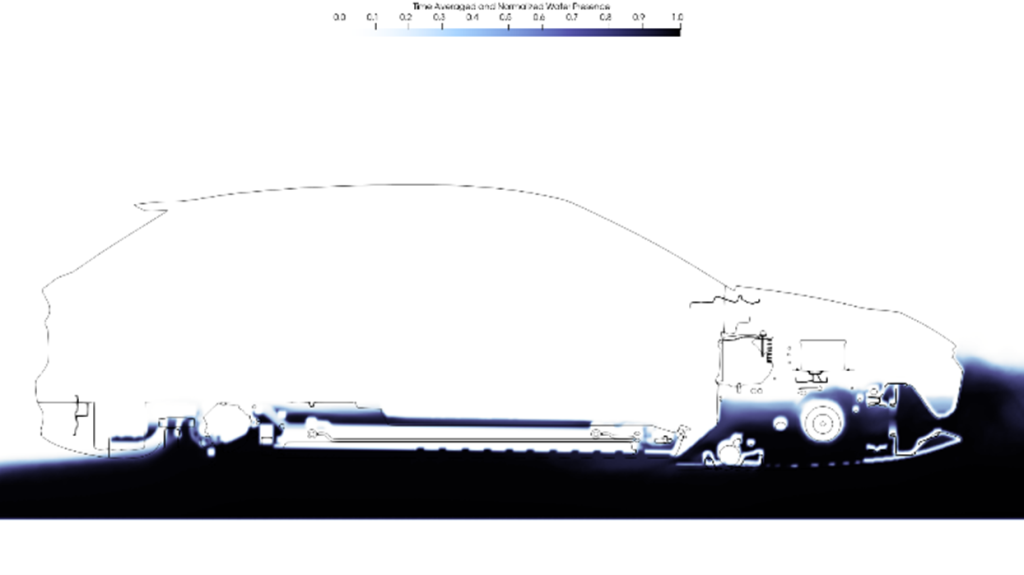
Whether from reckless driving or simply not paying attention, there is a good chance you will impact a large, heavy mass of water at high speeds with your car. You may not realize it at the time but this unfortunate event not only produces excessive water splashing but it can also lead to significant structural damage around the underbody of your car. Large panel deflections can produce unwanted stress or contact between components. So, although counterintuitive, a vehicle’s underbody must be designed for impact.
Engineers start the analysis by calculating high speed wading impact loads. These loads are then used as input conditions to predict underpanel deflections. The deflections correspond to mount point stresses which can lead to material fatigue and failure. The entire workflow is a coupled analysis called Fluid-Structure Interaction (FSI), and is essentially a two-part process with two separate simulation disciplines:
- CFD – A transient, multiphase (air/water) simulation calculates hydrodynamic pressure loads on the vehicle’s underbody as it wades (can include aerodynamic effects).
- FEA – Pressure loads are mapped onto a structural model and a Finite Element Analysis Solver is used to compute deflection, stress and strain of the underpanels and connecting components.
Taming the Spray: Fortifying Durability and Component Protection
We all remember childhood bike rides, drifting mindlessly between the road, sidewalk and puddles of rain. And it’s not until you are home when you realize that your back is completely soaking wet from the tire spray (more poor vehicle water management).
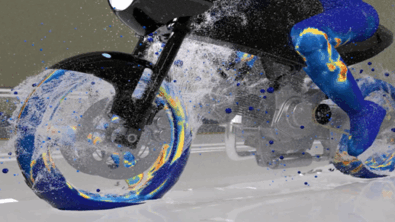
Water spray from a BMX bike could be seen as an acceptable nuisance (or even kind of fun), however, water spray from a motorcycle or car must be taken more seriously. It can be corrosive, destructive or even dangerous. Fortunately, there are several ways simulation can help mitigate the impact of tire spray early in the design cycle before the vehicle hits the road.
Driver Visibility & Safety
Spray simulations help engineers design components like wheel arches, underbody panels, and mudguards to minimize spray, improving driver visibility and addressing aero-acoustic and aesthetic issues.
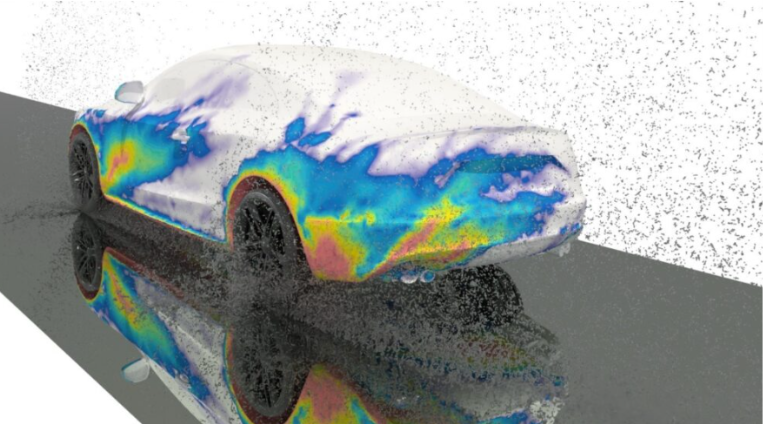
Component Contamination
A spray analysis can predict areas of high soiling on components like headlights, taillights, and radiators, allowing for optimized placement and the development of anti-adhesion coatings.
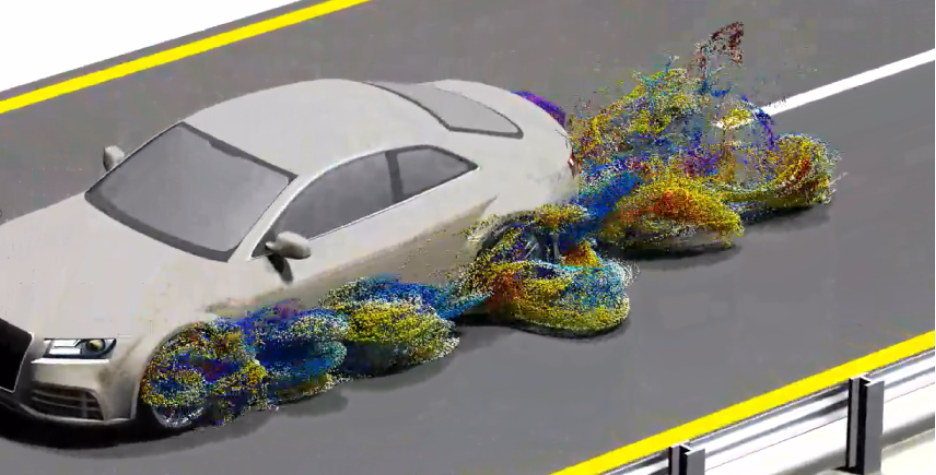
Corrosion and Component Failure
Dynamically simulating spray can also help engineers understand how corrosive substances like road salt affect vulnerable parts of a car or motorcycle over time, allowing for protective design measures.
Camera and Sensor Degradation
For Advanced Driver Assistance Systems (ADAS) and autonomous vehicles, a high-fidelity simulation can be critical for eliminating poor designs. Water droplet and film predictions help determine the optimal placement of cameras and sensors to minimize exposure to rain, mud, and dirt, and can aid in the design of effective cleaning systems.
Ingress Protection of Electronics
Ingress Protection (IP) Testing has become a critical part of modern vehicle validation as more electronics are packaged in exposed or splash-prone locations. Standards such as IEC 60529 and ISO 20653 define liquid ingress requirements for enclosures and road-vehicle electrical equipment (e.g. inverters, ECUs, sensors, battery pack housings, and connectors). It covers water-exposure scenarios that range from basic drip and spray protection (IPX1) to high-pressure, high-temperature washdown conditions (IPX9), representing progressively more demanding ingress protection requirements for automotive components.
Simulation is particularly effective for studying these behaviors because ingress failures are often driven by highly transient, localized water motion rather than steady flow. Short-duration events such as splash impingement, and impact-driven exposure can be analyzed to understand water pathways and accumulation. Simulation can also reveal how water enters components like latch mechanisms, while assessing the impact of vent and drain placement and identifying where water accumulates and repeatedly wets critical regions.
Optimizing Performance and System Functionality
Bulk water simulations also fine-tune how water interacts with complex vehicle systems.
Cowl Assembly Drainage and HVAC Ingress Control
The cowl assembly plays a critical role in vehicle water management, acting as a primary collection and redistribution zone for rainwater, spray, and runoff from the windshield and hood. At the same time, it often houses or feeds sensitive systems such as HVAC air intakes, cabin air filters, wiper mechanisms, and electronic components. During heavy rain or car wash events, the cowl experiences highly transient inflow, localized pooling, and rapid drainage demands. Poorly managed water behavior in this area can lead to ingestion into air-handling systems, water accumulation near electrical components, noise issues, or long-term durability concerns.
Simulation enables engineers to study these complex, time-dependent behaviors early in the design process. Transient water accumulation, overflow, splash-back, and interaction with grilles, screens, and drain paths can be visualized and quantified under repeatable conditions. This allows teams to evaluate cowl geometry, drain sizing and placement, and baffle effectiveness before physical prototypes are built. By understanding how water moves through the cowl under realistic loading scenarios, designers can reduce ingress risk, improve robustness, and avoid costly late-stage design changes.
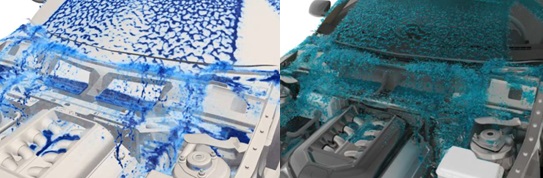
Hood and Tailgate Water Run-off
Run-off from the hood, decklid, and tailgate is a key aspect of vehicle water management, as water naturally follows surface geometry and will migrate toward gaps, edges, and interfaces if not intentionally guided. During rain and car-wash conditions, water films and rivulets form on exterior panels and detach at edges, hinges, lamps, and latch regions.
Simulation allows engineers to visualize these run-off paths under controlled conditions and evaluate features such as gutters, lips, channels, and drip rails that direct water away from openings and user touchpoints. This helps reduce water dumping during tailgate opening, limits repeated wetting of critical interfaces, and improves overall robustness before physical prototypes are built.
Tank Sloshing
Tank sloshing is a challenge in vehicle design, particularly in applications involving partially filled tanks such as fuel, coolant, or washer-fluid reservoirs. During braking, acceleration, cornering, or operation on uneven roads, liquid motion inside these tanks can become highly dynamic and chaotic. Uncontrolled sloshing can influence vehicle dynamics, introduce transient loads on tank walls and mounts, contribute to load shifting and slosh-induced roll moments, and generate noise. These effects are especially important in larger vehicles and systems where fluid volumes are significant and operating conditions vary widely.
Simulation provides a practical way to study and manage sloshing behavior early in the design process. Engineers can evaluate the influence of tank geometry, fill level, and internal features such as baffles under repeatable driving scenarios. This enables rapid optimization of baffle layouts to improve vehicle stability, reduce transient structural loading, limit fluid-induced center-of-mass movement, and mitigate slosh-related roll moments before physical testing begins.
Digital Drops, Real Impact
Vehicle water management is an intricate challenge, extending far beyond the backyards and driveways of our daily lives, and practical solutions may not always be obvious. Water mitigation requires insight, creativity and innovation – all of which the Simcenter portfolio of software and services can help provide.
With effective simulation, the unpredictable becomes calculable, transforming engineering from a reactive, trial-and-error process into a proactive, predictive science. Today’s engineers can innovate faster, build safer, and deliver more reliable products, ensuring a safer, drier, and more comfortable experience for everyone, regardless of the weather.
To get in touch with Simcenter Engineering Services, email us at engineeringservices.sisw@siemens.com.