Engineering a World Cup Goal: From sketch to stress results in minutes


How Siemens Designcenter NX and Simcenter Simsolid collapse a full design-and-simulation workflow into minutes, using a World Cup goalpost as the test.

With the FIFA World Cup 2026 underway, it is a good moment to look at the engineering that quietly makes the spectacle possible and at how dramatically the tools for that engineering have changed. The headline: an analysis that used to take a specialist most of a day can now be run by any competent designer in well under 20 minutes. Using Siemens Designcenter NX to build the geometry and Simcenter Simsolid to simulate it, you can go from a blank sketch to validated stress results without the meshing, defeaturing, and geometry cleanup that traditionally slow simulation to a crawl.
To make the point concrete, we put a regulation goalpost through one of the most heart-stopping moments in the sport: a shot ricocheting off the crossbar. The interesting part here though is not the goal; it’s how little time and effort it takes to find out whether the structure can take the hit.
Why this is so much faster than traditional simulation
Simcenter Simsolid, which joined the portfolio through the acquisition of Altair Engineering, runs structural studies without creating a mesh or simplifying geometry. In a conventional finite element workflow, meshing and defeaturing (removing small holes, logos, and fillets that trip up the solver) are the two most time-consuming and error-prone steps in the entire process. They are also where most projects stall.
Simcenter Simsolid skips them entirely. Instead of discretizing the model into a network of nodes, it uses advanced mathematics to approximate how stress and deformation distribute across the native CAD surfaces (CAD agnostic), then refines the solution to converge on accurate results. That accuracy is not a marketing claim: it has been independently verified by NAFEMS, the international authority on simulation quality.
The practical payoff is twofold. You work directly on native CAD geometry, so there is no translation or rebuild step between design and analysis. And solve times are rapid: the goalpost study below completed in roughly 30 seconds. That speed is what makes Simcenter Simsolid a natural fit for the design phase where it aids users in getting quick, credible answers while decisions are still being made, long before a model is handed off for final sign-off.
Designing the goal in Designcenter NX
Every regulation goal follows the same specification. The International Football Association Board (IFAB) requires goals to measure 8 ft (96 in) by 24 ft (288 in), built from reinforced aluminum, with the frame no wider than 5 inches. Those constraints are all the input the geometry needs.
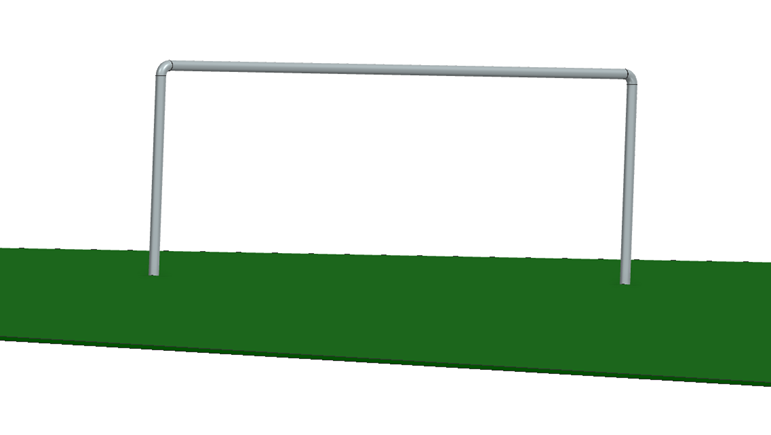
In Designcenter NX, the goal starts as a simple sketch, three lines matching the IFAB dimensions, with small fillets at the corners so the frame can later become a continuous hollow tube. A single Tube operation sweeps that profile into the finished goalpost. The whole shape is defined by a handful of moves, and because Simcenter Simsolid reads native CAD, the part file is saved exactly as you would save any other and imported as-is. No export gymnastics, no intermediate formats.
Simulating the crossbar impact in Simcenter Simsolid
Importing the model into Simcenter Simsolid is where the time savings become obvious. Simcenter Simsolid recognizes the goalposts and field as an assembly and generates the connections between parts automatically, with simple controls for gap and penetration tolerances. From there, and this is the step that normally consumes hours, there is nothing to defeature and no mesh to build. You go straight to setting up the study.
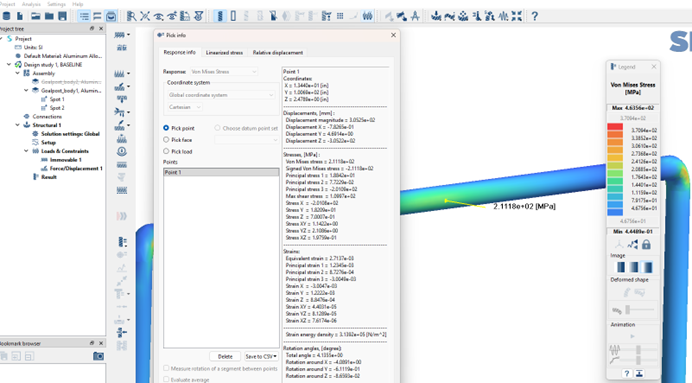
Setting it up is a matter of describing the physics: a structural linear study, immovable supports on the faces at the base of the posts, and a force applied to a precisely defined spot on the crossbar to represent the ball’s impact. The solve takes seconds, not the minutes or hours a meshed model of similar fidelity would demand.
The results are immediately interpretable. You can switch between stress, strain, displacement, and safety factor, then drill into any region of interest. A Pick Info tool reports the exact values at a single chosen point, useful for confirming whether the crossbar, at its most loaded moment, stays comfortably within the material’s limits.
From start to finish, a designer fluent in Designcenter NX and Simcenter Simsolid can model a structure like this and return validated simulation results in under 20 minutes. The speed comes from removing the friction: No meshing, no defeaturing, no CAD translation and not from cutting corners on accuracy.
That combination is what makes the pairing so effective in the design phase. Designcenter NX has become one of the most approachable yet capable tools for building geometry, and Simcenter Simsolid lets that same designer pressure-test it in minutes and act on real insight while there is still time to change the design. The goalpost is just a memorable example; the workflow applies to nearly anything you need to validate quickly.
For more walkthroughs and product feature highlights, visit the TrueInsight Blog.
Resources
- IFAB — The Field of Play
- NAFEMS — Simsolid benchmark validation
- Hero image from Adobe Stock.