Exploring Simcenter Reduced Order Modeling 2504

The latest version of Simcenter Reduced Order Modeling features enhancements and new capabilities that provide faster insights for better decision-making. Let’s look at the key highlights.
Gain faster insights with 3D surface field predictions
3D surface field ROMs are invaluable for the design engineer, since they represent the geometric reality, and efficiently capture the physical properties of an object’s exterior. This is often where critical interactions occur, such as heat transfer, fluid flow, and structural stress, to name a few.
With the latest release of Simcenter Reduced Order Modeling, and leveraging Simcenter STAR-CCM+ Design Manager, 3D scenes representing the effects of varying boundary condition such as flow rates, heat flux, radiation etc, can be captured and exported directly to Simcenter Reduced Order Modeling.
Transform surface-based models with varying boundary conditions into reduced-order models. By leveraging the fast and accurate Proper Orthogonal Decomposition (POD) method, you can now rapidly author parametric 3D field-based ROMs and visualize new variants of the model for quicker and faster insights.
The 3D visualization capabilities permit immersive interaction with the models whereby you can freely rotate, zoom, explore and inspect, whilst you evaluate new design variants intuitively and efficiently.
Observe directly how different parametric boundary conditions impact the models field-based predictions. The ROM is trained on precise field quantities previously solved and stored at mesh vertices and face centers, ensuring accurate representation of the physical phenomena and output field quantities of interest. Furthermore, you can export predictions for downstream collaboration, enabling seamless data mapping across various CFD and FEA applications.
Physics-based linearized heat matrix reduction for 3D thermal systems
This new capability allows Simcenter 3D thermal matrices to be imported directly to Simcenter Reduced Order Modeling creating a seamless pathway from 3D to 1D thermal modeling.

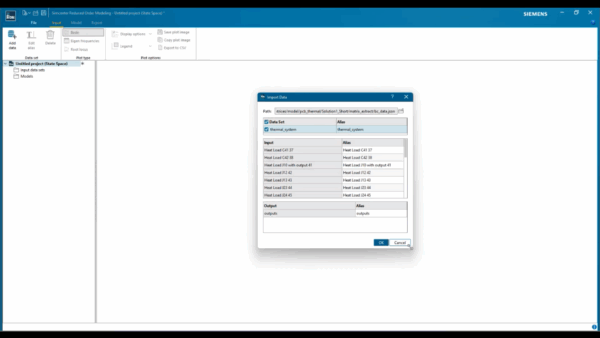
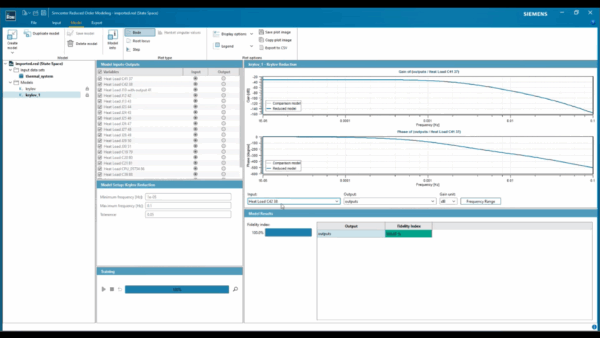
This advancement enables significantly faster downstream thermal analysis in tools like Simcenter Amesim and Simcenter Flomaster, while maintaining accuracy. Create fast physics-based ROMs to efficiently analyze complex thermal systems, such as spacecraft electronics PCBs, leveraging methods such as minimal Realization, Balanced Truncation and Krylov reduction. The streamlined workflow for authoring these ROMs saves both time and resources while providing reliable thermal predictions for critical thermal components.
Accelerating model sweeps
Model Sweep is an automated workflow that identifies promising combinations of model architectures and hyperparameters. The latest release introduces parallel processing capabilities to significantly speed up the training bandwidth for authoring ROMs. Multi-core CPU hardware can be fully leveraged to train multiple models simultaneously, resulting in a faster turn-around time for identifying those high performing model architectures.
Traceability improvements
Tracking training and validation datasets becomes increasingly challenging as ROMs evolve with new experimental and training data generated during product development. This lack of traceability can hinder model verification and future improvements.
The enhanced model information dialog now displays exactly what training and validation datasets were used for the model. In addition to the existing deails regarding model hyperparameters, input/output variables and scoring metrics.
This improved traceability enables better data management and more informed decision-making by providing a clear history of the model’s evolution. Staying organized whilst quickly identifying what worked (or didn’t) in previous iterations, leading to greater confidence. This is particularly valuable when multiple iterations of models are created over time with varying datasets.
Simcenter Reduced Order Modeling 2504 offers solutions to speed up processes, enhance traceability, and improve 3D field predictions.