Rethinking Systems Engineering for Software-Defined Products – The Death of the “Shall” Statement:
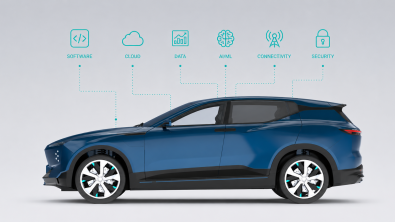
For decades, systems engineering lived by a comforting, linear reality: you froze physics, wrote thousands of deterministic requirements in an unyielding spreadsheet, and threw them over the wall to be built. But as artificial intelligence integrates deeper into our engineering loops and products become software-defined, this brittle foundation is collapsing. Welcome to the era of executable intent.

| Author: Piyush Karkare Global Director – Automotive Industry Solutions at Siemens |

1. The Static Mirage: Why Traditional Requirements Break
The classical V-model of systems engineering was built for a world dominated by physical
manufacturing constraints. In that paradigm, hardware definitions had to be frozen years before
a product hit the assembly line because retooling an injection mold or stamping die costs
millions of dollars. Requirements engineering naturally adapted to mirror this rigidity,
standardizing around natural-language statements patterned exactly like legal statutes: “The
system shall execute X behavior within Y milliseconds under Z constraints.”
This approach worked exceptionally well when systems were deterministic and isolated.
However, in modern Software-Defined Systems (SDS)—such as a Software-Defined Vehicle
(SDV) or an autonomous industrial robotics hub—the physical product leaving the factory floor
is no longer a static asset; it is merely a substrate. The product’s capabilities, performance
boundaries, and safety functions are continually redefined post-sale via over-the-air (OTA)
updates over a lifecycle spanning a decade or more.
“When a software commit can instantly alter the torque curve of an electric vehicle or rewrite
the perception algorithms of an airborne drone, a static, paper-based requirement is obsolete
before the ink is dry.”
When you overlay heavy AI utilization onto this lifecycle—using machine learning models both
within the embedded product architecture and throughout the automated development
toolchain—traditional requirements engineering faces an immediate, catastrophic scaling failure
driven by three core dynamics:
- The Combinatorial Variant Explosion: Post-launch feature personalization, continuous
software micro-patching, and regional regulatory calibrations create millions of valid running
configurations across a fleet. No engineering organization can manually map or review
relationships across this many permutations using legacy documentation or monolithic
databases. - The Probabilistic Paradigm Shift: Traditional validation depends on binary logic (Input A
yields Output B). Advanced AI models—like vision-transformers or vision-language-action
models used in autonomy are inherently probabilistic. They operate within statistical
performance envelopes, meaning you cannot write a deterministic ‘shall’ statement for how
a model will interpret a unique, pixel-by-pixel environmental edge case. - The Lifecycle Mismatch: Hardware lifecycles move on a cadence of years, software on a
cadence of weeks, and AI models on a cadence of days. Forcing software-defined
architectures through rigid, hardware-centric staging gates create engineering friction,
artificial bottlenecks, and catastrophic integration failures during late-stage physical
validation.
2. The Solution: The Semantic AI-Driven Digital Thread
Because manual human intervention can no longer track these multi-domain dependencies, the
industry is transitioning toward an AI-Driven Digital Thread. This is not simply about replacing
paper documents with cloud-hosted PDFs; it is an architectural re-engineering of the entire
development ecosystem.
At the heart of this shift is the Semantic Knowledge Graph. Instead of text documents isolated in
separate silos (Requirements in DOORS, code in Git, tests in a legacy test management suite), all
engineering entities are compiled into an interconnected web of live data. The graph explicitly
understands relationships: it knows that a mathematical parameter limitation in an autonomy
model is linked to a regulatory standard, verified by a specific synthetic simulation scenario, and
continually monitored by an operational cloud telemetry loop.
| Thread Phase | Data Flow & AI Orchestration |
|---|---|
| Dynamic Synthesis | AI agents ingest unstructured legacy data, automatically extracting constraints and using GraphRAG to flag contradictions across millions of system parameters. |
| Executable Specs | Requirements are translated directly into executable test blocks and code stubs. If an intent cannot be programmatically validated via automated simulation, it is flagged as mathematically invalid. |
| Virtualized Loop Validation | Physical benches are bypassed for continuous cloud simulation. Target software payloads are stress-tested in real-time against adversarial AI models designed to induce edge-case failures. |
| Closed-Loop Telemetry | Deployed products stream real-time telemetry back to the cloud. Machine Learning Models isolate performance anomalies and automatically map them back to the architectural graph, generating a development loop for the next software version. |
3. The Cultural Imperative: Guardrail Governance over Creation
The introduction of generative AI code co-pilots introduces a subtle engineering paradox: AI
accelerates both good and bad workflows with equal velocity. If an engineering team
provides an LLM co-pilot with ambiguous, poorly structured system requirements, the AI will
simply help them generate vast quantities of deeply flawed code, complex parameter conflicts,
and technical debt at an unprecedented speed.
Therefore, systems engineers must fundamentally change what they do on a day-to-day basis.
The engineer’s primary output is transitioning from writing text to managing context and
guardrails.
Instead of hand-crafting individual code modules, human systems engineers act as stewards of
the machine-readable knowledge layer. They define the rigid system guardrails, performance
envelopes, and structural boundary limits that the generative AI agents must work within. The
actual compilation, generation, and baseline testing of the artifacts are offloaded to automation,
allowing the engineer to spend their cognitive capital on system-wide synthesis and
architectural edge cases.
4. The Road Ahead: Continuous Virtual Sovereignty
For organizations engineering complex software-defined systems, the path forward requires an
aggressive pivot toward Simulation Sovereignty. If a product’s safety case cannot be
automatically verified through millions of parallel virtual simulation hours using highly realistic
synthetic data, that product will fail to scale in the marketplace.
We must leave behind the comforting but obsolete world of frozen text documents. To survive
the immense complexity of AI-accelerated product development, modern enterprises must treat
requirements as an executable, evolving software pipeline—ensuring that design, verification,
deployment, and real-world execution remain tightly bound within a single, continuous digital
thread.
5. Conclusion: Engineering the Next AI-Driven Reality
The architectural evolution from static text to a dynamic digital thread represents more than an
update to our tools—it forces a total rewrite of engineering philosophy. For decades, the goal of
an engineering team was to build a physical product and eventually find a way to patch an AI
model or a software module into it. This approach merely yields an AI-enabled product—a
classical machine with digital decorations, permanently limited by the rigid, siloed assumptions
made at its inception.
To win in a software-defined market, engineers must completely flip the stack. They must learn
to build the next generation of AI-driven products. These are systems designed from day one
to treat hardware as a generic, adaptable substrate controlled by an evolving digital nervous
system. In this new paradigm, the product is an adaptive, learning entity that natively expects its
parameters to drift, its code to self-optimize, and its operational envelopes to expand via
continuous feedback loops.
Moving forward, engineering excellence will no longer be measured by the perfection of an
initial, frozen specification sheet. Success belongs to the organizations that construct an
absolute closed loop: a semantic architecture where AI synthesizes intent, automated simulation
guarantees safety boundaries, and live operational telemetry constantly feeds the system’s
evolution. The traditional V-model has reached its structural limits; the future belongs to those
who build the continuous, self-sustaining digital thread.
| Author: Piyush Karkare Global Director – Automotive Industry Solutions at Siemens |