Static Risk Meets Operational Reality: Vulnerability Management with Polarion
In my earlier post (https://blogs.sw.siemens.com/polarion/cra-compliance-made-simple-how-polarion-helps-you-stay-ahead/), I covered the basics of the Cyber Resilience Act (CRA) and outlined how TARA, software bills of materials (SBOMs) and vulnerability data connect. This post goes a step further. A TARA (Threat Analysis and Risk Assessment) captures risks and mitigation actions during concept and development. A vulnerability, however, can surface at any point, often years after the product has reached the field. The value comes from connecting the two without losing the reasoning behind either. That is where Polarion helps: it keeps design-time analysis and operational data in one connected lifecycle.
A quick refresher on TARA
When running a TARA, we start with the things we want to protect: components, data and functions that matter to the product, its users or its operator. An asset on its own isn’t a risk. It becomes one when a threat could compromise it, and the result of a successful attack is a damage.
We rate every damage in four ways: Safety, Financial, Operational and Privacy/Environment (SFOP/SFOE). A compromised gateway might endanger people, halt production, trigger a recall and expose personal data, all at once. If we looked at only one of those, we’d miss the rest. To find threats, we often use STRIDE, a model developed at Microsoft. Each category is a way a security property can be broken:
- Spoofing breaks authenticity.
- Tampering breaks integrity.
- Repudiation breaks non-repudiation.
- Information disclosure breaks confidentiality.
- Denial of service breaks availability.
- Elevation of privilege breaks authorization.
Three of these cover the classic CIA triad, and STRIDE adds the properties that matter most in connected products. We come back to these categories when we triage new vulnerabilities. For each threat, we calculate attack feasibility. We can do that at a high level, or we can go deeper and calculate exploitability for each attack step, based on factors such as access path, required expertise and effort. Combined with the impact of the damage scenarios, feasibility gives us the risk. We then address each risk with a cybersecurity goal, justify it with a claim, or mitigate it with a control. Once all mitigations are in place, we re-evaluate the risk. Ideally, it comes out lower.
Orchestrating the SBOM
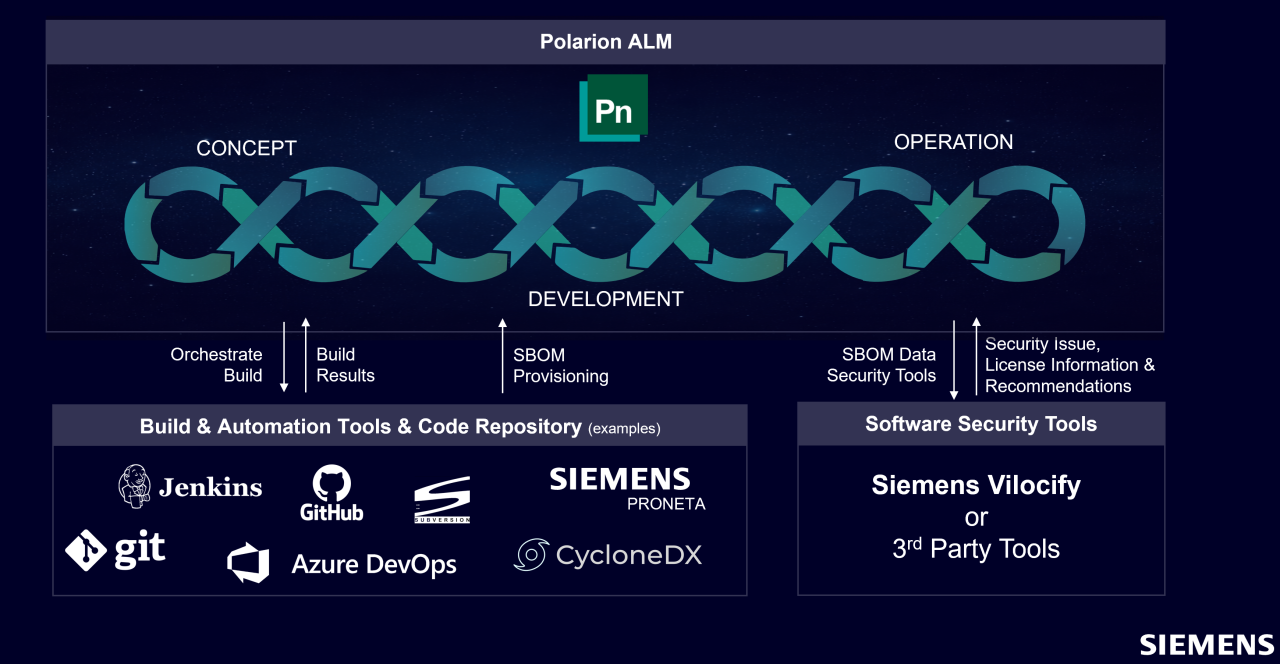
In my previous blog post, I showed how SBOM handling fits into the development pipeline. The pipeline is only one way an SBOM reaches Polarion. In practice, there are several entry points:
- Builds: each build produces a machine-readable SBOM, which the pipeline sends to Polarion.
- Network scans: tools such as ProNeta show which components are actually running on the network, including firmware revisions.
- Direct uploads: existing SBOMs in formats such as CycloneDX can be uploaded directly. This is useful for third-party components and for products that were built before the pipeline existed.
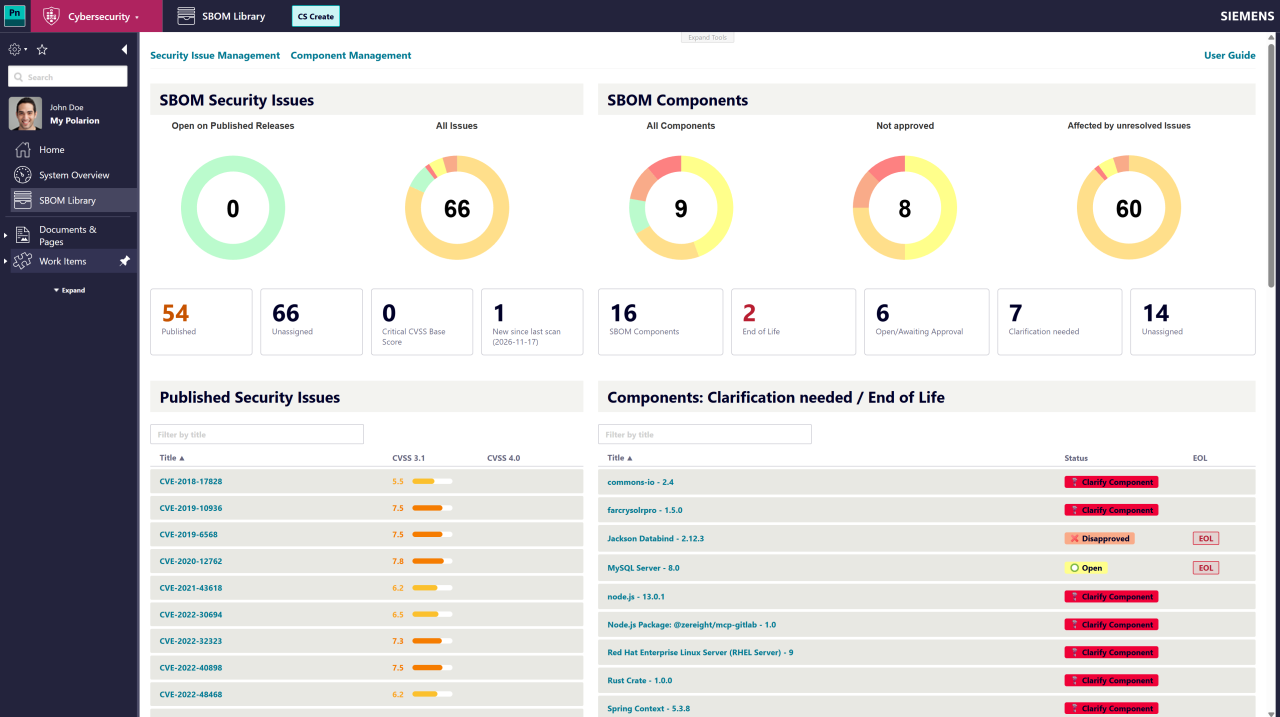
Whatever the source, Polarion collects the data in one central library instead of scattered files. From there, users can see which components and revisions are in use, track license and security issues, and follow each component through the releases that contain it. The orchestration is what matters. An SBOM is only useful if it stays current, whether it arrives with the next build, from a scan or through an upload.
Vulnerability Intelligence with Siemens Vilocify: Keeping an Eye on the Outside World
An SBOM tells us what we ship, but not which issues will be found in those components tomorrow. Those components include automation products, operating systems, open-source libraries and other third-party software, so the outside world is the real source of change. That is where Siemens Vilocify comes in. It monitors a large number of sources, including vendor advisories, vulnerability databases, CERTs and repositories, and turns them into normalized notifications with severity ratings and recommended actions.
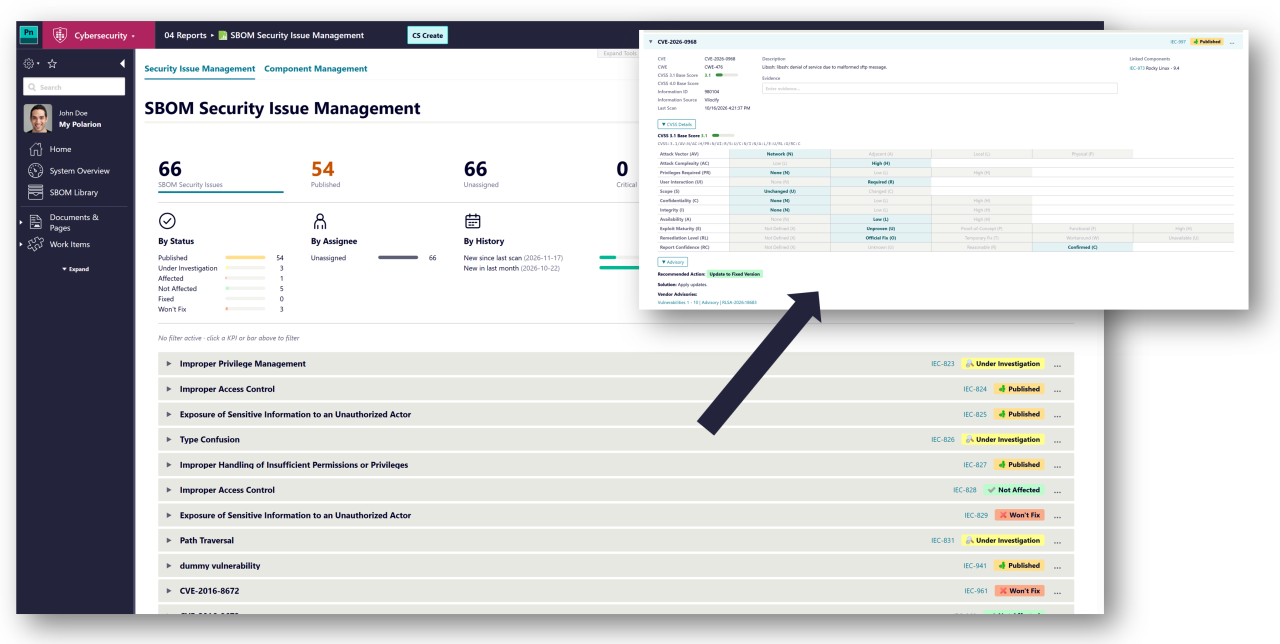
Polarion connects to Vilocify and synchronizes our components with known vulnerabilities automatically in the background. The link between what we ship and what is being found stays current without manual checks, and the findings land where the engineering and security decisions are made.
Where Design Knowledge Meets Vulnerabilities
We conduct TARA to learn which threat scenarios and attack feasibilities can occur, and which damages could follow. That knowledge gives us good insight into how to protect a system as designed. We also know how the system is made up and how it is built, and we have solutions in place to connect this to vulnerabilities at any point in time.
A vulnerability does not automatically matter. Sometimes it breaks an assumption the design relies on, such as a segregated network or a read-only flash, and an eliminated attack path can reopen. Other times the design still holds. The segregated network blocks the path, and the vulnerability cannot cause harm. Even then, we need to document the rationale, because a decision that nobody can trace is not a decision we can defend. So every new vulnerability raises the same three questions: which asset is affected, how we triage the information, and which follow-up actions we derive.
Which asset is affected?
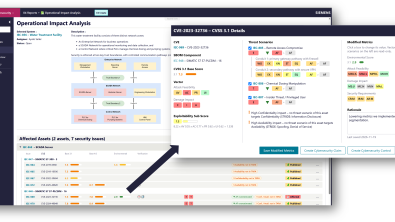
Vilocify synchronizes Common Vulnerabilities and Exposures (CVE) entries with our component revisions in Polarion. Each new CVE is first matched against the component revisions in our SBOM. That match alone shows which releases contain the component, so we immediately know whether action is needed on a release that is still in development or one that is already with customers. Connecting components to assets takes us a level deeper. We see which protected functionalities a vulnerable component supports, and with them the threats and impacts that apply. That turns a release-level match into concrete, actionable insight.
How do we triage the information?
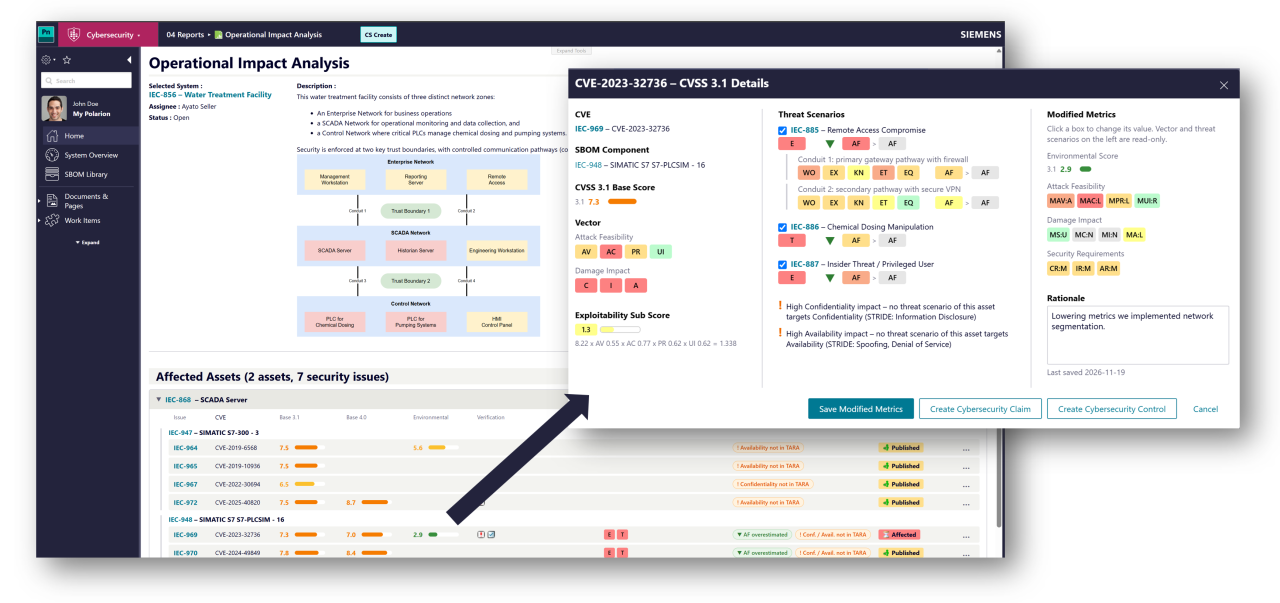
For each affected threat scenario, we combine two inputs. The first is feasibility: the Common Vulnerability Scoring System (CVSS) exploitability, adjusted for the in-system context. The second is impact: the damage scenarios across Safety, Financial, Operational and Privacy. The STRIDE category of the threat scenario tells us which security property is at stake, and that points us to the damages that matter most. For example, a vulnerability that enables information disclosure threatens confidentiality, so we look first at the privacy and operational damages. A vulnerability that enables tampering threatens integrity, so we look first at the safety and financial damages. We keep the individual dimensions visible, so a high worst case in one area is not hidden by a low score in another. The result falls into one of three outcomes:
- Not affected: the vulnerable code path cannot be reached in our design. We document this with a rationale, for example as a Vulnerability Exploitability eXchange (VEX) statement.
- Affected, risk acceptable: we keep the risk and justify it with a claim.
- Affected, risk too high: we add or strengthen a control and create a work item.
Which follow-up actions do we derive?
Each outcome leads to a concrete information object. A new or changed control becomes a requirement. A work item is linked to the affected releases and the threat scenarios it addresses. Once the mitigation is in place, we re-evaluate the risk. The residual risk should be lower, and the evidence should show it, which brings us back to the static analysis.
Why Polarion
Polarion gives us one place where the whole chain lives: the TARA with its threat scenarios, damages, controls and claims, the SBOM with its components and releases, and the vulnerability data from Vilocify. Because these are linked, a new CVE can be traced to the affected assets, and the reasoning behind each decision stays attached to the data it refers to. Baselines capture the state of the analysis at each release, which gives us the audit evidence we need. That matters for the CRA, where we need evidence that we monitor and act on vulnerabilities, and for standards such as ISO/SAE 21434, which also expect traceability. The result is not another list of vulnerabilities. It is a living risk picture that stays connected to the design it protects.static analysis.
What’s next?
This version of our cybersecurity template will be available early 2027. Reach out to your Siemens Sales representative for more information. Stay tuned.