Beyond optimization: how semiconductor manufacturing is entering the era of autonomous decision-making
Semiconductor manufacturing has always operated at the edge of what is technically and operationally possible. Precision has long been non‑negotiable, complexity unavoidable. What has changed in recent years is not the presence of complexity, but the speed at which multiple forces now converge on the factory at once.
Artificial intelligence, advanced packaging, sustainability targets, and global capacity expansion are no longer trends on the horizon. They are simultaneous pressures shaping everyday manufacturing decisions. For many organizations, this has shifted the core challenge away from capacity alone and toward something more fundamental: judgment.
Decisions must now be made earlier in the lifecycle, often before all variables are fully known. Their effects extend well beyond a single process step. Layout choices influence flexibility years later. Dispatching and batching rules affect both yield stability and energy consumption. Workforce decisions increasingly determine whether throughput can absorb disruption as effectively as automation does.
In this environment, competitive advantage does not come from making isolated processes faster. It comes from understanding how the production system behaves as a whole and guiding that system as it evolves. Across the industry, this marks a broader transition: a move away from digital tools used in isolation and toward digital intelligence applied continuously.
The limits of incremental optimization in semiconductor manufacturing
Much of the current discussion around manufacturing improvement still focuses on incremental gains. Faster scheduling algorithms promise near‑term efficiency. AI‑driven inspection improves detection at individual tools. Performance dashboards offer clearer visibility into selected KPIs.
Each of these capabilities delivers incredible value. Yet they also share a limitation that becomes increasingly apparent at scale: they optimize components, not systems.
The more consequential questions remain difficult to answer using fragmented approaches:
- How do decisions made in one part of the factory reshape overall behavior days or weeks later?
- How does a local improvement change material flow, workforce utilization, or downstream capacity under real operating conditions?
In high‑mix, high‑capital environments, these interactions matter. Optimization at the component level does not automatically translate into optimization at the factory level. Without a continuous, system‑level view, improvements in one area can easily be offset by unintended consequences elsewhere.
What manufacturers increasingly need is not another point solution, but a cohesive understanding that links intent, execution, and outcome without interruption.
Why production digital twins matter in semiconductor manufacturing
This is where the production digital twin becomes essential.
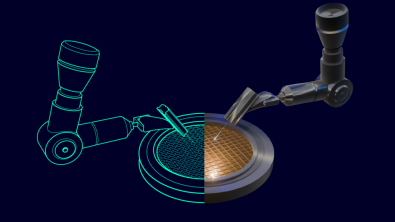
A genuine production digital twin is not a static model created for a single planning exercise. It is a living representation of how the factory actually behaves. It captures the interaction between layout, material flow, automation, workforce activity, and control logic, including the variability that defines real production rather than idealized conditions.
Just as importantly, it does not become obsolete once production begins. As the physical system changes, the digital representation is refined. Insight remains current, and decisions remain grounded in reality throughout the factory lifecycle.
Siemens’ approach to smart manufacturing is rooted in this principle. The closer the virtual representation aligns with the physical system, the greater the confidence manufacturers gain in their decisions. In this context, simulation is not confined to early planning. It becomes a continuously used decision framework, supporting concept development, ramp‑up, and ongoing optimization.
The true value lies not only in predicting outcomes, but in understanding how the system responds, and adjusting course before performance deteriorates.
Where Siemens thinks differently
The distinguishing strength of Siemens does not lie in any single capability. It lies in the ability to maintain continuity across disciplines and across time.
Rather than treating simulation, manufacturing execution, and lifecycle management as separate activities, they are connected through a shared digital foundation. Engineering intent, production behavior, and quality outcomes are not merely captured: they are related, compared, and fed back into future decisions.
This enables planning assumptions to be validated against execution, while operational insight informs the next iteration of design. Information flows in both directions, reducing the delay between discovery and response.
This approach addresses a long‑standing challenge in semiconductor manufacturing: the structural separation between design and manufacturing systems. When these domains operate independently, traceability weakens, change management slows, and learning remains localized. A unified digital thread restores coherence across the enterprise and supports more deliberate, informed decision‑making.
AI as a partner in engineering judgment
Artificial intelligence is already reshaping semiconductor markets. Its next, and more consequential, influence will be on how manufacturing decisions are formed.
The future does not point toward AI replacing engineering expertise. It points toward AI extending semiconductor expertise and augmenting it. By accelerating the exploration of alternatives, reducing manual effort in preparing analyses, and revealing patterns that are difficult to detect through experience alone, AI expands the engineer’s ability to reason about complex systems.
Equally important, AI shortens decision cycles. Assumptions can be tested more often. Tradeoffs can be explored before they harden into constraints. Instead of reacting to late‑stage surprises, organizations gain the ability to anticipate and adapt.
In this role, AI becomes an extension of the digital twin itself, enabling insights to keep pace with complexity rather than being overwhelmed by it.
The semiconductor inflection point: AI, chiplets, and system‑level complexity
Several powerful forces are converging, making a system‑level approach to manufacturing unavoidable. AI‑driven workloads are placing unprecedented demands on throughput stability and energy efficiency. At the same time, chiplet architectures and advanced packaging introduce variability that fundamentally reshapes back‑end production dynamics.
Heterogeneous integration further blurs the traditional boundary between front‑end and back‑end optimization. Decisions that were once treated independently now interact across the value stream in subtle but significant ways.
Sustainability adds another layer. Energy and resource efficiency can no longer be optimized locally. They must be managed at factory scale, where layout choices, dispatching policies, and automation strategies directly influence long‑term consumption patterns. Global capacity expansion only raises the stakes. As investments grow larger and timelines tighter, late discovery of constraints becomes increasingly costly.
What unites these trends is their amplification of interdependencies. Choices made during layout planning affect energy usage years later. Dispatching strategies influence yield predictability. Workforce allocation shapes both throughput and environmental outcomes. These effects rarely appear in isolation, and they are difficult to quantify without a holistic view.
Only a system‑level digital foundation makes these trade‑offs visible early enough to matter.
Toward autonomous and self-learning semiconductor factories
Looking ahead, the direction of semiconductor manufacturing is clear. Factories are evolving toward systems that continuously compare planned and actual performance, detect emerging constraints before they materialize, and adapt scheduling, routing, and resource allocation dynamically.
Energy efficiency and throughput optimization are increasingly pursued together rather than treated as competing objectives. Each production cycle becomes a learning opportunity, strengthening future decisions through accumulated insight. Over time, simulation transitions from a project‑based activity into an operational capability embedded in daily practice.
This is not a speculative vision. It is the natural outcome of tightly connecting virtual and physical systems through a unified digital twin. As production environments become more autonomous, the value of a trusted, system‑level foundation will define industry leadership.
By treating the factory as a connected cyber‑physical system and using digital twins as the backbone of decision‑making, manufacturers build resilience into their operations. They gain the ability to act earlier, learn continuously, and scale with confidence as complexity increases.
Bringing these capabilities into practice requires more than isolated tools. It requires a connected environment where planning and execution inform one another.
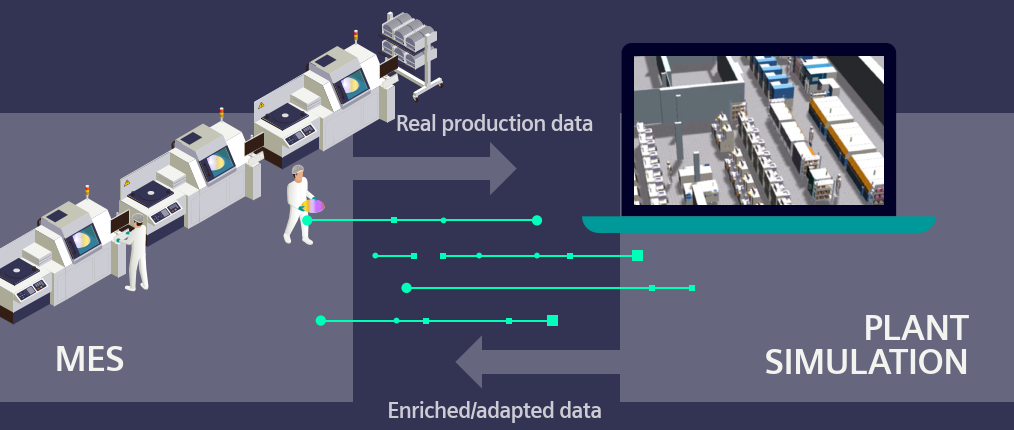
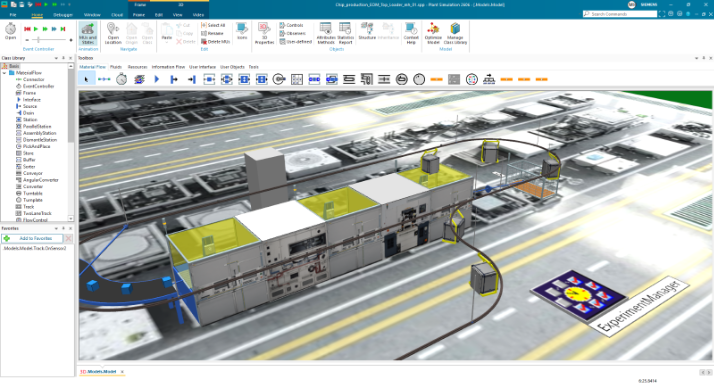
Combining the strength of Plant Simulation and Opcenter Execution, our MES software, semiconductor manufacturers can bridge this gap. Plant Simulation provides the ability to explore scenarios, validate decisions, and understand system behavior before changes are implemented, while the MES offers real‑time production data and execution control on the shop floor. Optimized schedules, resource strategies, and dispatching rules can be developed, tested, and then executed with confidence. This enables greater responsiveness to disruptions, more accurate capacity planning, improved utilization of equipment and workforce, and a stronger alignment between operational performance and long‑term strategic goals.
A Plant Simulation model in Digital Twin Composer offers significant benefits by making simulation results more accessible, interactive, and scalable. It enables users to move forward and backward in time, making it easier to analyze system behavior, understand cause-and-effect relationships, and review critical situations in detail. Complex simulation models can be executed efficiently, while simulations from different sources and varying levels of detail can be combined into one coherent environment. In addition, Digital Twin Composer allows simulation runs that normally take hours to be visualized smoothly within seconds, creating a fast and intuitive way to explore, communicate, and validate system behavior.
This is the future Siemens Digital Industries Software is building toward, and the foundation on which the next generation of semiconductor manufacturing will be shaped.
Explore what a connected digital twin strategy can unlock for your semiconductor operations and find out more on our website.