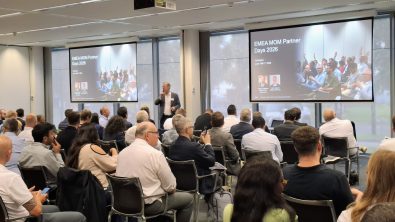
AI: Shaping the future of autonomous operations

AI agents, Insights Hub and Opcenter: turning shop‑floor data into fast, guided decisions
Introduction
At Hannover Messe, AI: Shaping the future of autonomous operations on‑stage presentation captured a clear and practical view of where industrial AI is taking manufacturing today: not toward some distant, fully autonomous fantasy, but toward stepwise, high‑impact automation that augments people, stabilizes operations and unlocks measurable value. Siemens is applying agents, industrial knowledge graphs and contextual analytics to move from siloed data toward coordinated, actionable workflows — the building blocks of what Ralf calls “autonomous operations.”
The data challenge — From silos to context
Manufacturers already collect large volumes of IoT telemetry, transactional records and quality inspections, yet these data streams often live in separate silos. The power comes from connecting them into a contextual layer — an industrial knowledge graph — and then placing intelligent agents on top.

These agents do more than answer questions: they can plan, check and act. In practice that means systems that detect an anomaly, identify whether it’s a process, supplier or material issue, and surface the right next step to the operator or planner. The result is fewer wasted service calls, faster root‑cause isolation and decisions made from a single, trusted context.
One of the most compelling threads in the talk was the role of AI agents. Unlike single‑purpose tools, agents can be orchestrated to run numerical analyses, pull the exact data required, and return concise, actionable insights without overwhelming the user.
Presenters highlighted examples ranging from flexible grasping robots (visual‑language action models that figure out what to pick without exhaustive step‑by‑step training) to “autonomous production planning” that adapts schedules when a part shipment is late. These agentic capabilities let factories react in minutes to issues that previously required lengthy investigations and many manual handoffs.
Insights Hub: The analytics and context layer
Insights Hub sits at the center of this approach. By ingesting time‑series, transactional and inspection data and contextualizing it against MES and PLM information, Insights Hub transforms raw signals into operational intelligence. This enables out‑of‑the‑box use cases such as predictive quality — where process and transactional inputs are combined to forecast whether the current part will meet tolerance — and rapid correlation of anomalies to supplier, batch or handling conditions. Speakers’ examples show how that contextualization prevents unnecessary technician dispatches and speeds corrective action by pointing to the true root cause, whether it’s a process drift or a supplier quality issue.
Opcenter: The Governed Execution Backbone
From a product and functional standpoint, the combined offering delivers several concrete capabilities. Opcenter provides the governed execution backbone — recipe and BOM management, multilevel genealogy, operator workflows and auditability — ensuring that data and actions are consistent and traceable across sites. Insights Hub adds the analytics and AI layer: data contextualization via knowledge graphs, low/no‑code model building for forecasting and anomaly detection, production copilot interfaces driven by LLMs and orchestration components (the production compiler and agent manager) that trigger the right analyses automatically. Copilot Studio extends this further by allowing customers to encapsulate proprietary skills and domain logic into the Copilot, so local know‑how becomes a reusable and governed capability.
The values coming from this combination are practical and measurable. Operators and shift lead get faster mean‑time‑to‑resolution and clearer remediation steps; quality and production engineers obtain predictive indicators that reduce scrap and rework; planning and operations teams gain agility through automated rescheduling and impact analysis; and supply‑chain interactions improve because the system can point to supplier‑related root causes quickly. Presenters pointed to real initiatives inside Siemens — and with partners such as NVIDIA and Accenture — where these building blocks are already moving factories toward higher autonomy and substantially reduced operational cost.
Adoption is about orchestration and simplicity. Too many tools or agents exposed directly to an operator would create confusion rather than value, so agent orchestration and a clean user experience are essential. The recommended path is pragmatic: pick a few high‑impact use cases, avoid creating new data silos, and build on a composable platform that supports governance and upgradeability. That way organizations can move from pilots to scaled deployments while preserving control and achieving ROI.

If you want to see these ideas in motion, the video recording of the Hannover Messe presentation gives a compact, insightful walkthrough.
Video Recording
Want to learn more about our products? Visit our Insights Hub and Opcenter MES web pages.