What you missed at Hannover Messe 2026

Hannover Messe 2026 ran from April 20–24 in Hannover, Germany, drawing more than 130,000 attendees and 4,000 exhibitors from across the global manufacturing and industrial technology landscape. If you weren’t there, here is a recap of everything Siemens brought to the world’s leading trade fair for manufacturing.
The Siemens Booth: Hall 27, Stand A48 – Turning AI into Industrial AI
Siemens’ new location in Hall 27 served as a gateway for visitors to experience Industrial AI across every step of the value chain. From the comprehensive Digital Twin to autonomous workflows, Siemens demonstrated how AI for the real world can help companies innovate faster, scale more easily, and operate smarter.

The overarching theme for Siemens this year was “Make data work for you” and the booth was built around making that promise tangible. Modern manufacturers are under more pressure than ever. Supply chains remain fragile, product complexity is rising, and customers expect faster delivery with greater customization while companies face persistent labor shortages and cost constraints. In Hall 27, the Siemens booth focused on how Industrial AI can help companies navigate this modern manufacturing landscape.
On the evening of April 20, Cedrik Neike, member of the Managing Board of Siemens AG and CEO of Siemens Digital Industries, presented at the Siemens press conference, focusing on how Siemens’ Industrial AI solutions are driving flexible manufacturing and full traceability across industries. You can find a small recap of Cedrik talking about those subjects in an interview here.
The Innovation Hub: Manufacturing a modern athletic shoe with AI
Inside the booth itself, the Innovation Hub offered a glimpse into the present and future of modern product design and manufacturing, using artificial intelligence in real-world examples, including the new AI Make Machining Suggestion copilot recommended machining operations for production of mold cores.

The showcase illustrated how a modern athletic shoe can be designed and produced when these factors guide both design and manufacturing within a connected workflow. The focus remained on aligning product geometry with performance requirements by following the design and manufacturing of the midsole and outsole portions of the shoe. The midsole sits between the upper, which surrounds the foot, and the outsole, which contacts the ground. These parts work together to manage impact, support movement, and contribute to energy return.
The midsole design followed a connected process that translated user requirements into production-ready geometry. Foot shape and pressure patterns helped clarify how forces moved across the foot during motion. This insight guided decisions on where impact absorption, structural support, and energy return mattered most.

The internal lattice structure was defined in Siemens NX, with lattice density and pattern varying across the midsole. Denser regions managed higher loads, while more open structures supported flexibility and controlled deformation.
With additive manufacturing capabilities in NX CAM, the design moved into production preparation. The workflow ensured accurate translation of the complex lattice geometry into a manufacturable form, supporting customized midsoles without dedicated tooling.
Unlike the midsole, the outsole is mass produced and follows standard shoe sizes using injection molding rather than custom geometry. During design, a natural-language copilot in NX X Designcenter suggested suitable design features for the outsole. The resulting geometry then became the input for designing mold tooling and inserts.
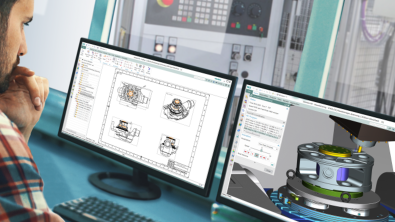
In manufacturing preparation, NX X Manufacturing was used along with the new AI Make Machining Suggestion capability for CAM programming. When a surface is selected for machining, the system uses AI to propose multiple machining strategies. The CNC programmer then reviews the options and selects the most suitable approach, reducing manual effort in toolpath planning while maintaining control over the final decision.
On the Hannover Messe Main Stage: Siemens Executives Took the Spotlight
The Siemens presence extended far beyond the show floor. Front and center on the Center Stage in Hall 25, where the event’s most prominent keynotes took place, Siemens executives could be found discussing the latest in manufacturing innovation.
In a fireside chat on April 20 from 12:00–12:30 pm at the Center Stage, Accenture Chair and CEO Julie Sweet joined Roland Busch, President and CEO of Siemens, to discuss what it takes to scale AI across complex industrial organizations. It was one of the most high-profile conversations of the entire fair week, touching on industrial sovereignty, workforce transformation, and the practical realities of deploying AI at enterprise scale.
In another session, Roland Busch and Friedrich Merz, Federal Chancellor of Germany, both highlighted the importance of industrial AI and its role in the future of industrial processes. This was a signal that Siemens’ Industrial AI agenda has moved well beyond the technology conversation and into national economic policy discussions.
Siemens at the Microsoft Booth: Hall 17
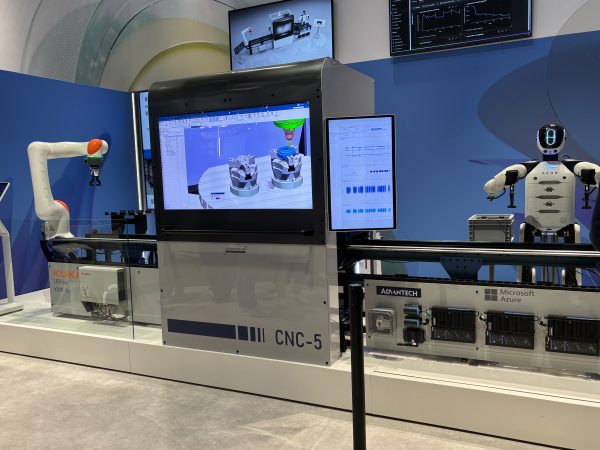
One stop that many attendees may have overlooked was the Microsoft booth in Hall 17. The Microsoft booth featured a main display demonstrating how artificial intelligence, powered by Siemens and Microsoft, can be used to design and manufacture a product. The entire digital thread was powered by the Azure cloud, allowing teams to collaborate throughout the production process and ensuring that operations can scale as business demands grow. Beside the main display, a Siemens-specific kiosk allowed visitors to talk with experts about the entirety of the Siemens landscape — including not just software but also controls.
Attendees at the Microsoft booth could experience Siemens NX X Manufacturing in action. Through the Siemens Xcelerator portfolio, visitors could explore an AI-powered digital thread, run on Microsoft Azure, that seamlessly connects design, engineering, and manufacturing.
The Bigger Picture
Whether you were able to attend or not, one thing is clear: the Siemens presence at Hannover Messe 2026 was designed to be immersive, practical, and forward-looking spanning Industrial AI strategy, digital twin deployment, and next-generation manufacturing software. The question for manufacturers today is not whether to adopt Industrial AI, but how quickly and effectively they can deploy it across their production lifecycle.
For those who missed it, Siemens has made its Digital Experience available online, where you can rewatch the full stage program on demand and explore the solutions showcased across the five-day event. The future of manufacturing was on full display in Hannover and Siemens was proud to be front and center.