How CAM software optimizes toolpaths, postprocessing and simulation

Computer-Aided Manufacturing (CAM) software has transformed CNC machining from manual programming into a connected digital process that delivers precision, efficiency, and consistency in part manufacturing. CAM software goes beyond NC programming—it provides the capabilities to optimize toolpaths, validate machining strategies through simulation, and connect design and quality with production execution.
Siemens NX CAM is a leading example of this evolution. Designed for high-performance part manufacturing, it enables manufacturers to program complex machining operations, validate them through realistic machine simulation, generate precise NC code with integrated postprocessing, and create optimized toolpaths for everything from simple prismatic parts to intricate multi-axis freeform surfaces. This helps achieve error-free machining, eliminate rework, accelerate time to market, and consistently deliver high-quality parts.
With these core capabilities, CAM software like NX CAM supports every stage of CNC programming. Beyond generating toolpaths and NC code, it provides the functionality needed for smarter, faster, and more reliable programming. These capabilities include toolpath creation, tooling management, machine simulation, integrated postprocessing, and the use of AI and automation—read on to see how each plays a role in modern CNC programming.
1. Smarter toolpath strategies
Every machining job starts with one question: how should the tool cut the material? This is where toolpath strategies matter most.
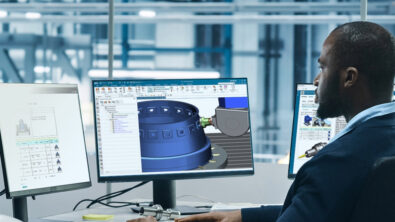
With modern CAM software, toolpaths are no longer just lines on a screen—they are intelligent paths designed to balance cutting speed, quality, and tool life. NX CAM makes this possible by automatically detecting part features, applying the right machining strategy, and using real-world tooling data to generate toolpaths that cut efficiently and accurately.
Some of the key capabilities that enable this are:
- Automatic feature recognition: Detects part features like holes and pockets automatically and applies the right machining strategy instantly.
- Built-in tool libraries: Real-world cutter and holder data ensure toolpath calculations are accurate and reliable.
- Flexible programming: From roughing large volumes to high-precision finishing, toolpaths can be adjusted to meet both speed and quality requirements.
The result is less manual coding, fewer errors, and more time spent optimizing machining performance.
2. Tooling management: minimizing errors and rework
Effective toolpaths depend on precise tooling data. Without it, even the most advanced machining strategies can lead to errors, delays, and rework. Modern CAM software addresses this challenge by providing integrated tooling libraries that keep every detail consistent and connected.
These libraries:
- Store detailed information on cutters, holders, and fixtures
- Ensure simulations match real machining conditions
- Automatically adjust toolpaths when designs change, reducing errors and rework
- Maintain consistency across machines and setups
- Rapidly import tool data from vendor catalogues
- Sustain high productivity throughout programming and execution
- Enable reliable, repeatable machining even as part designs evolve
3. Machine simulation: verify toolpaths before cutting
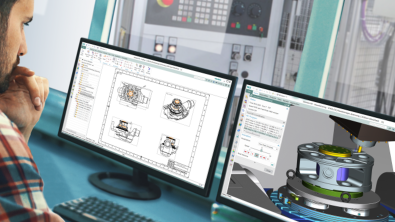
Even the most carefully programmed toolpath can fail if the process is not validated. One of the biggest risks in CNC machining is running an untested program—a single error can damage the part, the tool, or even the machine. Machine simulation addresses this by allowing programmers to test toolpaths in a digital environment that mirrors the real machine. CAM software like NX CAM lets users simulate toolpaths at full G-code level, detecting collisions and visualizing material removal before the first cut.
Key capabilities include:
- G-code driven simulation: Simulations run the exact code that will execute on the CNC.
- Collision detection: All axes, spindles, and fixtures are checked, reducing the risk of crashes.
- Material removal visualization: Stock removal is displayed layer by layer, making it easy to spot missed areas.
Simulating operations digitally reduces test runs, speeds up setups, and ensures that the first cut is correct—saving time, material, and tooling costs.
4. Integration that keeps design, machining and quality in sync
Advanced CAM software integrates directly with CAD and PLM systems, ensuring updates flow seamlessly across the manufacturing process. NX CAM connects NX CAD, Teamcenter, and Opcenter, and can interface with CNC controllers, linking design, toolpaths, and execution along the digital thread. This allows design updates to automatically propagate to machining plans, inspection feedback to adjust toolpaths in real time, and teams across multiple locations to stay aligned on the latest part data.
Key benefits include:
- Always current: Toolpaths update automatically when designs change, eliminating manual intervention.
- Closed-loop feedback: Inspection results feed directly into machining adjustments, reducing errors and rework.
- Collaboration across sites: Cloud-enabled solutions like NX X Manufacturing keep programmers and engineers aligned, ensuring consistent quality across production locations.
By connecting design, machining, and quality, these capabilities reduce errors, improve efficiency, and help manufacturers deliver high-quality parts faster and more reliably.
5. Postprocessing and simulation: from toolpath to machine-ready code
Toolpaths become valuable only when they can run accurately on CNC machines. Postprocessing translates these toolpaths into machine-ready NC code. NX CAM uses Post Hub, a cloud-based library of postprocessors and machine kits, providing CNC machine data, tooling, and controller settings to generate validated, production-ready NC programs.
Why it matters:
- Accurate NC code: Generates machine-ready programs tailored to specific controllers, using Post Hub and SMKS resources.
- Simulation-driven validation: Confirms toolpaths execute correctly before the first cut.
- Reduced setup errors: Integration with machine simulation minimizes mismatches between programming and machining.
By combining validated postprocessors, machine kits, and simulation, part manufacturers can ensure NC programs run correctly on the first cut, reduce costly rework, and accelerate the production of accurate, high-quality parts.
6. AI and automation: smarter CNC programming
The next stage in CNC programming is being transformed by AI and automation. Instead of manually defining every parameter, intelligent capabilities handle routine tasks and provide insights, allowing engineers to focus on strategy and productivity. Some of these functions are currently available in NX X Manufacturing Copilot, which uses AI to guide programming decisions, suggest optimized cutting strategies, and automate repetitive steps.
How AI enhances CNC programming:
- Optimized cutting strategies: AI recommends efficient toolpaths based on part geometry and machining goals.
- Automated programming steps: Repetitive operations are handled automatically, saving time and reducing errors.
- Predictive insights: AI can anticipate tool wear, adjust feeds and speeds, and suggest strategies to maintain consistent quality.
Combining AI with automation helps manufacturers reduce manual effort, improve first-pass accuracy, and accelerate the production of high-quality parts, while keeping engineers focused on innovation and process improvement.
7. Conclusion
For part manufacturers, CAM software extends far beyond programming and toolpath generation; it serves as a complete manufacturing solution. Siemens NX CAM supports these capabilities through advanced toolpath strategies that handle everything from simple prismatic parts to complex freeform surfaces, machine simulation that validates machining in realistic machine environments, seamless connectivity that keeps design and manufacturing data consistent, and cloud-based postprocessing that delivers accurate production-ready NC code across different CNC machines. Together, these capabilities allow manufacturers to program complex machining operations with confidence, maintain accuracy as designs evolve, and minimize the risk of errors and rework.
Whether producing aerospace components with tight tolerances, automotive molds with complex surfaces, or medical devices with intricate geometries, NX CAM delivers the precision, consistency, and reliability required in today’s competitive part manufacturing environment.
For deeper insights into CAM best practices, explore the following resources:
- Ultimate CAM software guide 2025
- NX CAM software overview
- The future of virtual toolpath optimization
- Postprocessing and machine simulation
- NX CAD/CAM trial access