Transforming Industrial Machinery and Components Design with AI

In the fast-evolving world of industrial machinery and components manufacturing, the pressure to innovate faster, design smarter and manufacture more efficiently has never been greater. So, it should be no surprise that when you introduce artificial intelligence (AI), it can become a transformative engineering force when used correctly. From automating repetitive tasks to generating optimized, manufacturable designs, AI is reshaping how engineers approach complex challenges.
Defining AI, the differences between Narrow AI, General AI and Super AI
According to IBM, there are three broad classifications for AI:
- Narrow AI, also known as ANI, is the only type that currently exists; this type is trained to complete one task from a small spectrum of tasks. A good example is a spam filter, which is trained to catch unwanted emails.
- General AI, also known as AGI, is a hypothetical form of AI that would use cognition to complete a wide range of tasks, akin to a human. A theoretical example would be an AI in the role of a scientist, where it generates hypotheses, executes experiments, draws correlations and adapts its research based on results.
- Super AI, also known as ASI, is another hypothetical form of AI that transcends the capabilities of human intelligence. It’s so intangible that an example cannot be ascertained.
Given these definitions, the AI we know and apply in today’s engineering field falls beneath the Narrow AI definition.
Predictive AI with CAD software design
Beneath the broad category of Narrow AI, AI within engineering design can take several sub-forms. For example, predictive AI is reshaping how engineers derive great value from their computer-aided design (CAD) software.
Specifically, predictive AI analyzes historical and real-time CAD data to anticipate user needs and workflows before providing input. This predictive capability is powered by large language models (LLMs), natural language processing (NLP), and large datasets – meaning, the AI is trained on natural language text and source codes to learn context, patterns and relationships. Machine learning algorithms help the AI determine common key words within commands, which are paired with a user’s real-time input and recently used commands to understand intent. This analysis then yields context-aware suggestions.
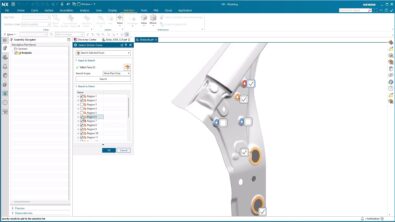
With the right CAD solution in place then, engineers can use predictive AI features, such as command prediction, to accelerate modeling processes and reduce the likelihood of errors; as command prediction observes user behavior before making suggestions that optimize industrial machinery and components designs.
Generative AI with design
In a similar vein, engineers can gain design value from the subfield of generative AI. Like predictive AI, generative AI analyzes large datasets for patterns — but instead of predicting user intent and making suggestions, it uses these patterned connections to create content, such as text, code, images, or even music.
Specifically, as generative AI analyzes massive data sets for structures and patterns, it uses a complex algorithm known as a neural network to detect and interpret the patterns. Neural network architectures can vary; the Transformer model tends to be one of the most popular models for text-based generative AI, as it processes sequential data before generating new sequences that take the form of content (text). This content reflects the patterns the Transformer model ascertained from its dataset analysis. After generation, content is at the discretion of the user and can be implemented as desired.
While we’ve all heard stories of the popular generative AI platform, ChatGPT, in engineering design, generative AI is even more powerful. The right CAD software provides generative design features that suggest lines of code; this code can optimize industrial machinery structures, weight, performance, appearance and several other design aspects. By designing and modeling the best possible product, engineers can shrink their design cycle times, expediting product development so that more products are introduced to the market sooner.
Improve product quality with Generative AI in Mesh Modeling
Generative AI doesn’t just apply to creating unique lines of traditional design code. It can also be used to improve the quality, accuracy and efficiency of simulated meshes, an important facet in convergent modeling (where 3D data is scanned into CAD software and recognized as faceted or meshed, meaning, you can build surfaces and shapes without any lengthy conversion processes.)
Generative AI’s use in mesh modeling begins with the AI analyzing historical and real-time datasets within the CAD program, then generating a high-quality mesh from its learnings. Users can refine this generation via customized input based around geometry parameters. During the simulation phase of design, generative AI can adaptively refine and dynamically adjust the mesh, adding or removing nodes in specific regions to improve the accuracy of the mesh. Users can continue to optimize the mesh by flexibly adjusting mesh generation parameters, in turn providing for a smoother and more accurate mesh modeling process. Through this entire generative AI-mesh modeling process, design engineers gain several benefits; for example, it streamlines the creation of complex models; it creates more efficient meshes for finite element analysis (FEA) and computation fluid dynamics (CFD); it improves the reliability of results; and it reduces resource costs, making it possible to allocate budget across more design segments.
AI and design leadership
AI may be shaping the future, but at the heart of this innovation, one principle remains unchanged: the engineer. AI should amplify human creativity, not replace it. With advanced CAD solutions like Siemens Designcenter, engineers gain access to multifaceted artificial intelligence, high-performance computing capabilities, progressive data science and fluid simulation capacities, in turn yielding greater control and optimization of the holistic design process. Ultimately, it’s engineers’ ingenuity, experience and vision paired with AI that drive the most meaningful breakthroughs in product development. Discover how AI can power your future by visiting our webpage.