The role of digital logistics in medical device circularity

Material shortages, increasing environmental and regulatory pressures, and rising operational risks are reshaping the landscape of the medical device industry. As companies look to futureproof their operations, it’s become increasingly clear: logistics and digital transformation are key enablers of sustainable growth.
In our new infographic, “The key role of logistics and the circular economy in the medical device industry” we examine how companies can adopt a circular approach to reduce emissions, unlock business value and meet evolving compliance demands.
Closing the loop in a critical industry
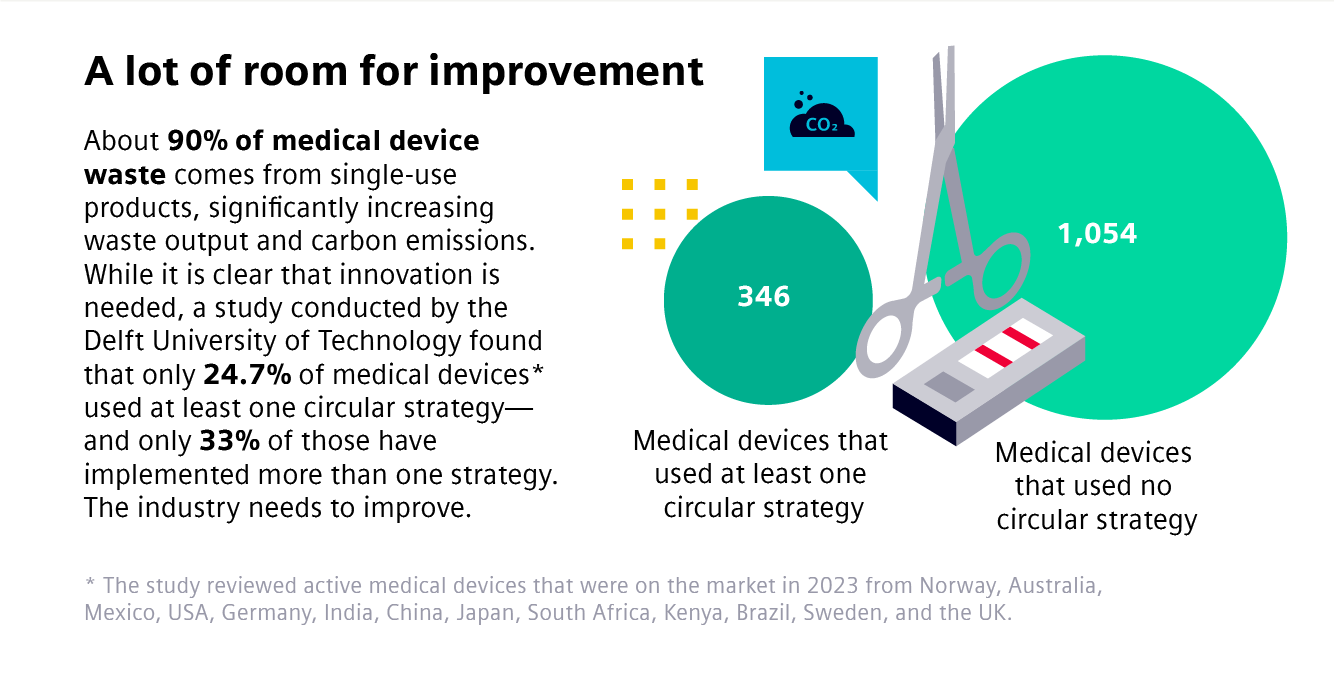
The medical device industry faces a unique challenge. Roughly 90% of device waste stems from single-use products. Yet only 24.7% of devices currently employ any form of circular strategy — and even fewer apply multiple approaches. In a sector where product safety and compliance are paramount, circularity must be carefully engineered from the very beginning. That starts with design.
Circular thinking redefines resource efficiency by considering the full product lifecycle — from sourcing to recycling. Today, just 8.6% of materials entering the global economy are reused. Designing with circularity in mind helps close that gap, creating products that are easier to disassemble, repair, refurbish or recycle.
Logistics: the engine of circular transformation
Supply chain emissions are, on average, 26 times higher than direct operational emissions. This underscores the vital role that logistics plays — not just in reducing carbon impact, but in enabling the circular economy.
Our infographic highlights seven critical logistics domains where circular principles can be applied across the medical device lifecycle:
- Product Design & Sourcing
Optimize sourcing decisions by factoring in CO₂ emissions, cost and availability of recycled materials. - Supply Chain Network Design
Minimize environmental impact through route optimization, better transport utilization and sustainable last-mile strategies. - Inbound Logistics
Boost visibility and reduce waste through full digitalization of incoming shipments and supplier coordination. - Intralogistics & Warehousing
Enhance energy efficiency and reduce material handling waste within distribution and production environments. - Production Scheduling
Integrate transportation visibility to adapt production planning in real time, preventing wasteful ramp-ups or delays. - Outbound Logistics & After Sales
Reduce packaging waste, optimize routing and streamline spare parts logistics through digital planning tools. - Collection & Recycling
Enable track-and-trace functionality for recyclable materials to support closed-loop recovery and reuse.
From supply chains to ecosystems
A shift toward circularity also means reimagining the entire value network. Logistics is no longer just about moving products, it’s about enabling a regenerative system. This requires digital integration, real-time visibility and cross-functional collaboration.
The circular economy transforms traditional supply chains into dynamic ecosystems, powered by digital platforms and advanced technologies. From AI-powered control towers to digital twins that simulate end-to-end operations, software solutions are now central to managing complexity and unlocking hidden efficiencies.
Value beyond compliance
Embracing circular strategies isn’t just a matter of meeting regulatory expectations. It’s also good business. Circular economy transactions generated $339 billion in global revenue in 2022. By 2026, this figure is expected to grow by 110%, reaching approximately $713 billion.
As highlighted in the infographic, logistics functions — when digitally transformed — can become powerful levers to capture this value. For the medical device industry, this creates a rare alignment of sustainability goals and bottom-line benefits.
Explore the infographic and more
To learn more about how your organization can align circular economy principles with smart logistics strategies, view the full infographic: “The key role of logistics and the circular economy in the medical device industry.”
It offers practical insights across all stages of the supply chain and highlights how the Siemens Digital Logistics portfolio can support your transformation toward a more sustainable future. For even more details on this topic, download the white paper “The Circular Economy — How digital technology is transforming the supply chain into an ecosystem.”


