Customer Success Story: FAW-Volkswagen accelerates digital manufacturing with Siemens Insights Hub

Customer: FAW-Volkswagen (FAW-VW)
Industry: Automotive manufacturing
Solution: Siemens Insights Hub – Industrial IoT and data operations platform
About FAW-Volkswagen
FAW-Volkswagen is a leading automotive manufacturer in China, operating large-scale production across multiple plants and complex manufacturing domains. With high requirements for quality, throughput, and operational stability, FAW-VW has been continuously investing in digitalization to improve transparency, decision speed, and enterprise-wide operational excellence.

Executive summary
FAW-Volkswagen set out to build a scalable industrial data foundation that could connect shopfloor assets, standardize data pipelines, and turn production data into actionable insights for daily operations and continuous improvement. By adopting Siemens Insights Hub, FAW-VW established an end-to-end path from data acquisition → data processing → data analytics → visualization and action, enabling faster transparency across equipment and lines and creating a reusable blueprint for smart manufacturing use cases—while also building a stronger digital workforce through structured enablement.
The challenge: Turning complex shopfloor data into consistent, usable insights
Like many large automotive manufacturers, FAW-VW operates a heterogeneous production environment—multiple plants, many production lines, and a wide range of industrial equipment and controllers. This creates common pain points:
- Data silos across devices, lines, and applications
- High effort to collect, normalize, and contextualize OT data
- Limited ability to scale from isolated pilots to a repeatable, enterprise-wide approach
- Need for intuitive visualization, monitoring, and alerting to support day-to-day decisions
FAW-VW needed a platform approach that could start small, prove value quickly, and then scale without re-architecting every new use case.
The vision: A future-ready digital transformation blueprint
FAW-VW aligned with a clear transformation principle:
- Build a strong data foundation first (connectivity, data flow, governance)
- Enable fast iteration through reusable tools and low-code orchestration
- Operationalize insights via dashboards, monitoring, and alarms—embedded into daily management routines
- Scale from “single-line visibility” to “multi-site operational intelligence”
This vision ensured the program was not “a one-off project,” but an expandable digital capability.
The solution: Insights Hub as the Industrial IoT data backbone
FAW-VW implemented Insights Hub to provide integrated platform covering:
- Data acquisition from industrial assets and systems
- Data storage and management for industrial time-series and operational context
- Data analytics to support deeper diagnostics and continuous improvement
- Data visualization, monitoring, and alarms to drive action
From the architecture perspective, FAW-VW established an industrial data flow connecting shopfloor devices (e.g., PLC-level data) through integration components and into Insights Hub applications and services—creating a standardized “data-to-insight” pipeline.
Insights Hub also supports using AI to analyze production line data; in FAW-VW’s roadmap this enables a shift from reactive troubleshooting toward earlier detection and prevention.
The journey: From connection to measurable operational impact
Phase 1 — Connect and collect: establishing reliable data acquisition
FAW-VW began by prioritizing equipment connectivity and ensuring stable data ingestion. With Insights Hub, the team could onboard industrial data sources and build a consistent approach to data collection—creating the base layer needed for scaling.
Phase 2 — Standardize the data pipeline: processing and contextualization
Once data was flowing, FAW-VW focused on repeatable processing logic—cleaning, structuring, and preparing data for analysis and visualization. This reduced manual work and improved consistency across lines and use cases.
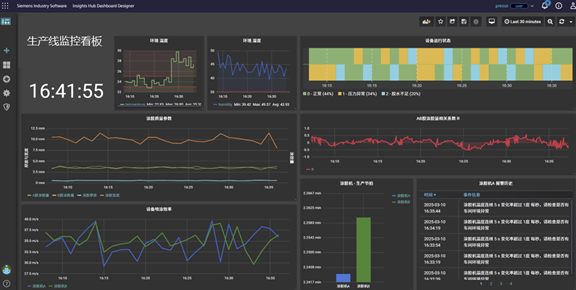
Phase 3 — Make it visible: dashboards, monitoring, and alarms for operations
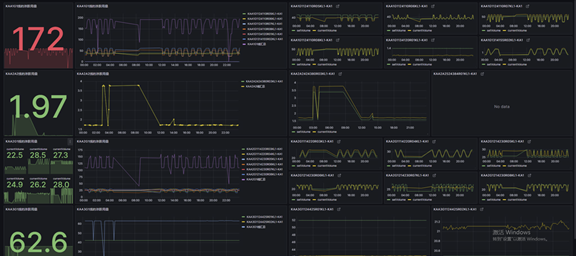
With structured data in place, the team rolled out operational dashboards and monitoring views for stakeholders across the organization. Alerts and monitoring helped shift from “after-the-fact analysis” toward faster awareness and response.
Phase 4 — Expand analytics and AI scenarios: from visibility to prediction
With a standardized data foundation, FAW-VW began strengthening AI-enabled analysis on production line data. This establishes the prerequisites for scenarios such as:
- Predictive maintenance: using historical and real-time equipment signals to identify degradation patterns, detect anomalies earlier, and plan maintenance proactively rather than reactively
- Health monitoring and early warning: combining monitoring + analytics to reduce unplanned downtime risk
- Process and line optimization: using AI-assisted analysis to uncover hidden drivers affecting stability, speed, or quality
Outcomes: A scalable “data to insight” engine—and a stronger digital workforce
By building on Insights Hub, FAW-VW achieved capabilities that support long-term digital manufacturing goals:
- End-to-end industrial data pipeline: acquisition → processing → analytics → visualization
- Faster transparency for equipment and line performance through dashboards and monitoring
- Reusable architecture that supports scaling across more assets and scenarios
- A practical foundation for broader smart manufacturing initiatives—connecting IoT/OT data to continuous improvement
Just as importantly, FAW-VW treated enablement as a core part of the transformation. Through training programs built around Insights Hub and industrial data practices, technical workers and frontline engineers strengthened their capabilities in areas such as data understanding, basic analytics thinking, and digital tool usage. This upskilling:
- Improved the speed and quality of shopfloor problem-solving (teams could “read” data, not just react to alarms)
- Reduced dependency on a small number of specialists for day-to-day analysis and dashboard iterations
- Created a sustainable talent foundation for FAW-VW’s broader digital transformation—so new plants, new lines, and new use cases can be scaled with people who are ready
Why it worked: Four deeper reasons behind the transformation
FAW-VW’s progress was not driven by technology alone. The program worked because the transformation design addressed systems, process, and people together:
- Platform first, use cases second
Instead of building isolated applications, FAW-VW invested in a common industrial data backbone. That decision reduced “pilot-to-production friction” and allowed new scenarios to reuse the same connectivity, pipeline, and visualization patterns. - A closed loop from data to action
Value came from operationalizing insights—not just collecting data. Dashboards, monitoring, and alarms created a practical loop where issues became visible, decisions could be made faster, and improvements could be verified with the same data stream. - Standardization without killing flexibility
FAW-VW standardized core elements (data flow, processing steps, visualization practices), while keeping room for local teams to iterate quickly using low-code tooling. That balance enabled scale and speed—two things that rarely coexist peacefully. - People as part of the architecture
The Insights Hub training effort meant digital capability was not trapped in the platform team. By lifting the baseline skills of technical workers, FAW-VW made transformation repeatable, resilient to turnover, and expandable across more operations—turning digitalization into an organizational competence rather than a project. - AI introduced at the right time—after data becomes trustworthy
AI and predictive scenarios become far more effective when built on consistent, contextualized data. FAW-VW’s staged approach created prerequisites for predictive maintenance and intelligent optimization to deliver real operational value.
What’s next
With both the platform foundation and workforce capability strengthened, FAW-VW is positioned to expand Insights Hub-driven scenarios across more assets, lines, and plants—deepening analytics maturity and accelerating smart factory initiatives with a scalable technical and talent base.
Learn more about Siemens Insights Hub


