From Data to Decisions: How AI is powering Autonomous Operations with Accenture
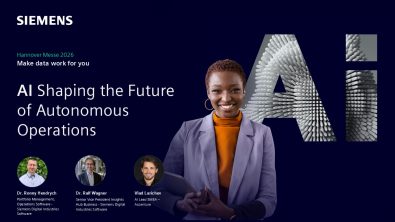
At Hannover Fair, one message came through loud and clear: AI is no longer just supporting industrial operations. It is beginning to shape how operations think, adapt, and act.
During the Siemens and Accenture panel, “AI Shaping the Future of Autonomous Operations,” the conversation moved beyond the usual AI hype. This was not about chatbots answering basic questions or dashboards showing more data. It was about the next chapter of manufacturing: agentic AI, connected industrial knowledge, and the path toward operations that can become more adaptive, more intelligent, and increasingly autonomous.
The pace of change is hard to ignore. AI systems are evolving from simple assistants into orchestration engines that can plan, check, coordinate, and act across multiple steps. For manufacturing, that shift could be transformational. The future of autonomous operations will not be built on automation alone. It will be built on context, intelligence, trust, and the ability to connect decisions across the full production environment.
From Automation to Autonomous Operations
For decades, manufacturers have invested in automation to make production faster, safer, and more efficient. But autonomous operations represent a different kind of leap.

Automation follows predefined rules. Autonomous operations adapt.
In the panel discussion, autonomous operations were described as AI-centric systems supported by intelligent agents that can reduce the need for manual intervention across the production process. That does not mean factories suddenly run without people. It means industrial teams gain digital co-workers that can analyze what is happening, understand operational context, recommend actions, and eventually help execute decisions with the right level of human oversight.
This is where agentic AI becomes so important. These systems are not simply answering questions. They are beginning to plan workflows, evaluate options, coordinate across systems, and support decisions in real time operational environments.
Why Context Is the Key to Autonomy
One of the strongest themes from the panel was that autonomous operations cannot happen without a strong digital foundation.
Many manufacturers already have critical systems in place. SCADA, MES, IoT, PLM, and other enterprise and operational platforms are all important building blocks. But in many environments, these systems still operate in silos. They hold valuable data, but that data is often disconnected from the broader production story.
To move toward autonomous operations, data needs context.
That is where the industrial knowledge graph becomes a major enabler. It connects information across systems and creates relationships between machines, materials, processes, products, quality outcomes, and production constraints. Once those relationships are understood, AI agents can reason across the production environment instead of only analyzing isolated data points.
This is the difference between knowing that a machine has a quality issue and understanding how material age, viscosity, scheduling, operator actions, and production conditions may be contributing to that issue.
Agentic AI as the New Operational Co-Worker
The future of autonomous operations is not about removing people from manufacturing. It is about helping people operate with better information, faster analysis, and stronger decision support.
That is why the idea of AI as a shop-floor co-worker is so powerful. An agentic AI system can help operators, engineers, maintenance teams, and production planners understand what is changing and what to do next. It can coordinate across different applications, bring together relevant context, and support multi-step decision-making.
In practical terms, this could mean helping a planner reschedule production when a critical material shipment is delayed. It could mean helping a quality engineer identify why part dimensions are drifting. It could mean helping an operator understand which corrective action has the highest probability of restoring performance.
This is not AI as a side tool. This is AI becoming part of the operational rhythm.
Real-World Use Cases Are Already Emerging
The panel highlighted that this future is not theoretical. Siemens is already exploring physical AI and agentic AI use cases in its own factory environments, including the Erlangen electronics factory. These factories serve as real-world proving grounds where AI can be tested against actual operational complexity.
One example is flexible robotic grasping, where robots use visual language action models to dynamically identify what to grasp instead of being trained on every individual motion. Another is autonomous production planning, especially in high-variance, high-frequency manufacturing environments with thousands of products, parts, and materials.
In a factory like that, one missing component can trigger a chain reaction. If a truck misses a delivery, the operation must quickly decide what to reschedule, which production orders to adjust, and how to minimize disruption. Agentic AI can help evaluate those choices faster and support more adaptive production decisions.
The panel also touched on flexible production and pop-up factories, including scenarios where demand changes quickly around major events. In those cases, agents can support decisions about what products to produce, where to produce them, and how to respond to shifting demand patterns.

A Practical Example: When AI Finds the “Why”
One of the clearest examples from the discussion involved an injection molding machine producing plastic parts.
An AI agent detects that part quality is starting to vary. Another agent performs root cause analysis using contextualized industrial data. It finds a correlation between quality variation and material viscosity. Then it goes one level deeper and discovers that viscosity is related to the age of the plastic material.
Instead of simply flagging the issue, the system proposes a practical operational improvement: introduce a FIFO (First In, First Out) consumption process to reduce viscosity fluctuations and restore quality levels.
That is the future of autonomous operations in action. The system does not just detect a problem. It helps explain the cause and recommends a path forward.
In many factories, this kind of discovery might traditionally happen through daily standups, troubleshooting sessions, or manual analysis across multiple teams. With agentic AI, the insight can happen faster, closer to the problem, and with stronger context.
The Biggest Shift Is Not Just Technical
Autonomous operations require more than advanced AI models. They require transformation across technology, people, and processes.
This is one of the reasons the Siemens-Accenture discussion was so relevant. AI is no longer only an IT topic. It is becoming a core business transformation topic because it changes how decisions are made, how work is coordinated, and how teams interact with industrial systems.
But AI cannot be layered onto broken processes and fragmented data. Organizations need to redesign workflows, strengthen data foundations, and build trust with the people who will rely on AI every day.
This is especially important in manufacturing, where teams are used to deterministic systems. Industrial environments value precision, repeatability, and control. AI introduces a new dynamic because it can be probabilistic and nondeterministic. That means adoption depends on transparency, governance, and visible daily value.
Once teams see AI helping them solve real problems, trust grows. And when trust grows, transformation accelerates.
Clearing Up the Misconceptions Around AI and Autonomous Operations
A major takeaway from the panel was the need to move past the common misconceptions around AI.
AI is not a magic box. It is not something manufacturers can simply switch on and expect immediate transformation. It requires a strong foundation, quality data, contextualized systems, and continuous management.
The biggest misconception is that AI is a magic box you can switch on and leave alone. In industrial environments, AI needs a strong digital foundation, high-quality contextualized data, and continuous management. More data does not automatically mean better AI. Better context, better structure, and better guardrails are what make AI useful, trusted, and scalable.”
Ralf Wagner, SVP Insights Hub, Siemens Digital Industries Software
That point is critical for the future of autonomous operations. AI systems must be monitored. Models can drift. Production environments change. Data quality can degrade. Business processes evolve. Without management and governance, AI can quickly lose relevance.
The real opportunity is not simply to collect more data. It is to create the right industrial context so AI can support better decisions.
The Future Is Autonomous, But the Journey Starts Now
The future of manufacturing will not be defined by one big leap into fully autonomous factories. It will be shaped by practical steps that make operations more intelligent, adaptive, and connected over time.
Manufacturers are already using AI in focused areas such as planning, design, maintenance, and quality. The next opportunity is connecting those use cases across the full operational workflow. That is where agentic AI, industrial knowledge graphs, and strong digital foundations come together.
The message from the panel was clear: autonomous operations are not a distant dream. They are an emerging reality.
And while much will change in AI by next year, companies do not need to wait for the perfect moment. The right move is to start now, build the foundation, identify high-value use cases, and help teams experience the value of AI in their daily work.
Because AI is not just shaping the future of autonomous operations. It is shaping the future of how manufacturing works.


