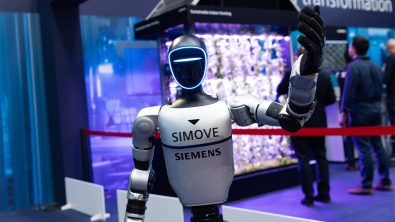
Simcenter for humanoid robot engineering

Humanoid robots are on the verge of reshaping industrial operations, offering a level of versatility and adaptability that fixed automation can’t match.
Realizing this potential, however, requires overcoming engineering challenges spanning motion, controls, structure and thermal management.
Humanoid robot engineering simulation with Simcenter transforms development from guesswork to science, helping innovators pioneer new frontiers in automation.
Engineering challenges in humanoid robot development
Designing and deploying humanoid robots poses new engineering challenges unlike any other automation solution.
That’s because humanoid robots must balance on two feet, walk with a natural gait and adapt their center of gravity on the fly, all while managing uneven terrain and unexpected contact. Every joint faces unpredictable loads, which demand careful analysis to prevent fatigue or failure.
On top of this, the system’s controls must synchronize dozens of movements smoothly. The mechanical skeleton must be robust, yet lightweight. It needs to be strong enough to endure repetitive use without becoming cumbersome or energy-intensive.
Within the confined frame, high-performance motors and control boards contend with the risk of heat buildup, while a host of electronic and physical systems must interact seamlessly for reliable performance.
The more a robot mimics the complexity of human movement and anatomy, the more subtle and interconnected these engineering hurdles become.
Model humanoid robot systems with Simcenter Amesim
Taming this complexity begins at the system level. With Simcenter Amesim, engineers can create high-fidelity digital twins of entire robots, including power, actuation, sensors and control logic.
The platform allows for virtual prototyping of mechatronic systems, supporting a holistic approach to humanoid robot modeling and control.
The result is the ability to refine, synchronize and validate every subsystem, delivering stable motion, optimized energy efficiency and robust responses to the unexpected, all before building a single prototype.
This system-level perspective enables innovation and confidence early in development.
Validate motion, balance and joint dynamics with Simcenter
To move and interact in the real world, humanoid robots need more than theoretical models.
Simcenter’s powerful simulation environment makes it possible to validate every aspect of robot motion, including walking, grasping and balancing. Multibody dynamics models realistically capture the interplay of limbs, joints and actuators, addressing factors like friction, compliance and backlash.
Engineers can examine dynamic performance – how the robot balances, recovers and responds to external forces – enabling safe, reliable, and agile operation.
Simcenter helps transform mechanical concepts into practical, life-like motion through the rigors of virtual testing.
Assess structural, thermal and multiphysics performance
Once the robot’s movement is defined, structural integrity and environmental endurance become key considerations.
With Simcenter 3D and STAR-CCM+, teams can predict and optimize mechanical strength, fatigue life and topology for every component to ensure the structure stays strong while minimizing unnecessary weight.
Accurate thermal analysis ensures any heat generated by motors and electronics dissipates effectively to protect against shutdowns and component failures.
These advanced multiphysics simulations empower engineers to balance robustness, efficiency and performance in the smallest, most complex assemblies.
Reduce physical prototypes with virtual testing and design exploration
When each physical prototype represents significant investment, simulation-first innovation is essential.
Simcenter enables virtual validation and iterative design exploration from day one. By evaluating countless “what-if” scenarios and optimizing with tools like HEEDS, engineers systematically reduce uncertainty and compress timelines.
This approach identifies critical issues and ideal design combinations early, minimizing late-stage surprises and accelerating robot deployment, all while controlling costs and resources.
Connect Simcenter with the Siemens humanoid robotic workflow
The power of Simcenter multiplies when connected with the full digital thread.
Designcenter provides CAD integration with URDF export capabilities. Teamcenter manages data and lifecycle processes to optimize timelines and improve supply chain transparency. And Tecnomatix supports production planning with humanoid robot simulation on the factory floor.
Siemens Xcelerator links hardware and cloud innovation, while NVIDIA Isaac Sim provides a seamless pipeline for advanced robotics co-simulation.
Together, these tools create an end-to-end development environment, turning complex humanoid robotics from vision to reality.
Ready to see what’s possible with Simcenter for humanoid robot engineering? Download the ebook, “Mastering humanoid robotics,” and start building your competitive advantage today.
Frequently asked questions (FAQ) about Simcenter for humanoid robot engineering
What engineering challenges make humanoid robots difficult to validate?
Humanoid robots are difficult to validate because motion, balance, center of gravity, joint loads, controls, structural integrity, thermal behavior and complex subsystem interactions all relate and influence each other. Each must be understood and addressed to ensure safe operation and long-term reliability.
How does Simcenter support humanoid robot engineering?
Simcenter supports humanoid robot engineering by bringing together simulation for every aspect: modeling the robot as a connected system, validating controls and motion, studying dynamics and structure and assessing thermal efficiency. All of this put together delivers a higher level of certainty before physical testing.
What is humanoid system modeling?
Humanoid system modeling represents the robot as an interconnected system, representing all mechatronic, control and energy elements of the robot. This allows engineering teams to understand, optimize and coordinate behavior and performance early in the design process.
What is multibody dynamics in humanoid robotics?
Multibody dynamics simulate how interconnected joints, limbs and mechanisms move and interact under real-world conditions, making it possible to perfect walking, balancing and manipulation before building prototypes.
How do engineers evaluate humanoid robot balance before physical testing?
Engineers can evaluate balance by simulating the robot’s movement and analyzing stability metrics in software. Engineers can anticipate risks and optimize the control systems to maintain safe, stable posture in every activity.
How can simulation-first design reduce prototype development timelines?
Simulation-first design allows engineering teams to test, refine and optimize concepts virtually to uncover problems and highlight the best designs without the time and cost of repeated physical prototype cycles.
What simulations are performed during humanoid robot development?
Humanoid robot development requires system modeling, motion and multibody dynamics, gait validation, structural and fatigue analysis, thermal and fluid simulations, design optimization studies and test correlation. Simcenter provides a portfolio of tools that supports these engineering validation needs.
How does engineering simulation complement NVIDIA Isaac Sim?
Engineering simulation and NVIDIA Isaac Sim support different parts of the humanoid workflow. Simcenter ensures the robot works mechanically and physically upstream, while NVIDIA Isaac Sim enables advanced robotic behavior and AI verification downstream. This collaboration allows for seamless handoffs and co-simulation between domains.
How does Simcenter fit into the Siemens humanoid robotics workflow?
Simcenter provides integrated simulation and digital twin capabilities alongside Siemens design, lifecycle and manufacturing tools, ensuring continuity and innovation across every phase of robotics development.