Accelerate humanoid robot development and manufacturing with an end-to-end solution
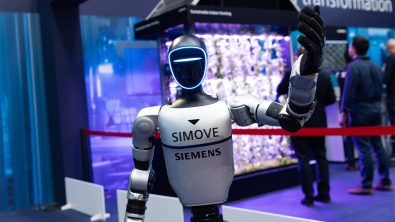
Humanoid robots are showing up on factory floors, warehouses and manufacturing environments at an increasingly rapid pace. Shipments of humanoid robots are expected to quadruple – or more – compared to last year.
According to recent industry research, labor shortages have dominated manufacturing challenges, and Deloitte projects that as many as half of new manufacturing openings could go unfilled between now and 2033.
Companies across the globe are turning to robotics and artificial intelligence to make operations more efficient, and humanoid robots are viable commercial solutions capable of the flexibility modern manufacturing requires.
Unlike traditional industrial robots engineered for specific, repetitive tasks, humanoid robots are built around the human form, enabling them to operate in spaces and workflows originally designed for people.
This fundamental advantage allows manufacturers to pivot quickly between tasks without costly reconfiguration, driving continuous automation into production processes that demand flexibility.
Despite their promise, humanoid robot development faces a critical bottleneck threatening to slow deployment and inflate costs: the disconnect between mechanical design and the simulation and control environments that bring these machines to life.
The hidden complexity of humanoid robot engineering
Humanoid robot engineering introduces unprecedented design complexity. Dozens of articulated joints must work together with precise mass, inertia and center-of-gravity control.
Mechanical design, electronics and control software are tightly connected. Even small structural changes can significantly affect balance, gait, reach and energy efficiency.
As a result, humanoid robot development has evolved into a systems engineering challenge demanding close collaboration across mechanical, mechatronic, control and AI disciplines.
While most organizations maintain mature computer-aided design (CAD) processes, many humanoid programs still rely on manual and fragmented methods to translate mechanical designs into robotic simulation and control environments.
Kinematic models are often manually rebuilt, mass and inertia properties are approximated rather than derived from real geometry, and joint definitions can drift between design and control representations.
These disconnects slow iteration, undermine simulation accuracy and frequently force mechanical designs to freeze prematurely to avoid downstream rework.
Balance, stability and manipulation are highly sensitive to physical parameters, so these inaccuracies directly degrade AI training efficiency and simulation-to-reality performance.
The consequences extend beyond the virtual world. Inaccuracies affect expected performance during physical prototyping, leading to costly fixes and extended development cycles.
Why traditional workflows are failing humanoid robot manufacturing
Traditional development processes treat mechanical design and robot intelligence as sequential activities, making late-stage changes costly and unpredictable.
Without native integration between design and simulation platforms, engineering teams contend with:
- Misaligned teams: Disconnected handoffs between mechanical, control and AI teams result in inconsistent models and definitions
- Design freezes: Discrepancies in data and models impact downstream work, preventing mechanical designs from progressing through development
- Slow iteration cycles: Manual reconstruction and data translation errors delay the design process holistically, making it harder to scale and optimize designs
- Inaccurate simulations: Approximated mass and inertia properties undermine simulation fidelity, leading to differences between virtual and real-world performance
These challenges create a fundamental barrier to scaling humanoid robot manufacturing at the speed and quality required for commercial deployment. Fortunately, there are solutions available to overcome these challenges.

Holistic design: The foundation for end-to-end humanoid robot development
Creating viable, fully functioning humanoids for manufacturing environments requires a holistic design approach that encompasses the entire product lifecycle from conceptual structure to deployment and optimization.
Organizations need a trusted solution that eliminates systemic design obstacles and shifts the workplace mindset from consecutive to parallel product development.
This approach helps produce humanoids at an accelerated rate without increasing costs or decreasing quality.
A comprehensive humanoid development platform provides:
Native URDF Export: Unified robot description format (URDF) export makes it possible to transfer models between CAD and simulation platforms without manual model rebuilds, mistranslations or data errors. A single click exports URDF models from a CAD platform while mapping links, joints and kinematic hierarchies.
Integrated mechanical, electrical and control design: Tighter collaboration across disciplines eliminates disconnected handoffs between teams. By keeping mechanical and control intent tightly aligned, departments can avoid misaligned joint definitions and keep models consistent between design and control environments.
Simulation-driven design: Structural, multibody and thermal analysis allow performance, stability and motion behavior to be evaluated early using physically accurate data. This reduces reliance on approximated mass and inertia properties that undermine simulation accuracy and enables early assessment of stability and motion.
Model-based definition (MBD) as a single source of truth: Ensuring that geometry, kinematics, mass properties and annotations remain consistent across engineering and downstream simulation workflows minimizes manual reconstruction and data translation errors.

From one-time-right design to one-time-right intelligence
As humanoid robots scale toward commercial deployment, success depends on advanced algorithms and the fidelity of the mechanical data driving those algorithms.
A holistic design platform with native URDF export enables continuous iteration between geometry, kinematics and motion, supporting parallel collaboration across mechanical, control and AI teams while driving data integrity and consistency across parameters like joints, motions and hierarchies.
This approach allows teams to move beyond “one-time-right design” and toward “one-time-right design, training and deployment” every time. By maintaining a single authoritative model from structure through URDF, designs can evolve consistently from concept through operation.
This means engineers can collaborate more easily and gain greater design flexibility while humanoid robots get to market faster at a lower cost without sacrificing quality.
Enabling commercial-scale humanoid manufacturing
As products become more autonomous, adaptive and software-driven, engineering teams aren’t just designing physical structures. They’re building complete intelligent systems that carry intent seamlessly from design through simulation and control.
Humanoid robots represent a powerful example of this new reality, where mechanical design, kinematics and control systems must work together consistently from concept to operation.
The robotics industry is witnessing significant advancements in humanoids designed to perform a wide range of tasks in various environments. The human-like design with two arms and two legs allows robots to be used flexibly in work environments created for humans, enabling easy integration into existing warehouse processes and infrastructure.
Organizations that adopt holistic design approaches with native URDF export capabilities position themselves to lead the commercial humanoid revolution.
Frequently asked questions (FAQs) about humanoid robot development
What is holistic design for humanoid robots?
Holistic design for humanoid robots is an integrated approach that encompasses the entire product lifecycle from conceptual structure and kinematics definition through manufacturing, deployment and optimization. It eliminates the traditional sequential handoffs between mechanical design, simulation and control teams by maintaining a single authoritative model that synchronizes across all disciplines. This approach enables parallel collaboration, reduces rework and ensures that design intent translates accurately into robot behavior and intelligence.
How does URDF export improve humanoid robot development workflows?
URDF (Unified Robot Description Format) export enables seamless transfer of mechanical designs from CAD platforms to simulation and control environments without manual rebuilding. With a single click, URDF models export complete kinematic hierarchies, joint definitions and mass properties that are compatible with physics-based simulation engines like NVIDIA Isaac Sim. This eliminates data translation errors, reduces development time, improves simulation accuracy and allows teams to validate balance, gait and reachability earlier in the development process, significantly reducing reliance on costly physical prototypes.
What are the minimum technical requirements for implementing native URDF export in humanoid robot engineering?
A robust humanoid development platform with native URDF export should provide: (1) Design-simulation interoperability that maps URDF models directly into advanced simulation platforms without reinterpretation; (2) Top-down, parametric system modeling where master sketches enable rapid iteration without breaking downstream relationships; (3) Integrated co-design capabilities across mechanical, electrical, and control disciplines; (4) Model-Based Definition (MBD) maintaining a single source of truth for geometry, kinematics and mass properties; and (5) Real-time geometric definitions where kinematic criteria are computed automatically as designs evolve.
How can engineering teams choose the best humanoid robot development solution for their organization?
When evaluating humanoid development platforms, teams should assess whether solutions possess: native URDF support with one-click export mapping links, joints and kinematic hierarchies; design-simulation interoperability enabling faster convergence between virtual and real-world behavior; simulation-driven design with structural, multibody and thermal analysis for early validation; integrated mechanical, electrical and control co-design eliminating disconnected handoffs; and cloud-based collaboration supporting remote, global development teams. Additionally, evaluate integration capabilities with PLM systems, quality management tools and AI training platforms like NVIDIA Isaac Sim.
How does holistic humanoid design integrate with existing MES, PLM and simulation systems without creating data silos?
Holistic design platforms maintain Model-Based Definition (MBD) as a single source of truth, ensuring geometry, kinematics, mass properties and annotations remain consistent across all engineering and downstream workflows. Integration with PLM systems enables requirements management and BOM-level change tracking throughout the product lifecycle. Quality system integrations create accountability and support safety requirements during manufacturing scale-up. Native URDF export ensures that simulation platforms receive accurate, physics-based data directly from the authoritative CAD model, eliminating manual data translation that typically creates silos. This unified approach connects design genesis, creation flow and the coexistence loop—enabling data from in-field robots to drive future design iterations.