Multi-domain system simulation is the new competitive differentiator for industrial machinery manufacturers: Here’s why

Today’s machines are smart, connected and more complex than they’ve ever been, and successful machine builders are finding ways to manage that complexity better than their competitors.
Multi-domain system simulation plays a significant role in managing the complexity, and it helps engineers deliver highly customized, intelligent machines faster than ever.
The customization paradox
Customers are asking for unprecedented levels of customization all while delivery timelines continue to shrink. A single machine that once had three standard configurations now requires validation across dozens of variants — each with different specifications and safety parameters.
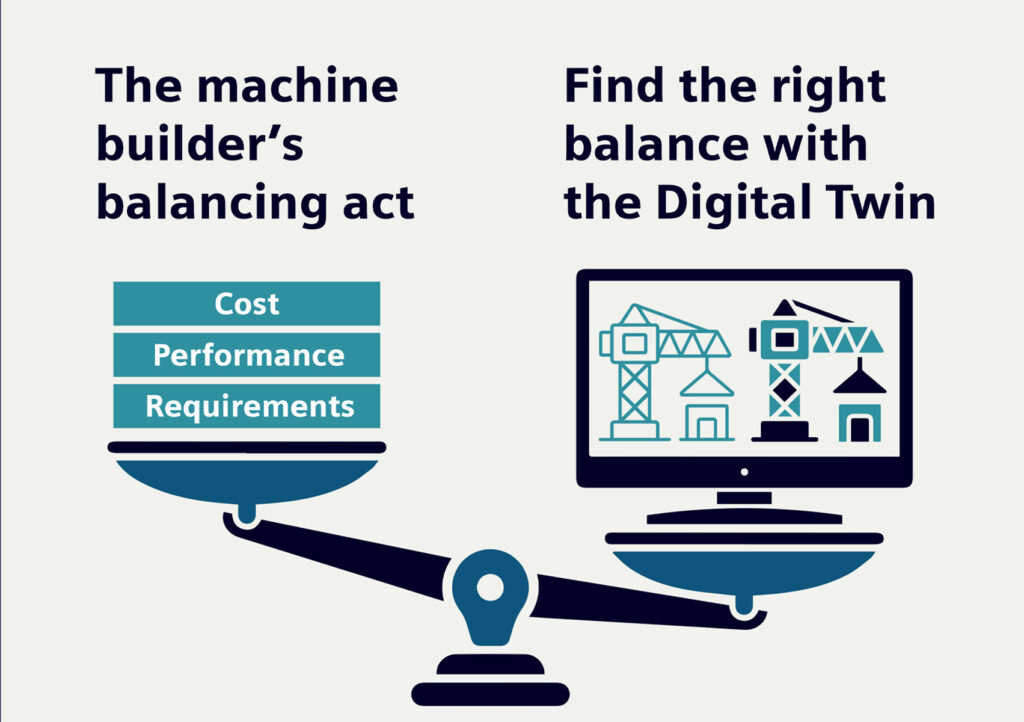
Machine builders are forced to balance cost, performance and requirements. Different customizations and configurations affect each of these things. And it’s the engineer’s job to find all the right solutions.
This isn’t a temporary market fluctuation. It’s the new normal.
According to industry research, machine builders now face three to five times more customization requests than a decade ago, with each variant requiring extensive validation across mechanical, electrical, thermal and control system domains to ensure safety, performance and regulatory compliance.
The traditional approach — building physical prototypes for each configuration — has become impossible because of cost and time constraints.
Machine builders who refuse to adapt can either stretch delivery timelines, possibly losing customers along the way, or ship untested variants, risking catastrophic failures.
The third option, multi-domain system simulation, allows machine builders to embrace the complexity and move more quickly.
Move beyond single physics thinking with multi-domain system simulation
Multi-domain system simulation represents a fundamental shift in how machine builders approach design.
Rather than treating mechanical, electrical, thermal, fluid dynamics and control systems as separate engineering silos, this approach recognizes that modern machines are inherently multi-physics systems where changes in one domain cascade across all the others.
For example, increasing production speed by upgrading to a more powerful motor brings up a surge of new questions regarding new possibilities for excessive heat, added vibrations impacting structural integrity, faster response times for control systems and additional energy consumption.
In siloed engineering environments, accounting for all these potential issues requires sequential handoffs between teams, multiple iteration cycles and ultimately, physical testing to validate assumptions. The process can take weeks or months.
Multi-domain system simulation condenses this timeline by enabling concurrent engineering. Design and simulation engineers work from the same digital twin, a comprehensive virtual model that captures mechanical geometry, electrical systems, thermal behavior, fluid dynamics, and control logic in a single, integrated environment.
When the motor specifications change, engineers can immediately simulate the impact across all domains, identifying potential issues before a single physical component is manufactured.
The digital twin as a single source of truth
The digital twin sits at the center of effective multi-domain system simulation. It’s a practical engineering asset.
The digital twin serves as the single source of truth, keeping simulation data in perfect sync with design information throughout the development process.
This synchronization is critical. In traditional workflows, design changes often outpace simulation updates, creating version control nightmares and invalidating previous analyses. Engineers waste valuable time rerunning simulations on outdated models or, worse, making decisions based on obsolete data.
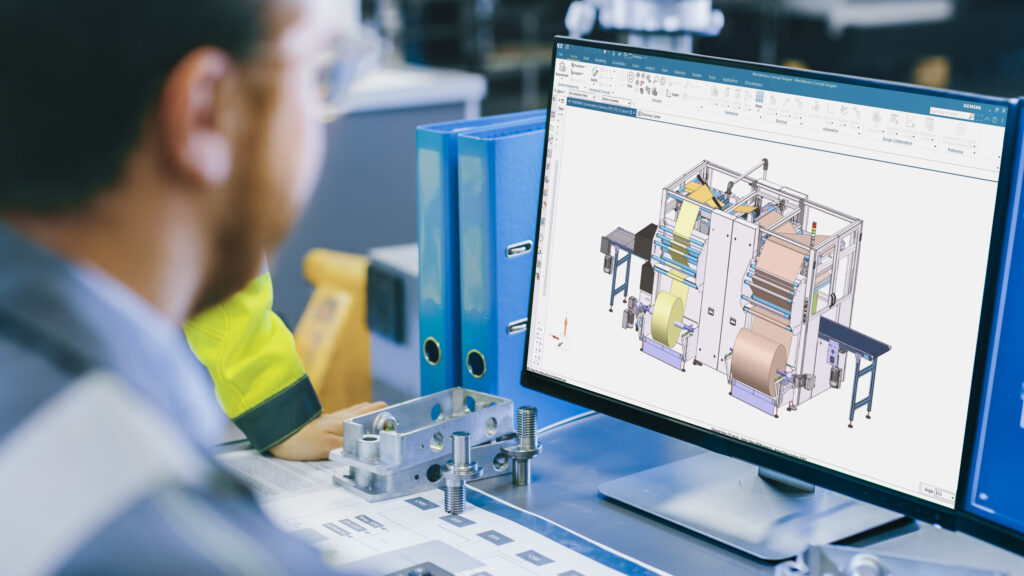
An integrated approach eliminates these challenges. When designers and simulation engineers use the same model in a single system, changes propagate automatically.
Libraries of validated components built up over years or decades enable rapid what-if scenario analysis during the conceptual design phase, long before detailed CAD geometry exists.
This capability also alleviates risk. Instead of gambling on untested configurations, machine builders can assemble new variants from proven, validated components. A multi-disciplinary bill of materials (BOM) becomes the foundation for configuration management, ensuring that every customization draws from a library of known building blocks.
Integrated design and simulation breaks down barriers
The power of multi-domain system simulation reaches its full potential when design and simulation work hand in hand as opposed to separate, sequential activities.
The integration changes how machine builders approach product development, changing simulation from a validation checkpoint into a constant design partner.
In traditional workflows, design teams create CAD models and hand them off to simulation specialists for analysis. Days or weeks later, results come back revealing issues that require design changes.
The cycle repeats, creating bottlenecks that extend development timelines and limit the number of design iterations teams can explore before deadlines force decisions.
Integrated design and simulation eliminates these handoffs, and engineers can work within a unified environment where design changes automatically update simulation models and simulation results immediately inform design decisions. This bidirectional flow creates a continuous feedback loop that accelerates innovation while reducing risk.
The shift from sequential to integrated workflows allows engineering teams to manage machine complexity at scale.
From virtual to real: Closing the loop
The most sophisticated implementations of multi-domain system simulation extend beyond design validation into virtual commissioning and operational optimization.
By combining physics-based simulation with actual automation systems like PLCs, CNCs and other control units, machine builders can test entire system behaviors before physical assembly.
This closed-loop approach delivers multiple benefits:
- Shorter commissioning times: Control logic is debugged in the virtual environment, eliminating costly on-site troubleshooting
- Reduced machine downtime: Predictive maintenance models, validated against the digital twin, anticipate failures before they occur
- Higher-quality designs: Multi-domain optimization balances competing objectives (performance vs. energy efficiency, speed vs. reliability) mathematically rather than through trial and error
- Accurate cost and schedule estimates: Validated digital twins provide realistic performance predictions, reducing budget overruns and delivery delays
Machine builders implementing multi-domain system simulation are shortening development cycles with automated workflows, reducing design-phase duration and decreasing commissioning times.
The competitive imperative of multi-domain system simulation
Multi-domain system simulation is no longer a nice-to-have capability for forward-thinking engineering teams. It’s become a competitive imperative for machine builders who want to survive in today’s market.
Customers expect personalized solutions, and they want them faster. All of that requires additional customization on compressed development timelines. The current skilled labor shortages only add to these challenges.
Government mandates on sustainability and rising energy costs are putting greater pressure on more energy-efficient, low-emission designs. Differing regulatory requirements across global markets only add to the complexity.
The machine builders who master multi-domain system simulation can turn all of this complexity into a competitive advantage.
They’ll be able to deliver high-performing, more reliable machines in less time with fewer physical prototypes and lower development costs. Responses to customer requirements can be made with confidence, knowing every configuration has been virtually validated across all relevant physics domains.
The unsustainable cycle of extended timelines, cost overruns, and quality issues will be a thing of the past.
The path to multi-domain system simulation
The transition to multi-domain system simulation requires more than just a new software tool. It requires organizational change: breaking down silos between mechanical, electrical, and controls engineering; establishing centralized repositories for design and simulation data; building libraries of validated components; and creating workflows that support concurrent engineering.
But the machine builders willing to make this investment will experience a significant return on their investment. They’ll be able to innovate faster, deliver smarter machines and thrive in an industry where complexity is the only constant.
The question isn’t whether to adopt multi-domain systems simulation. It’s how quickly you can turn it into a competitive advantage.