Why automated ECAD-MCAD co-design is the future of heavy equipment engineering
There is a particular kind of pressure heavy equipment engineers know well. Designing machines that must perform flawlessly in rugged, dirty environments is no easy task.
These machines operate in fields caked with dust, on construction sites vibrating with activity and in mines where temperatures swing to extremes.
The equipment can’t fail because the operators depending on it can’t afford it to fail.
And yet, the engineering teams responsible for building these machines are being asked to do more, to do it faster and with less room for error.
This is the reality of modern heavy equipment design, and it’s why the conversation around automated ECAD-MCAD co-design has never been more urgent.
The growing electromechanical challenges in off-highway vehicles
Not long ago, the electrical systems of an agricultural tractor or a commercial excavator were relatively straightforward. Today, that picture looks entirely different.
A network of electronic control units (ECUs) and sensors monitors and controls critical systems across these vehicles, measuring temperature, pressure and component position, and governing the actuation of hydraulics, engine valves and more. In the cabin, drivers expect digital controls, climate systems and connectivity features that would have seemed futuristic a decade ago.
Meanwhile, the mechanical architecture of these machines hasn’t shrunk to accommodate this growth. The physical space available for routing wiring, managing harness bundles and integrating electrical components has largely remained constant, even as the electrical content has expanded dramatically.

The result is a design environment of immense electromechanical complexity. And in that environment, even subtle errors like an improperly shielded wire or a wiring bundle that exceeds its bend radius can cascade into serious consequences.
Equipment could underperform in the field. Or worse, safety hazards may emerge for operators and nearby workers.
In heavy equipment, where margins are already tight and production volumes are low, a delayed launch is more than an inconvenience, it’s a threat to the business.
Why traditional approaches fall short
For years, electrical and mechanical engineering teams have operated in largely separate worlds. They use different tools, speak different terminology and often work in different physical locations.
Their CAD systems represent the same objects in fundamentally different ways. An MCAD system might describe a computer module through its physical bill of materials, while an ECAD system represents the same module as a functional schematic that transcends physical structure entirely.
Bridging these two worlds has historically been a manual, error-prone process.
Teams have exchanged sticky notes, emails, spreadsheets and marked-up PDFs to track changes and communicate design intent across domains. These methods were inefficient and fundamentally unreliable.
Product development teams resorted to internally developed software to manage the collaboration. Software that required dedicated in-house support staff to maintain and update with every new release of the underlying tools.
The introduction of XML-based interfaces improved the situation. By allowing data stored in a platform-agnostic format to be transferred between ECAD and MCAD environments, XML bridged some of the gap that had traditionally existed between the two domains.
The integration of Capital electrical design software and Designcenter NX mechanical CAD environment through PLMXML, for example, enabled periodic synchronization of design data, allowing engineers to verify compatibility at regular intervals while working in their native environments.
But even this approach has its limits.
XML data must be manually exported and imported, so one designer must wait for the other to review and accept or reject proposed changes before work can continue.
The power of true co-design
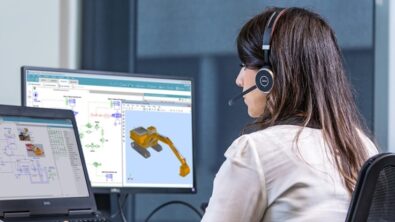
The next evolution in ECAD-MCAD collaboration moves beyond file-based exchange entirely. True co-design connects the two domains at the API level, enabling direct, real-time communication between Capital and NX, so design updates are immediately reflected across both environments.
This is what automated ECAD-MCAD co-design makes possible, and the implications for heavy equipment engineering teams are significant. Electrical system and wiring harness design can now be completed with explicit knowledge of the wet, hot and noisy areas of the mechanical design.
Space reservations can be made in the mechanical model to ensure wiring bundles conform to minimum bend radius and diameter constraints before a single physical prototype is built. Design rule checks run automatically, ensuring generated and routed wires do not exceed mechanical constraints.

The benefit of this contextual awareness extends to change management as well. Modern off-highway vehicles can generate hundreds or even thousands of engineering change orders over the course of a development program, affecting cable length, type and physical placement.
A sophisticated change management tool like the one built into Capital automatically creates a list of changes made to the design, allowing engineers to accept or reject each change individually rather than as an undifferentiated set.
As each part is selected in the change management interface, it is automatically highlighted in both the MCAD and ECAD environments, giving engineers the cross-domain visibility they need to evaluate changes with confidence.
Electrification, autonomy and the stakes of getting it right
The urgency of automated ECAD-MCAD co-design only intensifies as the heavy equipment industry moves deeper into electrification and autonomous operation. An increasing number of off-highway manufacturers are investing in hybrid and fully electric powertrains that introduce new electrical complexity into vehicles already operating in extreme conditions.
Super- and ultracapacitors must handle the substantial, rapid charge and discharge rates produced by regenerative braking and heavy lifting. These electrical systems must be integrated with existing hydraulic and mechanical systems in machines that work long hours in rugged environments.
Autonomous technology further complicates electromechanical design. High-voltage power signals must be separated from data wires to prevent electromagnetic interference. Redundant electrical systems need to be incorporated to preserve critical functions during electronic failures or accidents.
Advanced camera and image processing systems require extremely fast data rates, which means a change in cable length or a new splice could compromise signal integrity. Every one of these constraints creates new dependencies between the electrical and mechanical domains.
ECAD-MCAD integration is no longer a nice-to-have feature. It’s a critical link that creates an unbroken digital thread between domains, from requirements to manufacturing.
The competitive advantage of integrated design
The heavy equipment industry is in the midst of a transformation driven by electrification, digitalization and the growing demand for customization and performance. Leading companies are investing in design processes and tools that allow their electrical and mechanical teams to work as one.
To learn more about automated ECAD-MCAD co-design, download the white paper: Automated ECAD-MCAD Co-Design for Enhanced Off-Highway Vehicle Design.

This white paper provides a detailed look at the technology, workflows and real-world scenarios where integrated co-design delivers its greatest value. Find out how engineering teams can design smarter, collaborate more effectively and build the reliable, high-performance machines your customers depend on.
Frequently asked questions about automated ECAD-MCAD co-design:
What is automated ECAD-MCAD co-design, and why does it matter for heavy equipment manufacturers?
Automated ECAD-MCAD co-design is the practice of connecting electrical computer-aided design (ECAD) and mechanical computer-aided design (MCAD) environments so that engineering teams can share design data in real time, identify incompatibilities early, and collaborate across domains without leaving their native tools. For heavy equipment manufacturers, this matters because the electrical and mechanical systems of modern off-highway vehicles are deeply interdependent. A wiring harness that does not account for the bend radius constraints of the mechanical structure, or an electrical component placed in a thermally hostile zone without proper shielding, can lead to field failures, safety hazards, and costly rework. Automated co-design eliminates these risks by ensuring that both domains are informed by each other throughout the entire development process.
How is API-level ECAD-MCAD integration different from XML-based file exchange?
XML-based integration was a meaningful step forward from manual methods like spreadsheets and PDFs, but it still required engineers to manually export and import data files whenever changes were made in one domain. This created waiting periods and meant that an engineer could propose changes in their own domain without knowing whether those changes would cause violations in the other. API-level integration — as enabled by the direct connection between Siemens Capital and NX — removes this bottleneck entirely. Changes made in one environment are immediately communicated to the other, giving both electrical and mechanical engineers real-time contextual awareness of the full design. The result is faster iteration, fewer errors, and a more collaborative working relationship between teams.
What specific design challenges does ECAD-MCAD co-design help solve in off-highway vehicles?
Off-highway vehicles present a unique set of electromechanical design challenges. Wiring harnesses must be routed through complex mechanical structures while respecting bend radius and diameter constraints. Electrical components must be placed to avoid wet, hot, and noisy areas that could degrade performance. High-voltage power signals must be separated from data wires to prevent electromagnetic interference. And as vehicles incorporate more autonomous and electrified systems, the number of interdependencies between electrical and mechanical domains continues to grow. Automated ECAD-MCAD co-design addresses all of these challenges by enabling design rule checks to run automatically, by giving engineers cross-domain visibility through cross-probing, and by providing a structured change management workflow that tracks and evaluates every engineering change order across both domains.
How does ECAD-MCAD co-design support heavy equipment manufacturers investing in electrification and autonomy?
Hybrid and fully electric powertrains introduce new levels of electrical complexity into vehicles that already operate in extreme conditions. Super- and ultracapacitors, regenerative braking systems, and high-voltage power networks must all be integrated with existing hydraulic and mechanical systems. Autonomous technology adds further constraints: redundant electrical systems, advanced sensor arrays, and camera systems with stringent signal integrity requirements all create new dependencies between the electrical and mechanical domains. Automated ECAD-MCAD co-design ensures that these dependencies are managed systematically throughout the development program — allowing engineers to preview and evaluate the impact of design changes before implementation, and ensuring that neither signal integrity nor mechanical clearance is compromised as the design evolves.
How does integrated ECAD-MCAD design connect to the broader concept of a digital thread in heavy equipment development?
The digital thread is the idea of maintaining a continuous, connected flow of data across every phase of a product’s lifecycle — from requirements and design through manufacturing and service. ECAD-MCAD integration is a foundational element of that thread. When electrical and mechanical design data is synchronized through a shared PLM environment like Siemens Teamcenter, the design intent established early in the program is preserved and traceable all the way through to manufacturing. This means that harness manufacturers can receive accurate, up-to-date design data to inform their optimization recommendations, and that engineering change orders are managed with full visibility into their downstream impact. For heavy equipment manufacturers navigating the complexity of modern vehicle development, an unbroken digital thread is not just a technological advantage — it is a strategic imperative.