Karen De Meyer: Music, marketing, everything in between
Introduction
For Karen De Meyer, hair tells a story.
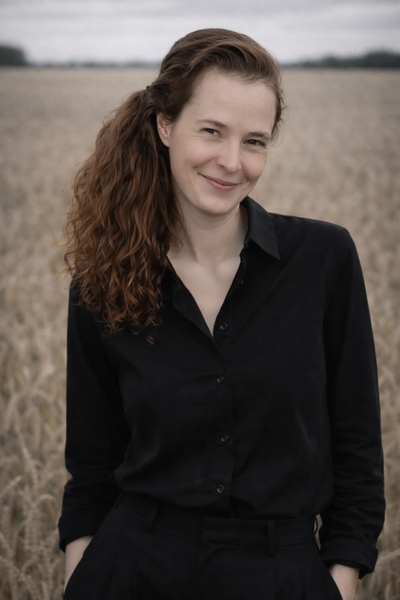
When she’s working on videography and marketing at Siemens’ Leuven office in Belgium, her signature hairstyle sweeps to the left. That ponytail signals she’s been at her desk, editing footage and transforming ideas into motion. If it’s parted to the right, her hair reflects a whole different side of Karen’s day.
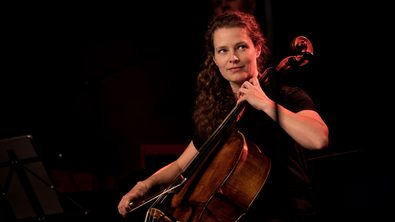
The right-side part means Karen has been playing the cello, an instrument that’s been part of her life since she was four years old. Outside of her work as a creative content manager for the Simcenter portfolio, Karen is a professional cellist with the Ataneres Ensemble, whose work earned a four-star review from BBC Music Magazine. Most recently, the ensemble recorded the film score for the upcoming movie “Le Roi du Game,” composed by Oscar and Golden Globe winner Ludovic Bource. The film is scheduled to premiere on October 21.
Karen’s roles as a cellist and videographer usually live separately, but the Sound of Science brought these passions together. The project created digital twins of some of Europe’s most famous concert venues, including the National Theatre in Munich, Germany. It gives musicians and venue organizers the chance to test the acoustics of a space digitally, long before anyone sets foot on stage.
Seeing science and music paired together is rare. Engineers and musicians, as Karen puts it, are like oil and water — two worlds that don’t naturally find each other. But between them stood Karen: a cellist in the tech industry, fluent in both languages, and uniquely positioned to bring the two together.
Music to Marketing
Q: How did you find your way into videography and marketing?
Karen: Through music, I discovered the power to speak to people’s emotions. Music can make people very, very happy, and at the same time, very, very sad. There’s this power to it which I like to have. I discovered fairly soon that video or moving imagery has the same power, especially when it is meticulously synced to really great music.
With this power, you can actually change people’s behavior as well. To speak in Siemens terminology, you can maybe even convince them to consider buying the more sustainable car if you bring the message in a way that really touches upon emotions.
Engineers and musicians are two completely different kinds of people. I think it’s probably good to have a person in the middle that has one leg into both worlds.
If you think about it, all the products that our customers develop are products that serve their lives better — every single one of them. So, there’s some emotion in that component of every story. As a videographer, you’re uniquely positioned to go find that and bring it out.
The Sound of Science
Q: The sound of science let’s talk about it. You’re getting to bring together video and cello. How did that start?
It started with a customer story. There was a violin maker in Italy who used our testing equipment to really make better violins, to test how they could sound better. Does he scrape off a little more wood, or does he leave it on? What type of varnish does he use?
We got to talking, and we made a really nice video about it. This video was picked up by Siemens Arts, which is a dedicated department we have at Siemens AG. They support a lot of artistic initiatives. They reached out and said, “This is incredible. We love to see how arts and science can come together. Can you think of anything else where we can do this cross-pollination?” I made a couple of propositions, which I thought were cool ideas and just this one stuck.
We made a digital twin of numerous concert venues to simulate how they sound, but more specifically how they would sound if you were to make certain modifications to the hall or to the configuration of how it’s been set up, how the orchestra plays. So, it’s a classical typical digital twin example of simulating something that is not actually there and perceiving how the product, in this case a concert venue, would behave in that condition.
Q: I don’t think that everyone realizes the depth of the Simcenter portfolio. Whenever I talk about our software, I always talk about a car; you simulate airflow and liquid. The varnish on a violin and how that might affect the sound is a detail that I don’t think that everybody thinks about every day.
Karen: And that’s the beauty of the demonstrator. The acoustic solver we used for the Sound of Science, we don’t typically use it for concert venues. We use it on a daily basis in a car cabin or plane cabin to simulate how much noise a vacuum cleaner makes. In this sense, it’s a truly industry-agnostic demonstrator of our software.
It doesn’t speak to anyone in particular — not automotive engineers, not the aerospace engineer — but at the same time, it speaks to all of them, because everybody likes music, right? So, everybody’s triggered to come and try it out, and they can still understand what we’re talking about at the technical level.
Q: How did you find your background in music helping you with this project? Do you think that played a role?
Karen: Engineers and musicians are two completely different kinds of people. You might even say they are like oil and water — they don’t mix. From this point of view, I think it’s probably good to have a person in the middle that has one leg into both worlds.
I know the hardships of a musical stage: coming into a space not knowing upfront what it’s going to sound like. You only have this general rehearsal to make very little adaptations. But if you know upfront, we have to play our notes longer, or we might have to try out slightly slower pace of tempo to give the harmonies really the space to really settle in this room. These types of things, I know about them. I’ve experienced them firsthand. It can be really annoying. On the other hand, I know what a digital twin can do, what the technical possibilities are.
These two worlds don’t naturally find each other. I see myself a bit, maybe as a catalyst — you know, this is a problem, here’s a possible solution.
Q: Is the intent of the project to perfect the space in a way, or is the intent for it to be a living digital twin that can fluctuate depending on who’s playing and what people’s preferences are?
I think it can be both. So, from an artistic point of view, I think it’s very useful for a group of musicians to be able to experience upfront what their music is going to sound like when they arrive at a concert venue. And similarly for the venue organizer to maybe make some small changes. Do we add some extra walls? How do we do the decor? Because decor also plays a great role. It can project into the hall or it could even absorb sounds. We could make some small modifications up front. So, knowing this information up front helps to prepare for performance.
On the other hand, if your hall does not sound exactly like you want with a digital twin, you can try out things. What will happen if we were to put extra acoustic panels on the ceiling over there? Or what will happen if we raise our stage level with two meters? These experiments would be really expensive and time-consuming if you did a trial and error kind of exercise. But with our software, you can try them out in simulation and listen to it before it’s even built.
Beyond the office
Q: Is there anything that would surprise your colleagues that they don’t know about you besides that you’re a cellist?
Karen: I’m really good at playing soccer. These days it’s not so special anymore because we’ve got heaps of girls playing soccer. But for my generation, it was still kind of a special thing as a girl.
The other thing, only a few people know about me is that you can tell by my hair if I played the cello that day or not. I have this signature hairstyle, where it’s always on the left side. If it’s on the other side, I’m scheduled to play cello or have already played cello, because this is where the neck of the cello goes. Otherwise, it gets stuck in between the strings and the fingerboard.
Q: Are you playing all the time still?
There’s some days that I don’t get to it, because sometimes things get busy. I play in a professional orchestra that does projects. Sometimes, we’re really busy with projects and then Siemens actually grants me the flexibility to arrange my agenda, so I can compensate.
Last week was the last project. It was really exciting. It was recording a soundtrack, so film score music to a movie that’s coming out in September from an Oscar winning composer — a full week in the studio.
Q: Is there any specific piece of music that is super important to you?
There is this signature piece of my orchestra. Do you know “Recomposed” by Max Richter? You should play the recording of my orchestra, because it got a four-star review from the BBC Music Magazine.
This piece is recomposing the original “Four Seasons” by Antonio Vivaldi; Richter is a contemporary composer. I particularly like it, because it’s the piece that introduced classical music to my own children. It speaks to all kinds of people, regardless of even age. My five-year-old son, when he hears that music, you can see he really enjoys it. It’s also one of the first concerts that he came to watch me play live. So, this is maybe a piece that comes to mind.