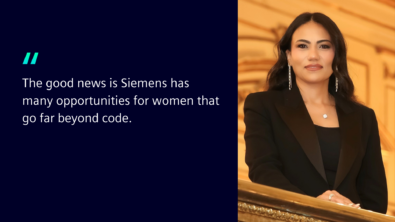
Pam Marko on career paths for creatives and preference marketing in engineering software

Pam Marko has spent most of her career in advertising and marketing positions in Metro Detroit, but her heart clearly belongs on the farm. As the head of preference and engagement marketing for Siemens Digital Industries Software, she spends her days crafting strategies to position Siemens as customers’ first choice long before they enter the procurement process. But when she’s not thinking about competitive differentiation and brand preference, you’ll find her tending to 31 chickens, harvesting hundreds of pumpkins, and chasing foxes away from her coop — sometimes barefoot in the snow.
Marko’s journey to Siemens began with a journalism degree from Michigan State University and early years in Detroit’s automotive advertising scene, working with clients like Ford, Visteon and Magna. She transitioned to the client side at companies including Sandvik and Aptiv before spending six and a half years at Altair, which Siemens acquired in 2024 for $10 billion. The acquisition brought not just advanced simulation and high-performance computing capabilities to Siemens’ portfolio, but also talent like Marko, who was recruited to build an entirely new function within the software division.
Her role represents a strategic shift in how B2B technology companies approach customer engagement. Rather than waiting for prospects to begin vendor evaluations, Marko’s team focuses on creating “first choice” preference through targeted programs that reach customers early on. It’s a philosophy rooted in Forrester research showing that 68% of B2B buyers have a preferred vendor at the start of the buying process – and 80% of B2B buyers select this preferred vendor.
We spoke with Marko from her 10-acre property in rural SE Michigan. The conversation below has been edited for length and clarity.
Building Preference in a Crowded Market
Natalie: Let’s start with your new role. What exactly does “preference and engagement marketing” mean?
Pam: I started in September of last year as the head of preference and engagement marketing. I have a group of amazing, talented individuals that I get to be privileged to work alongside, and our sole objective is to create first choice and preference among our customers and prospects at Siemens within the software group. Any customer-facing software programs that are preference driven, we are part of those overall campaigns.
Natalie: When you say preference driven, what does that mean exactly?
Pam: Forrester came out with a study last year that said around 68% of B2B buyers have a preferred vendor at the start of the buying process – and 80% of B2B buyers select this preferred vendor.
Our objective is to get in front of our customers and prospects before they even start the selection process. How do we create that glide path into demand by developing these preference programs that really target our customers in front of when they’re going to make a selection on a vendor?
Natalie: So how did you end up in this role? I imagine it might not have been your dream as a little girl to be in preference marketing?
Pam: Ha. I love the creative process of marketing and advertising and branding and communications. Starting off very young, I was hugely drawn to art and creativity. I loved writing. I went to Michigan State University — Go Green! — for my journalism degree. Then I started off in the advertising agency side of the business and worked with wonderful clients such as Ford, Visteon, Magna and a variety of others. Being in the Detroit area, I was very heavily in the automotive space.
I transitioned from the agency side of the business to the customer side at Sandvik for a couple years, then worked at Aptiv, which was formerly Delphi, for almost 11 years, and then was at Altair for six and a half years. Then Siemens acquired Altair in 2025 and they were standing up this new role in the software go-to-market group for preference, and asked me if I would be interested leading the group. It seemed like a very fun challenge and a lot of opportunity. I always have loved creating transformative new structures and programs.
Natalie: It’s interesting how those art degrees can take you places. My background’s in design too — I have an art degree undergrad, did the agency world, then PR, and now I’m here doing communications.
Pam: Wasn’t it Mark Cuban who talked a lot about civics and the arts and the importance of that? I do think there is something within our brains that are wired a little different, and we see things differently. I think that’s important when you look at businesses and how these organizations operate. I find it fascinating because our brains are wired differently and that brings a certain value to our roles that we share within marketing and communications.
Natalie: I also think it’s interesting because you get trained, especially as an art student, to get a lot of feedback. You’re critiqued constantly as a young person, and learning to take that critique and give productive critique is a skill I find very valuable day-to-day.
Pam: Yes, I do think that’s important because you develop that emotional intelligence and skill set to receive the feedback, understand what that means to the whole — whatever you had developed — and how you feed that back to the person who gave it. I think that’s really important.
Natalie: You mentioned your team. What’s one thing you really like about your job?
Pam: I love the fact that this is new to the organization and it allows us to think a little bit differently than we’ve done when looking through a traditional demand lens, and I think that’s very important. The team has come together in a way that they are also open, and it’s just a really interesting dynamic. Each brings their own backgrounds and their own ideas, but coming together with this one singular objective to build this preference engine within the organization has been really rewarding for all of us.
I do think there is something within our brains (as creatives) that are wired a little different, and we just see things differently. I think that’s important when you look at businesses and how these organizations operate.
Natalie: When you talk about building preference, it reminds me of when you buy a car and then suddenly everybody has your car, because all of a sudden it’s on your radar. Getting ahead of that process is fascinating.
Pam: That’s exactly it. I use that analogy when I try to describe what preference is. I recently bought a new car and I had a Subaru Outback, and I was like, okay, I want to look at something different. So I looked a short list of brands, some of which I hadn’t considered before because I had no established preference for them. I went on all the test drives and looked at everything and compared everything, and guess what I selected? A Subaru.
It just really goes to show you — when you create an experience with the customer you create an emotional connection — that they’ve created a brand I assimilate with. I understand it and I like what they stand for. It feels comfortable. It’s got all the technology bells and whistles I want, but it’s also a brand that I have come to align with, and for me that was important. It’s a perfect analogy.
Natalie: It’s so interesting to think about getting ahead of that and how you create that feeling.
Pam: Well, that’s the whole thing. Why Siemens for our customers? That should be our driving thought within all of the programs we are creating. Why are we better? Why do we stand apart from our competitors? To be able to package that up and serve that up to our prospects and customers in a way they can understand and learn more about is really what’s driving us.
Natalie: What’s a problem that you spend a lot of time thinking about in your job?
Pam: How to get in front of our customers. That is always what I’m thinking about — what is the best avenue specifically for the different target audiences that we’re going after? And how do we package that in a way that stands out from our competition? How do we package that in a way that they understand how we can help them? That’s what I noodle over quite often.
Natalie: You came from Altair, which everyone knows we purchased last year and have been integrating quickly. How has that experience been for you? How are you finding the integration and bringing the cultures together?
Pam: The integration’s been great. Obviously there are challenges that we’re all facing as you’re integrating Altair into a new organization. But everybody has come into it with a spirit of understanding, wanting it to work, and kindness. I think that is very important. They know this is a big change for the people that are coming in from Altair and what that means, and I think they’ve been very thoughtful in how they’ve structured that integration.
Natalie: It felt like everybody said the whole time it was an easy culture fit. I think it’s been nice that we’ve been able to bring everybody together so quickly too.
Pam: Yes, I think that helps a lot. I know there was probably at certain points in time people thinking we’re going too fast. But I think from a culture standpoint, it’s important because trying to get the Altairians to feel a part of the Siemens family is critical to the future success.
AI and Creativity
Natalie: Siemens’ purpose is creating technology that transforms the everyday for everyone. What does that mean to you from your background or the culture you’re coming from?
Pam: For me, technology opens doors, and I think having access to that is critical. It’s critical in our day-to-day job every day. Even having AI capabilities that we may not have had even two years ago — to have that now is just remarkable. Using it in our day-to-day has provided productivity opportunities that I don’t think we could have imagined a couple years ago. It frees up time for more ideation, more creativity, more strategy, and that’s in work and outside of work as well.
Natalie: What’s your favorite AI use case? What do you use it for personally?
Pam: I think for me it’s having the ideas in your head but not having the time to put them all down because that takes time. So by jumpstarting it through AI, I can be like, “This is what I’m looking for.” It can spit it back and I can say, “No,” or “Yeah, that sounds good,” or “Can you do more of that?” That ideation and iteration process is super helpful. Then you make it your own. Obviously, that’s what it’s supposed to be there for — a support structure to making something better. That is what I love working with it on. Sometimes I get mad at it, but for the most part, it does give me what I want.
Natalie: I get mad at it too. I use Copilot for work and sometimes it can be too nosy. I ask it a question and it goes, “Well I referenced this and this and this,” and I’m say, “I didn’t want you to reference that.” Though sometimes I’m like, “Oh, that was probably good that you referenced that — I didn’t think about doing that.”
Pam: I’ve had similar back and forth. Me: “That’s not what I asked for.” The LLM comes back with: “I’m so sorry.” But I think it comes from the agency side. If you’ve ever worked on an agency side, to have that collaboration within that tool is kind of how you would go through the creative process at an agency. I think you have your own personal ad group with you, which I think is pretty cool.
About that 10-acre farm
Natalie: Let’s talk about your life outside work. We started with animals — you have two dogs, a cat and 31 chickens. What is there anything else that people might be surprised to know about you?

Pam: I think probably because I always wear dresses and they’re like, “Wait, you’re on a farm?” I’m like, “Yes, I am, and I get in the dirt.” We grow tomatoes and hot peppers. We have a little orchard, so we have apples and pears. We do a lot of cucumbers and all the garden vegetables for the summer. And we do pumpkins. That’s another big thing. At any given point in time, at the end of the fall season, we might have 500 to 750 pumpkins that we give away.
Natalie: That’s a lot of pumpkins.
Pam: Yeah, we’re on 10 acres, so that does help. But yeah, that was the first season we did it. I was like, “We have a lot of pumpkins. What are we gonna do?” We do a lot of heirloom pumpkins. You get the green ones, the orange ones, the white ones.
Natalie: I like to grow a garden too. Mine is very small comparatively, but I did some heirloom tomatoes this past year and really enjoyed it because I got a purple, a green, a yellow and a red. It’s hard to tell when green tomatoes are ripe though.
Pam: Yes, it is. But when they are, it’s amazing. Homegrown tomatoes — you will never taste a tomato like that in the middle of the sun in summertime with salt. It’s great.

Natalie: Do you have any fun stories about your chickens? Do they have personalities or preferences?
Pam: Yes, they do have personalities. They are fun to watch. My favorite are my Cochins, which are super fat and fluffy and they have feathered feet. They’re very cute and I have those in a variety of different colors.
I would say one funny story is that I ran after a fox who had one of my chickens in his mouth, in my bare feet in the middle of the winter, because I saw it. At one point in time we had them pasture ranging and he picked it up and grabbed it and started running, and I booked it out of my house, freezing, and he ended up dropping it so I got her back.
Natalie: Good for you! Don’t mess with the chicken mom. It’s amazing what you’ll tolerate for your animals.
Pam: Exactly. I was walking back with her and my feet are numb, and I’m just like, “Oh my gosh, this was a mistake.” We don’t have livestock—that’s the only thing.

Natalie Navales is a senior executive communications manager at Siemens. Her most recent employee spotlight interview, with Brian Lee, CEO of Dotmatics, a Siemens company, is available here.